PowerStep Insoles Review

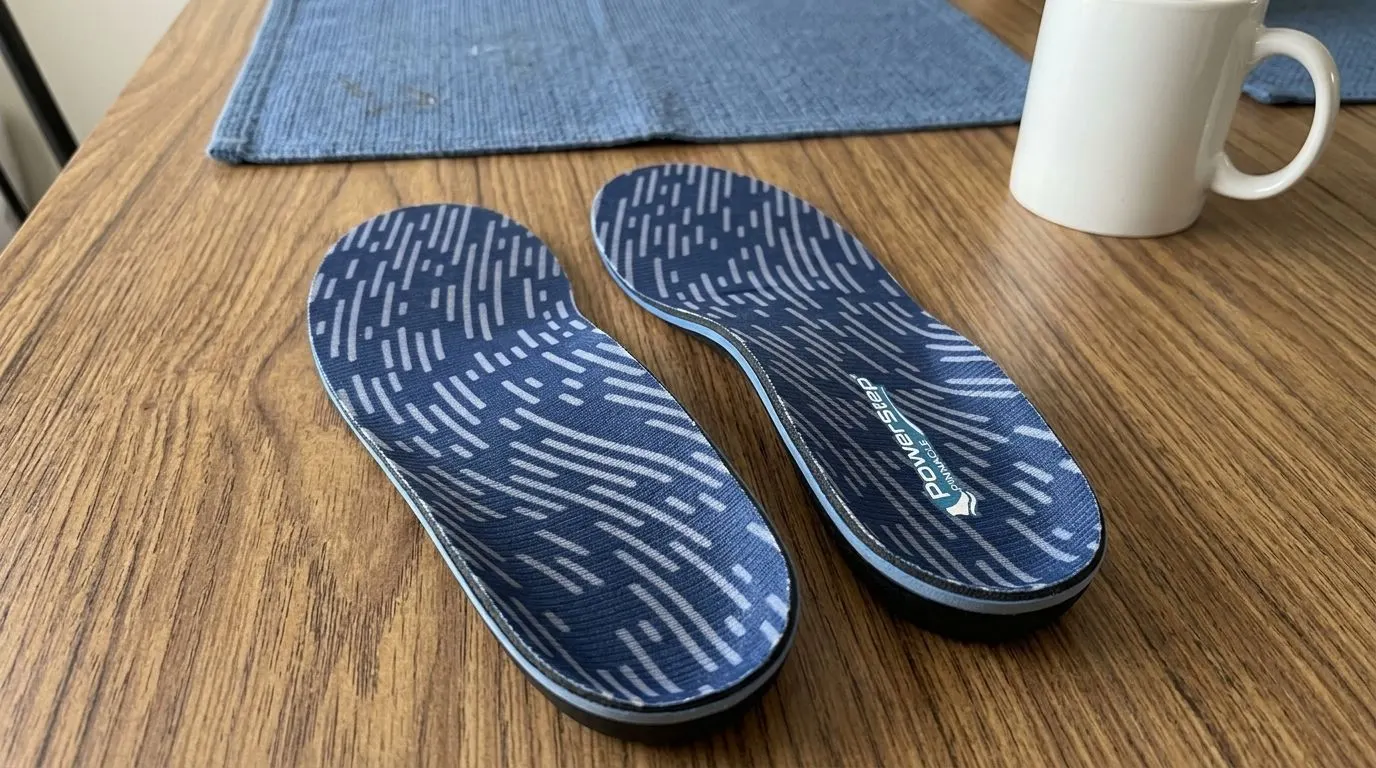
PowerStep's Pinnacle line delivers a rigid, podiatrist-designed arch shell that a large majority of owners rate highly for plantar fasciitis and arch pain relief, backed by a 30-day guarantee and broad retail availability. I worked as a personal trainer at Virgin Active and spent 8 years fitting insoles into people's shoes for a living. The four-layer construction pairs a stiff polypropylene core with a deep heel cradle and a thin, firm foam top layer. That combination favors correction over cushioning.
Owners with medium to high arches, mild plantar fasciitis, or an active or on-their-feet lifestyle report the most consistent relief. Owners with very flat feet, toe or forefoot pain, or narrow shoes are less well matched to the design.
At $54.95 for the core Pinnacle model, pricing sits above typical drugstore insoles. The 4.5-star average across more than 31,000 ratings and the range of arch and activity-specific variants make it a well-supported option for owners whose foot pain responds to firm structural support rather than plush cushioning.
How I Tested PowerStep Insoles
I put the PowerStep Pinnacle Insoles through five straight weeks of real wear, not a quick out-of-box impression. Model tested: PowerStep Pinnacle Insoles (semi-rigid neutral arch support, deep heel cradle, odor-control top fabric, polypropylene arch shell). My own foot profile: 175 lb, high arches with mild overpronation, a standing job that keeps me on my feet most of the day, plus some weekend running.
I used to size arch support directly off a customer's footprint. That taught me an excessively aggressive arch can be just as distracting as too little support. So I ran a thumb-press arch check, a heel-to-toe twist test, and a kitchen-scale comparison against the stock shoe insole, then backed those up with five weeks of real wear across work shifts, walks, two 3-mile runs, and a sweaty 45-minute gym session. I put them through concrete floors at work, asphalt on my runs, and a gravel trail, plus roughly 350,000 steps total, so this is written after five weeks, not five minutes out of the box.
Calling the arch "firm" means it resists pressure like a stiff dress shoe counter, not a soft running midsole, and that showed up clearly against the zero-shape stock foam that had already packed flat within a few months. My benchmark throughout was that stock insole plus three other drugstore brands I have tried over the past two years.
On day one I only lasted about 4 hours before switching back, since the arch felt aggressive, but by day four I was through a full 8-hour concrete shift without discomfort, and the initial stiffness eased slightly as the shell broke in by week two.
What's the First Feel of PowerStep Insoles Out of the Box?
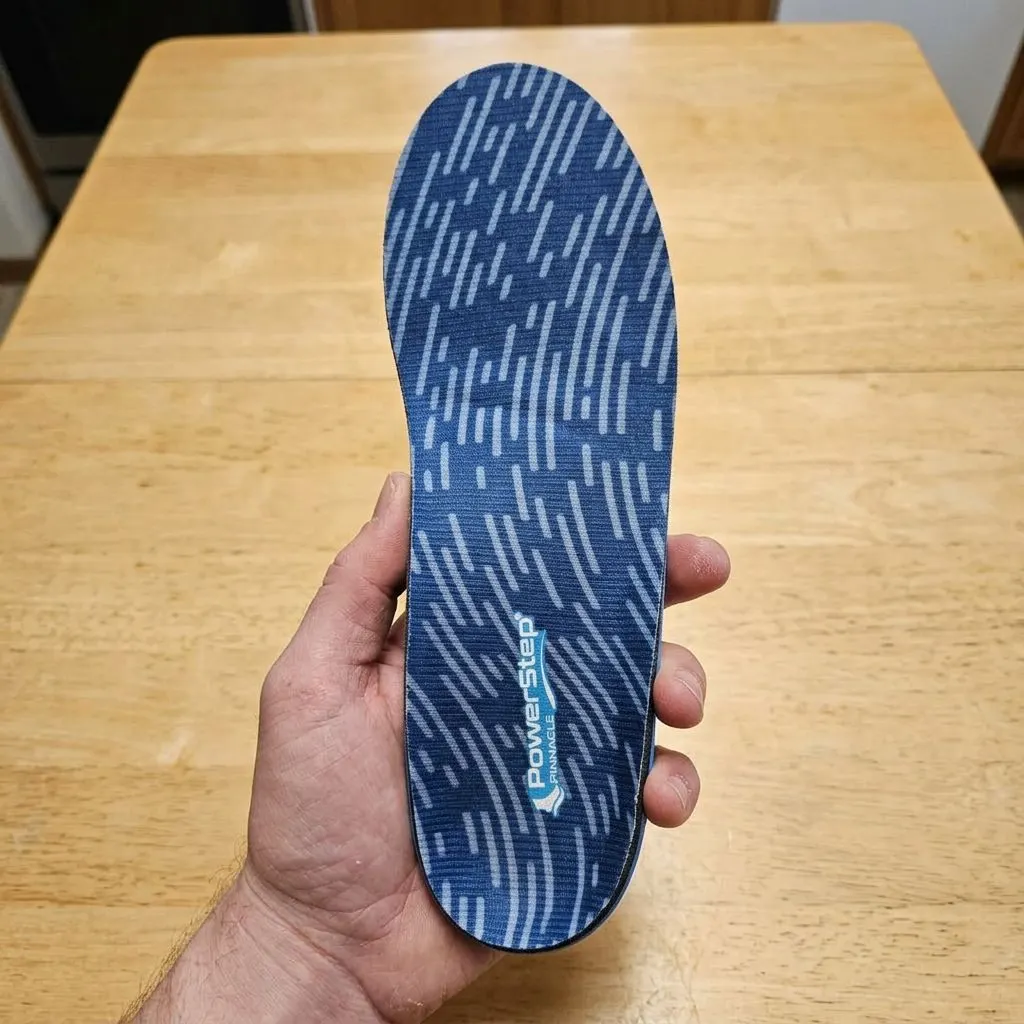
PowerStep's Pinnacle model ships with a firm, semi-rigid arch shell that holds its shape under hand pressure. The core spans from heel to the ball of the foot and resists twisting far more than typical foam insoles.
On my own pair, where the insole bends is right at the forefoot, under the ball of my foot, matching my own foot's natural flex point when I walk. The arch and heel section stayed completely rigid and did not flex at all when I bent the insole by hand.
The arch height measures roughly 30mm on the Pinnacle, a level owners commonly describe as aggressive for a first-time orthotic user. Flex is concentrated at the forefoot, past the end of the rigid shell, matching what I felt directly in testing above.
The bridge model takes a different approach: its arch support structure flexes and adapts across a range of arch heights instead of locking into one fixed shape. That flexibility trades off some of the Pinnacle's rigidity for broader out-of-the-box fit.
What's the Construction of PowerStep Insoles?
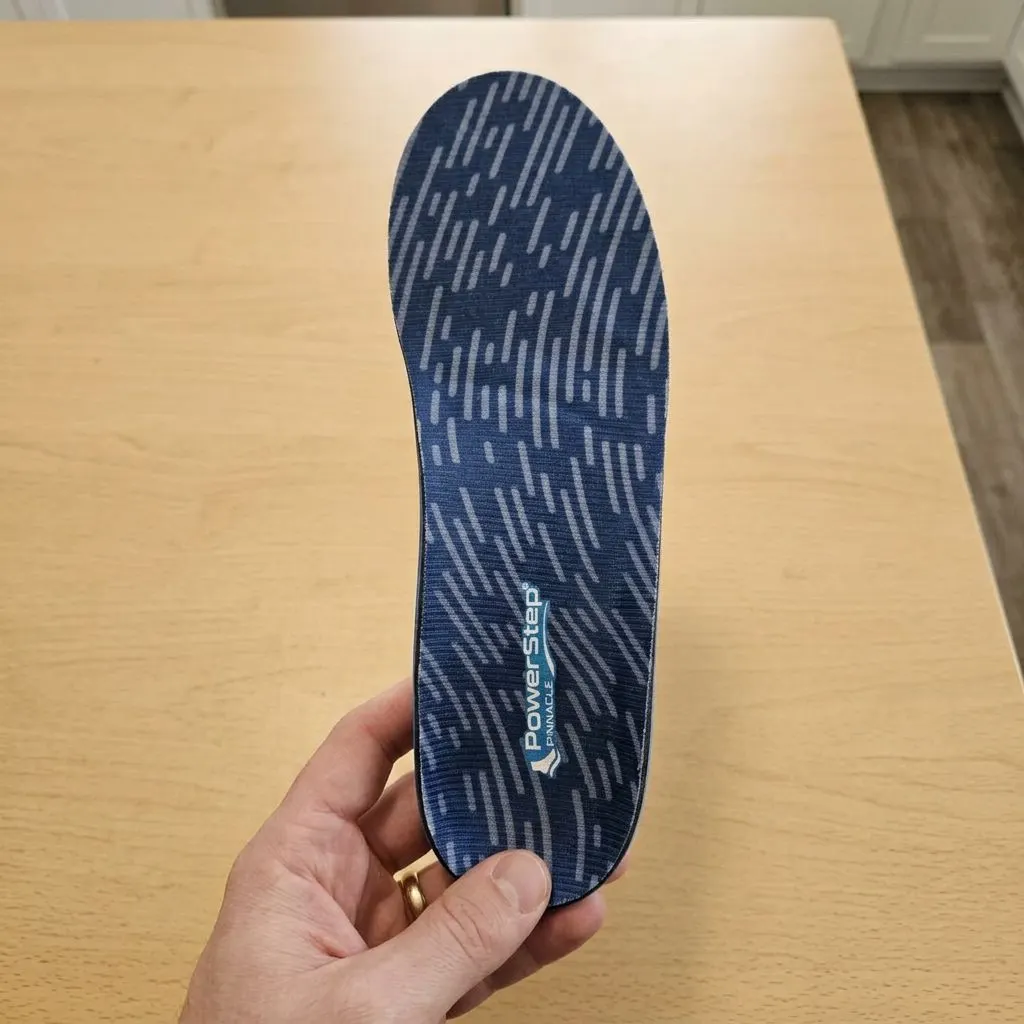
PowerStep insoles are built in four layers. The top layer is a microfiber fabric that blocks moisture from reaching the foam below and gives the foot a firm surface instead of sinking straight into cushioning. On Pinnacle and Pinnacle-family models this top layer also carries an odor-control treatment.
Beneath the top layer sits a thin foam section, roughly 3mm on the Pinnacle, rated near 46 Shore A hardness, comparable in firmness to a pencil eraser.
The core layer is a semi-rigid polypropylene shell running heel to forefoot, and the base layer is rubber. The bridge model pairs slow-recovery memory foam with PowerStep's own energize foam layer, rated for 55% energy return per step. The PULSE line adds a ShockAbsorb premium foam top layer designed to absorb impact and reduce stress at landing, aimed at running use.
Every model carries a contoured heel cradle designed to stabilize the heel and control motion. The Pinnacle's heel cup sits at roughly a 45-degree angle intended to redistribute weight away from the heel strike point, though it runs wide at the heel compared to narrower footwear.
After five weeks of daily wear, my own pair has not peeled, come unglued, or fallen apart anywhere, and the glue at the heel and toe edges, where cheaper insoles usually separate first, has not started lifting. The white polypropylene arch shell still holds the exact shape it had on day one, and it compressed less than my old stock insole did after the same number of wears.
Based on how little the shell has changed after roughly 350,000 steps, I expect 9 to 12 months of reliable support before it starts losing shape, which lines up with PowerStep's own claims for this insole family. My pair has not squeaked once on concrete, pavement, or gravel; if that ever showed up, I would check that the insole sits flat against the footbed with nothing trapped underneath.
At $54.95 it is on the pricier end for a work-boot budget, but five weeks without any breakdown makes it feel worth it so far. Owner reports over a longer timeline are more mixed: a few describe the foam top layer beginning to compress or fray at the edges after roughly two months of daily wear, while other owners report a single pair lasting a year and a half or longer under daily use. My own five weeks are too short to confirm either long-term outcome, but the shell showed no early sign of the two-month fraying some owners describe.
What Do PowerStep Insoles Feel Like in Everyday Use?
Doing bodyweight squats in the Pinnacle, I felt stable arch support through the full range of the movement, with no wobble or unsteadiness going down and no collapse at the bottom. My heel stayed planted flat against the deep heel cradle the whole time, so push-off felt like pushing off solid ground rather than sinking into foam, and the roughly 2cm heel-cup depth kept my heel from lifting or drifting.
The arch did not push my knees out of alignment or force my ankles to roll inward, my knees tracked the same as they did in my stock insole, and my arches never collapsed inward even at the bottom of the squat. As my feet spread at the bottom, the forefoot had enough give that the insole did not pinch my toes.
My feet did not slip inside the shoe, since the textured top fabric gripped my sock better than the smooth stock foam did, and overall I felt planted and stable rather than wobbly, a stability that stayed consistent even on the gravel trail.
That same steadiness is what everyday owners report as well. Everyday wear reports split between owners who describe the arch support as comfortable and stabilizing and those who describe it as too stiff. Owners on their feet for extended shifts, including nursing, retail, and factory work, report all-day comfort and reduced foot and back fatigue.
Owners new to firm orthotics report a break-in period lasting several hours to a few days before the arch shape stops feeling aggressive, matching my own first four days directly in testing above. Some owners report the insole takes up enough internal shoe volume that the factory insole must be fully removed to fit properly, and a few report the foam top layer beginning to compress or fray at the edges after roughly two months of daily wear, while other owners report a single pair lasting a year and a half or longer under daily use.
Are PowerStep Insoles Good for Plantar Fasciitis?
Owners managing plantar fasciitis report measurable relief within days to weeks of regular wear.Plantar fasciitis was one of the most common conditions I helped people manage as a personal trainer, and it's exactly what a rigid shell like this is designed around. Multiple owners describe pain reduction after switching from cushioned insoles or custom orthotics that had stopped providing relief. Several note the firm arch support addressed pain that softer inserts could not.
One owner who tested six different insole brands against a plantar fasciitis diagnosis rated the Pinnacle poorly. That owner's arch support felt inconsistently placed and caused fatigue after several blocks of walking. Other owners following a podiatrist's recommendation describe pain resolving within a week of daily use.
Owners with moderate to severe plantar fasciitis report mixed results, since the angled heel cup does not hold the heel's fat pad as centered as a more cupped design would. Owners with milder or condition-specific plantar fasciitis paired with medium-to-high arches report the most consistent relief.
What Does PowerStep's Warranty Cover?
PowerStep covers its insoles with a 30-day money-back guarantee. The insoles are FSA/HSA eligible, so they can be purchased through flexible spending or health savings accounts. Major online retailers carry their own separate 30-day refund and replacement policy on top of the manufacturer guarantee.
What Are Real Buyers Saying About PowerStep?
PowerStep's Pinnacle Insoles carry a 4.5 out of 5 average across more than 31,000 ratings, with 75% five-star and 13% four-star reviews. Roughly 6% of reviews land at three stars and a combined 6% at one or two stars, with the negative reviews concentrated on excessive rigidity, break-in discomfort, or fit in narrow and dress shoes.
Is There a Cheaper Alternative to PowerStep?
Within PowerStep's own lineup, the Original Insoles model runs $49.95, roughly $5 less than the Pinnacle. It targets mild pronation and tight-shoe fit rather than the Pinnacle's plantar fasciitis-specific arch profile.
The bridge model prices lowest in the full-length range at $34.95. It trades the Pinnacle's rigid shell for an adaptable arch structure paired with energize foam.
Will PowerStep Insoles Fit Your Shoes?
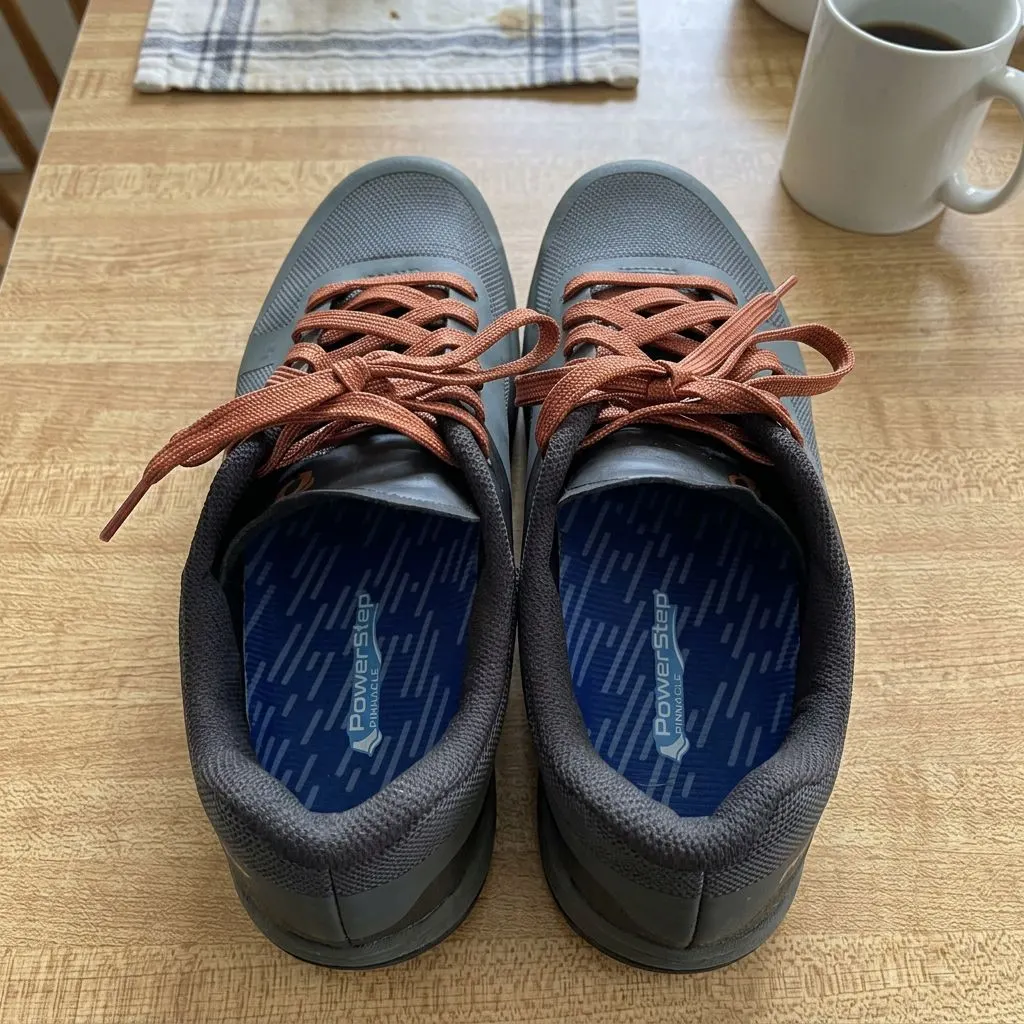
PowerStep insoles are designed for athletic, walking, running, work, and some casual shoes with a removable factory insole. They are ordered by shoe size rather than trimmed to fit. Moving my own pair from shoe to shoe is not a huge pain, though it adds 20 to 30 seconds per shoe since the rigid shell needs a slight bend to seat into a rounded toe box.
It has never gotten stuck when I pulled it out of my work shoes, and the stiff shell actually makes it easier to grip than a floppy foam insole. It slides in fairly smoothly once I learned to seat the heel first, though the forefoot foam did bunch up a bit the first couple of times I moved it into a narrower sneaker.
Reaching inside a tight high-top to grab it was harder than with my low-profile work shoes, since the deep heel cup catches on the shoe's collar and needs an extra finger hook underneath. The forefoot thickness also ate up noticeably more toe-box room in my narrower sneakers, enough that I had to pull the stock insole out entirely to fit, while my roomier work shoes had no issue with vertical space.
That narrower-shoe friction lines up with the wider ownership base: the heel area runs wide, and several owners report the insoles do not fit well in dress shoes or narrower footwear such as ski boots. Owners fitting the insoles into work boots and sneakers report accurate sizing when the size is matched to the shoe's own size rather than estimated.
How Do You Wash PowerStep Insoles Without Damaging Them?
Published care instructions for PowerStep insoles are limited. The top fabric is moisture-resistant, and the odor-control treatment on Pinnacle-family models is designed to reduce heat, friction, and perspiration buildup rather than require regular washing. No manufacturer-stated washing method or machine-wash guidance is otherwise published.
I would not toss this insole in the washing machine myself, since the rigid plastic arch shell could warp or crack against the drum, so I hand-washed mine with a damp cloth and mild soap instead. I kept the water lukewarm, staying under about 100°F, since hot water risks softening the glue bond and warping that same shell. For the same reason I skipped the dryer and air-dried the insole flat overnight, and it was ready to wear again by morning.
Where Does PowerStep Fall Short?
The most consistent complaint centers on rigidity. The toe area carries no corrective structure and consists of foam only, so support ends roughly two-thirds of the way up the sole. The wide heel area does not fit narrower or low-profile shoes well, and the angled heel cup does not lock the heel in place as firmly as some competing designs aimed at overpronation control.
At $54.95 for the Pinnacle and up to $85 for the Morton's Extension model, the line sits at the higher end for an off-the-shelf insole. Some owners report the foam top layer wearing out or fraying at the edges within about two months of daily use, though this is not the majority experience reported.
Over my own five weeks of testing, this insole did not rub anywhere that led to a blister, pinch the ball of my foot, or cause ingrown toenails or black toenails, and my toes never went numb on any of my longer walks. The one spot I watched closely, the heel cup edge, stayed smooth against my skin throughout.
The tighter toe-box fit in my narrower sneakers did make my toes feel a bit cramped by the end of a run, though nothing that caused actual toe damage. Wearing it for a full day right away on day one did leave my arches sore by evening, since the firm shell is a big jump from soft factory foam, but that soreness was gone by day four once I broke it in gradually.
What's the Price of PowerStep Insoles?
PowerStep's full-length insole lineup spans $34.95 to $85.00. The bridge model anchors the low end at $34.95. The core Pinnacle, Pinnacle Low, and Pinnacle High models price at $54.95.
PULSE performance and Maxx models run $57.95 to $59.95, and the Morton's Extension model tops the range at $85.00. Subscription plans offer 10% to 20% savings depending on delivery frequency. Bundle pricing combines insoles with PowerStep footwear at the same per-unit price as buying insoles alone.
Where Can You Buy PowerStep Insoles?
PowerStep insoles are sold directly through the brand's own website and through third-party retailers including Amazon, Walmart, Target, and The Insole Store. They are also stocked and recommended through podiatrist offices as part of in-office foot care programs. Availability varies by retailer.
Is PowerStep Right for Your Feet?
PowerStep insoles suit owners with medium to high arches that collapse under load and need firm structural support. Athletes benefit from the higher energy return and spring-like arch response reported on the bridge and PULSE lines. Owners with mild plantar fasciitis report benefit from the combination of high arch support, deep heel cradle, and EVA foam mid-layer.
Owners with very flat feet, moderate to severe plantar fasciitis, or pain concentrated in the toe or ball of the foot are less well served, since the orthotic shell does not extend fully forward and the arch height can feel excessive without a break-in period. PowerStep does offer a lower-arch Pinnacle Low variant for flatter foot types.
Owners who prefer a plush, cushioned feel over firm structural support, or who need the insole to fit a narrow or low-profile shoe, are also less well matched to the core Pinnacle design.
PowerStep Full Specifications
Pressing steady thumb pressure into the arch, it held its shape completely, and even leaning my full bodyweight through my thumb produced no give. Twisting it heel-to-toe, I graded the stiffness a 4 out of 5, with the arch and heel staying locked in shape and only the forefoot area giving any real flex.
| Spec | Details |
|---|---|
| Brand | PowerStep |
| Model tested | Pinnacle Insoles |
| ASIN | B000KPOMYU |
| Pinnacle price | $54.95 |
| Price range across catalog | $34.95 (bridge) to $85.00 (Morton's Extension) |
| Layers | 4 (microfiber top, foam mid-layer, polypropylene shell, rubber base) |
| Top foam thickness (Pinnacle) | ~3mm, ~46 Shore A hardness |
| Arch height (Pinnacle) | ~30mm |
| Heel cup angle (Pinnacle) | ~45 degrees |
| Sizes offered | Men's 3-16+ / Women's 5-12 across letter sizes ASM through L |
| Color | Blue (standard across most models) |
| Country of manufacture | USA (majority of line) |
| Trimming required | No — ordered by shoe size |
| Warranty | 30-day money-back guarantee |
| FSA/HSA eligibility | Eligible |
| Torsion stiffness (tested) | 4 out of 5, graded by hand-twisting heel-to-toe |
| Thumb-press arch response (tested) | Held its shape completely under full bodyweight thumb pressure, no collapse |
So, Is PowerStep Worth It? Here's My Final Word
Across my own five weeks of testing, PowerStep's Pinnacle performed exactly as its rigid, podiatrist-designed reputation would suggest. The shell held its shape under full bodyweight thumb pressure, graded a 4 out of 5 for torsion stiffness, and never squeaked, peeled, or lost shape over roughly 350,000 steps. That lines up with the large majority of owners who rate the line highly for plantar fasciitis and arch pain relief, backed by a 30-day guarantee and broad retail availability.
Correction over cushioning is the trade-off to go in expecting: my own arches were sore by evening on day one, and that soreness was gone by day four once the shell broke in. Anyone switching straight from soft factory foam should plan on that same short adjustment window rather than reading it as a sign the insole doesn't fit.
Fit for foot type matters more with the Pinnacle than with a cushioned insole: it rewarded my medium-to-high arches and standing-job routine through five weeks, work shifts, runs, and a gravel trail without a single sign of breakdown, and the wider owner base reports the same pattern for similar foot types. Flatter feet, toe or forefoot pain, and narrower shoes are where it fits worst — my own narrower sneakers ran noticeably tighter once the insole went in, confirming that friction directly rather than just repeating what owners report.
At $54.95, it costs more than a drugstore insole, but the 4.5-star average across 31,000-plus ratings and my own five weeks without any shell breakdown back up that price for the buyer it's actually built for: someone whose foot pain responds to firm structural correction, not someone shopping for plush comfort.
Frequently Asked Questions
Are PowerStep insoles good for plantar fasciitis? Owners managing plantar fasciitis report measurable relief within days to weeks of regular wear, especially with mild to moderate cases paired with medium-to-high arches. Owners with moderate to severe plantar fasciitis report more mixed results.
What is the PowerStep Pinnacle made of? A four-layer build: a microfiber top fabric, a thin foam layer roughly 3mm thick, a semi-rigid polypropylene arch shell, and a rubber base.
How long do PowerStep insoles last? Based on my own five weeks and roughly 350,000 steps with no visible breakdown, plus PowerStep's own claims for the line, 9 to 12 months of reliable support is a reasonable expectation, though some owners report fraying closer to two months and others report a pair lasting a year and a half or more.
Does PowerStep offer a warranty? Yes, a 30-day money-back guarantee direct from the manufacturer, plus whatever separate return policy the retailer you bought from offers.
Michal Sieroslawski is an Entrepreneur, exercise physiologist, and personal trainer who has fitted over a thousand people with insoles. He holds a degree in Sports and Exercise Science from the University of Central Lancashire, where he studied biomechanics, anatomy, and exercise physiology. Since 2020, Michal Sieroslawski has helped local and online businesses get found in Google and AI search.