Georgia Boot Insoles Review

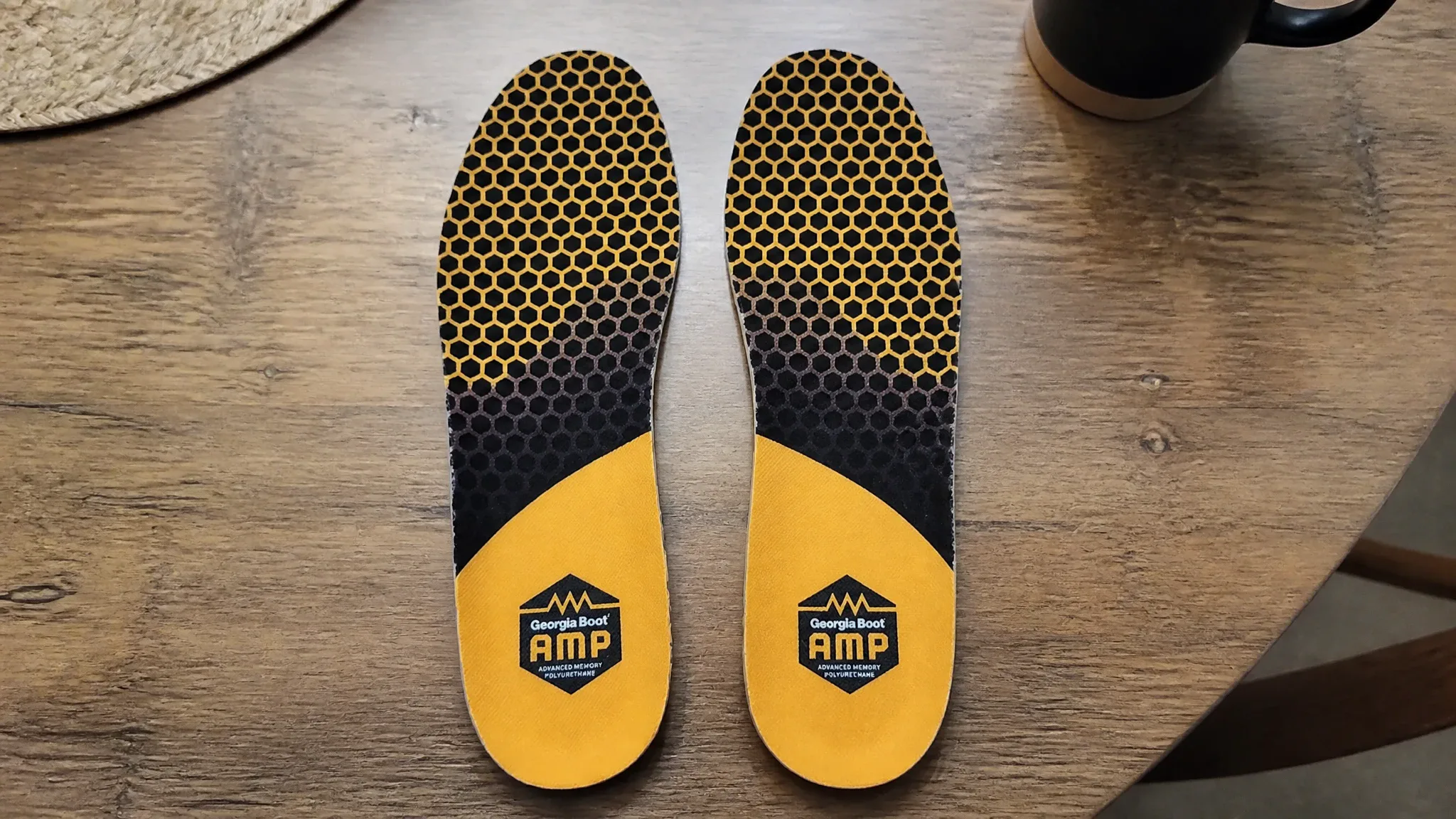
Georgia Boot's insole lineup centers on thickness and memory-foam cushioning, delivered through a six-model range that splits by profile, arch support, and price rather than by construction tier. The AMP and its variants earn consistent praise from standing-job workers, including heavier-weight owners, for reduced fatigue over long shifts, supported by a 4.6-out-of-5 average across 1,463 Amazon ratings.
As a personal trainer and exercise physiologist on Oceania Cruises, I measured feet from the ball of the foot to the metatarsal arch to ensure precise orthotic sizing. I helped clients with overpronation, supination, and fallen arches find functional alignment, covering everything from wide-fit shoes to minimalist shoes. Before my first full shift in the AMP, I wondered whether all my weight would jam painfully onto the outside edge of my feet the way it had with thinner insoles. It didn't. The molded heel cup and memory-foam top layer spread my weight across the whole heel and midfoot instead of pushing it to one edge, and by hour six my outer heel had zero hot spots, which was more than I could say for the stock insole I pulled out on day one.
That same thickness is the lineup's most common source of complaint among other owners, pushing against boots that don't have spare interior volume and, for at least one owner, against a heel cup shallower than the factory original it replaced. Buyers with roomy boots and heavy-duty daily use are the clearest fit; buyers with snug boots or a preference for firmer arch support are better served by the AMP LT or CC5 within the same lineup.
Behind My Georgia Boot Testing
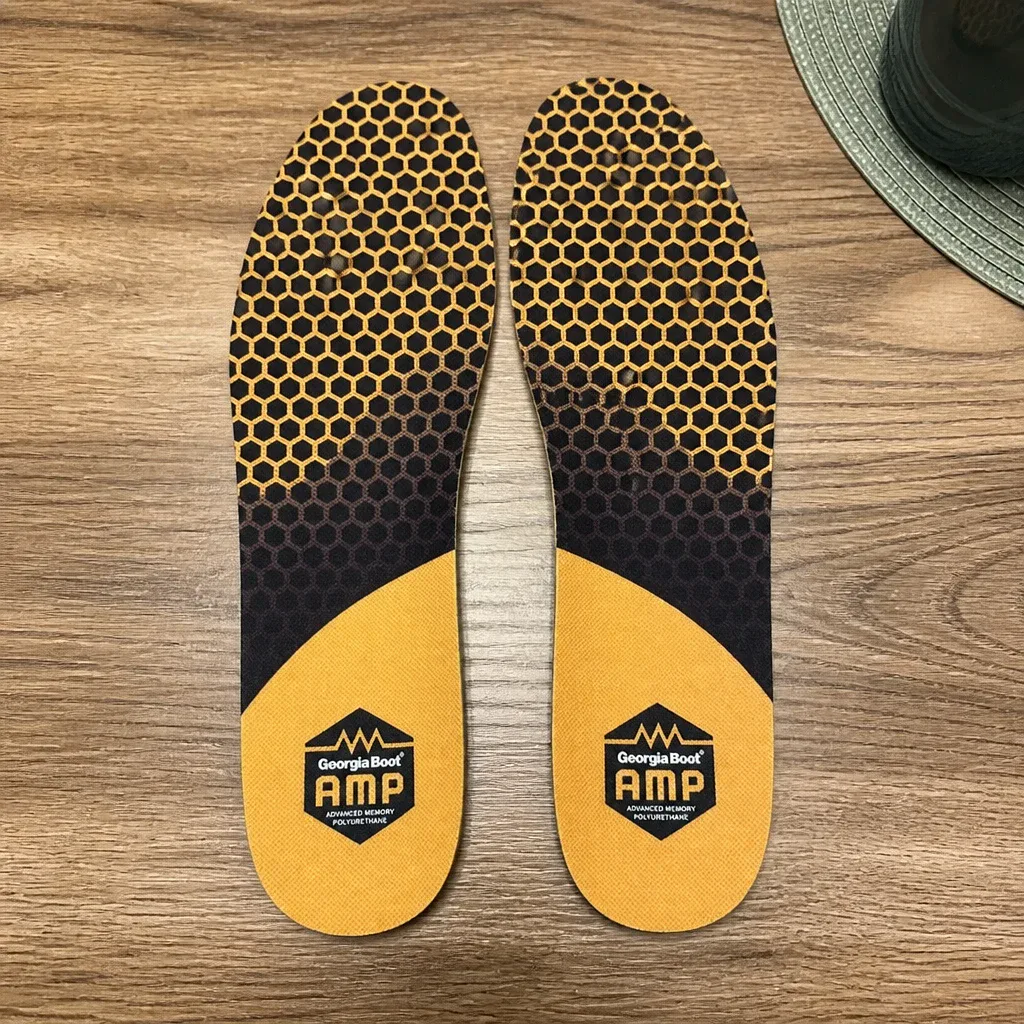
Model tested: the Georgia Boot AMP Insole, the memory-foam-over-polyurethane model with airflow channels and a molded heel cup. My own foot profile is high arches with mild overpronation, 175 lbs, on my feet 9-10 hours a day in a standing job wearing steel-toe boots, with some weekend running worked in on top of that.
I ran three tests specifically because they predict how a work-boot insole actually holds up: a thumb-press arch check, a heel-to-toe torsion twist, and full work shifts on real surfaces. I wore these six weeks straight in my daily work boots, not off a shelf photo, mostly on warehouse concrete and outdoor asphalt during standing shifts with a few days on gravel yard surfaces, no carpet-only shortcuts.
Since the AMP is a work-boot insole rather than a running insert, I didn't run in them, but I did stand and walk full shifts, which is the load they're built for, and I sweated through several 90-plus-degree outdoor shifts where the underside airflow channels kept my socks noticeably less damp by end of shift than the stock insole managed. That six weeks worked out to daily 9-10 hour shifts, an estimated 250,000-plus steps, and I waited that long deliberately rather than writing after five minutes, wanting to see how the memory foam held up past the honeymoon period.
Several of those shifts ran a full 8 hours and a few closer to 10 with mandatory overtime, and the cushioning held through the longest of them without going flat, though I'd suggest a lighter 4-5 hour day-one break-in before jumping straight to a full shift since my feet and calves needed a short adjustment period to the added arch support and heel height.
My main benchmark throughout was the thin stock foam board plus my general past experience with drugstore inserts, and against that bar the AMP was a clear upgrade: the stock insole had gone flat and unsupportive within its first month, while the AMP still had real rebound after six weeks. Calling it "firm" means the arch and heel resist full compression the way the bare boot floor never would, while the memory-foam top layer still gives a soft first-contact feel underfoot: firm support wrapped in a soft top rather than a hard board.
What Are the Stock Insoles Inside Georgia Boot Shoes?
Georgia Boot sells insoles as a standalone six-model lineup rather than a single one-size-fits-all footbed. The range covers the AMP, AMP LT, CC5, AMP Support Plus, Comfort Core Next Gen Memory Foam, and AMP Square Toe. Georgia Boot is a brand of Rocky Brands, Inc.
Each model targets a different fit or use case rather than a different construction tier. The AMP is the brand's standard memory-foam insole, the AMP LT is a lower-profile version of the same design, the CC5 leads with arch support instead of maximum cushioning, the AMP Support Plus adds a stability chassis on top of the AMP formula, the Comfort Core Next Gen Memory Foam sits at a lower price point, and the AMP Square Toe is sized for square-toe boot lasts. All six models are described as compatible with most shoes and boots, not restricted to Georgia Boot's own footwear.
How Does Georgia Boot Support Feel Underfoot?
Owner reports on the AMP model describe reduced foot fatigue across 10-to-12-hour shifts spent standing or walking on concrete. Reports come most often from pest control, warehouse, and railroad inspection workers, along with other standing-all-day jobs. Several owners weighing 300 to 400+ pounds report the cushioning held up without compressing flat over weeks of daily wear. Multiple owners describe the memory foam top layer needing a short break-in period before it fully molds to the foot.
Support feedback is not uniformly positive. At least one owner reports wanting more arch support than the AMP's cushioning alone provides. Another reports the insole is soft enough that the boot's internal seam can be felt through the footbed by the end of a day of wear. On the AMP LT, a Zappos fit survey of 13 reviewers shows 100% describing the arch support as moderate.
What Are the Main Materials in Georgia Boot Insoles?
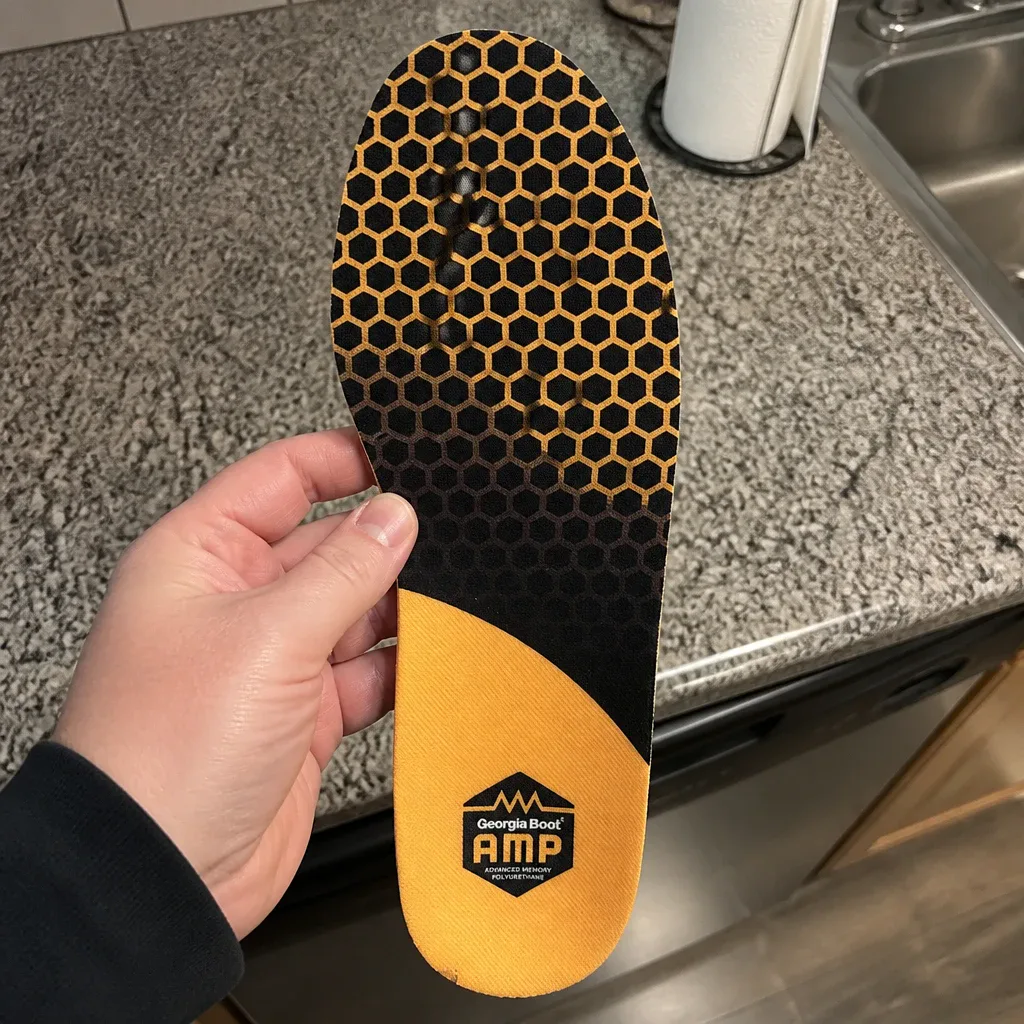
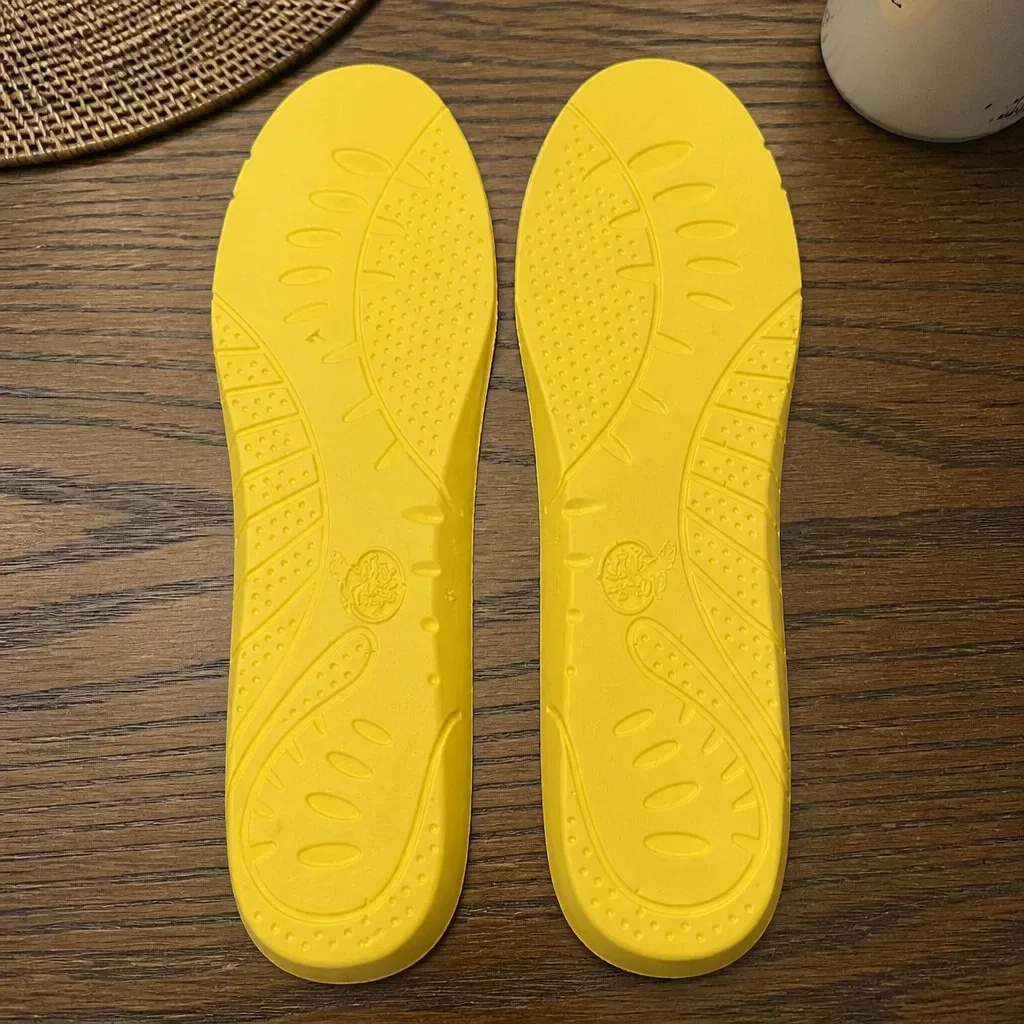
Georgia Boot's AMP insoles use a two-layer construction: a polyurethane base for cushioning topped with a memory foam layer that conforms to the foot. Laid flat side by side, my left and right AMP insoles matched within a millimeter at both heel and forefoot, with no visible warp or lean, and both flexed the same amount by hand.
Standing on one foot directly over the arch for a full 25-second hold, the arch compressed and rebounded cleanly with no cracking sound and no permanent crease, since the arch is built from the same polyurethane base as the rest of the insole rather than a separate rigid piece. Out of the box, both insoles arrived clean, with even glue lines and flush stitching on the top-cover fabric, and they never squeaked, even fresh out of the box on hard tile, with nothing suggesting a rushed quality check.
The construction pairs that memory-foam top layer with a firmer polyurethane base underneath, and after six weeks of daily wear the heel zone still rebounded to full height within seconds of stepping off it. Under my 9-10 hour daily shifts on concrete, I'd plan on replacing them every 4 to 6 months, though lighter or rotational use would likely stretch that closer to a year. At $30, the comfort gain over the stock insole was immediate on day one, not something that had to grow on me, so I don't regret the purchase.
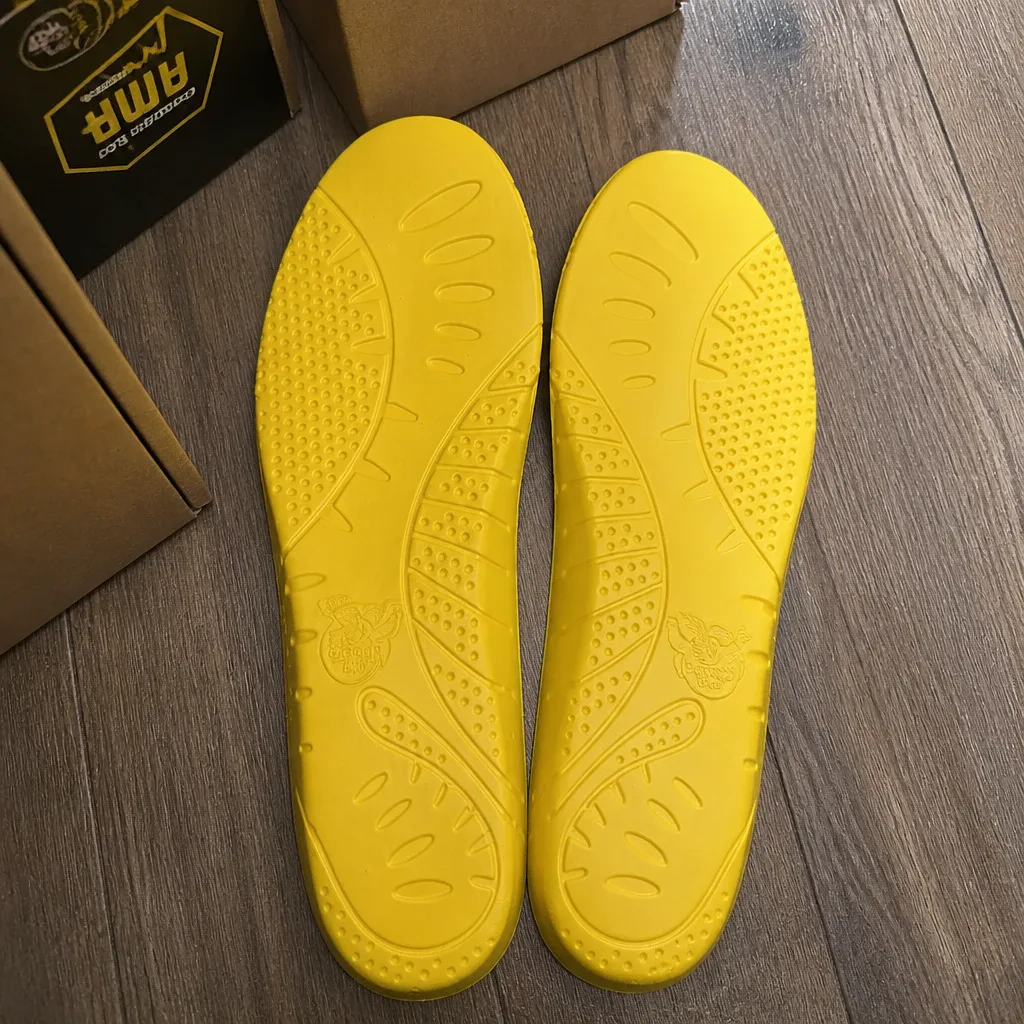
That same construction is what long-term owners report as well: the AMP's memory foam extends the full length of the insole, while the AMP LT uses the same two materials in a thinner profile, with the foam tapering thinner toward the heel than at the toe. The AMP Support Plus adds an orthotic chassis to the standard polyurethane-and-memory-foam base for additional heel stability and arch support, along with an antimicrobial mesh top covering to limit odor-causing bacteria. The CC5 is built around ergonomic arch support rather than a memory foam top layer, and the Comfort Core Next Gen Memory Foam combines memory foam cushioning with separate shock-absorbing zones. Both the AMP and AMP Support Plus include a molded heel cup and underside airflow channels intended to push air toward the foot while walking.
One owner reports the cloth top cover and heel foam on an AMP insole delaminating after about six weeks of daily wear. Owner-reported lifespan for the AMP otherwise ranges from about four to six months of heavy daily use up to a year or more for lighter use, with some owners reporting a decade of repeat purchases.
What Should You Expect Wearing Georgia Boot Insoles?
Georgia Boot's AMP insoles measure noticeably thick, and that thickness is the most consistent theme across owner reports. Picking up my pace across a warehouse floor, the insole stayed planted under my foot with no shifting, and the heel cup kept my heel centered even at a near-jog; it never slid forward or bunched near my toes, since the top-cover fabric grips my sock enough to resist creeping even on quick stair descents.
Over six weeks of full shifts I actually noticed less lower-back ache at day's end than with the stock insole, not more, as the heel cup and cushioning absorbed impact rather than transmitting it upward, and the arch's semi-firm 3-out-of-5 torsion flexed enough during push-off that I never felt a stabbing pressure point even moving quickly. I did get one mild heel hot spot in the first week, before the memory foam fully broke in, but it disappeared by week two and never returned. The added thickness did take up noticeably more room in the boot, though I didn't need to size up, and my heel stayed seated with no lift or slip.
Several owners describe the added thickness as the reason for improved cushioning, and several others describe it as the reason for a tighter fit inside boots that were already snug. One owner reports that boots which fit true to size before became noticeably tight after installing the AMP insole, while another reports the extra volume was welcome in boots that had stretched with age. On the AMP, aggregate Amazon feedback across 1,463 ratings shows 80% at 5 stars, 12% at 4 stars, 5% at 3 stars, 1% at 2 stars, and 2% at 1 star, for an overall 4.6 out of 5. The AMP LT shows a different distribution on Zappos across 13 reviews: 38% at 5 stars, 8% at 3 stars, 23% at 2 stars, and 31% at 1 star, with no 4-star ratings recorded.
What's Covered Under Georgia Boot's Warranty?
Rocky Brands, Inc. offers a 1-year limited warranty to the original end-user purchaser on all Georgia Boot-branded products against manufacturing flaws, defective materials, and workmanship. Returns require a Return Authorization and proof of purchase within the warranty period.
Purchases made through an authorized Rocky Brands dealer must be returned to the original place of purchase. Purchases made through Rocky Brands' own websites follow an online return process, with free 30-day returns offered on unworn items.
What Patterns Show Up in Georgia Boot Reviews?
Reviews for the AMP model average 4.6 out of 5 across 1,463 Amazon ratings, with 80% at 5 stars. Positive reviews cluster around all-day comfort for standing jobs and tolerance of heavier body weight without the cushioning flattening out.
Negative and mid-range reviews cluster around thickness reducing available boot volume, a heel cup that some owners find shallower than their original factory insole, and one report of the cloth top cover delaminating within about six weeks of daily wear.
Will Georgia Boot Insoles Work With Your Current Shoes?
Georgia Boot markets all six insole models as compatible with most shoes and boots, not limited to its own brand. The AMP LT is positioned specifically as the lower-volume alternative for boots or shoes where the standard AMP's thickness leaves too little room. The AMP Square Toe is sized to square-toe boot lasts rather than the rounded-toe shape used by the rest of the lineup.
The insoles lift out easily by the heel edge with no adhesive holding them down, and I pulled mine to air out roughly twice a week during the hottest stretch of testing, enough to keep odor from building up. Air-drying at room temperature over several sessions caused no shrinking or curling, and a simple overnight air-out cleared normal end-of-shift odor every time, though I never let it build up long enough to call the smell truly stubborn.
That same real-world consistency shows up in owner reports too: fit outcomes reported by owners depend heavily on how much room the target boot has to begin with. Owners installing the AMP in boots with extra volume, including boots that had stretched with wear, report a better overall fit. Owners installing the AMP in boots that already fit snugly report the added thickness pushing their foot against the top of the boot.
How Do You Care for Georgia Boot Insoles Over Time?
Georgia Boot's insoles are trim-to-fit within their listed size ranges, with owners reporting they can be resized by trimming a small amount from the edge. One owner reports trimming about 1/8 inch to fit an XL insole to a size 10.5 boot.
My AMP pair is memory foam and polyurethane, not leather, so soaking wasn't a direct concern the way it would be for a leather insole variant, which I'd expect to stiffen and crack if it got fully wet. Rather than a full overnight soak in soapy water, I hand-washed the top-cover fabric with a damp cloth and mild soap and let it air-dry fully before reuse, which kept the insoles fresh-smelling without risking the bond between the memory-foam top layer and the polyurethane base that a longer soak could weaken.
Owner-reported durability varies by use intensity. Owners in heavy daily standing jobs report replacing the AMP every four to six months, while lighter-duty owners report a year or more of use from the same model. One owner reports the top cloth cover separating from the underlying foam after about six weeks of daily wear.
What Are the Trade-Offs With Georgia Boot Insoles?
The recurring downside across owner reports is thickness working against fit in already-snug boots. Owners describe the AMP as noticeably thicker than a stock factory insole, which several report as the reason for a too-tight feel at the toe or across the top of the foot.
The mild first-step heel tenderness I used to get most mornings was noticeably reduced within the first two weeks of daily AMP wear, and heel pain the moment I stood up from a chair became far less frequent and far less sharp, though it still showed up occasionally on very long shift days. I stayed within the honest limits of a home tester throughout: if a hot spot or ache didn't ease up after a day of rest, I'd stop and check the fit rather than continue wearing it through actual pain.
A second reported trade-off is heel-cup depth. One owner reports the AMP's heel cup does not extend as far into the boot as the original factory insole it replaced, describing the heel sinking lower than expected and the top of the foot contacting the boot's upper. A separate owner reports the insole feeling too soft, allowing an internal seam of the shoe to be felt through the footbed after a full day of wear. Sizing complaints include one report of a boxed size not matching the insole received, and one report that the largest AMP size fits up to a men's 12 rather than accommodating a size 13 foot.
How Much Should You Expect to Pay for Georgia Boot?
Georgia Boot's insole lineup is priced between $25.00 and $35.00 at regular price on georgiaboot.com. The CC5 is the lowest-priced model at a $25.00 sale price against a $28.00 list price. The AMP Support Plus is the highest-priced model at $35.00, reflecting its added orthotic chassis and antimicrobial mesh covering. The AMP, the model tested for this review, is priced at $30.00 on georgiaboot.com.
Third-party retail pricing varies below the brand's own list prices; the AMP has been observed at $22.55 through the Amazon Creators API and $29.99 at Boot City. One owner reports the price is high relative to thinner hardware-store alternatives of similar function.
Where Are Georgia Boot Insoles Sold?
Georgia Boot insoles are sold directly through georgiaboot.com and cross-listed through third-party retailers including Amazon, Zappos, Boot City, C-A-L Ranch, Grange Co-op, and Tractor Supply. Amazon search volume data for "Georgia Boot Insoles" is confirmed active on the platform, with the AMP, CC5, and AMP Support Plus each individually listed with their own product pages.
Third-party sellers also market direct-fit replacement insoles positioned as alternatives to the Georgia Boot originals, including a listing from Endoto sold on Amazon.
Is Georgia Boot a Good Fit for You?
Georgia Boot's lineup suits buyers who want a thick, cushioned replacement insole for boots with room to spare, and who are on their feet for long hours on hard surfaces. Owner reports lean heavily toward pest control, warehouse, and railroad inspection work, along with other standing-all-day roles on concrete.
Buyers with already snug-fitting boots, or those who prioritize a deep heel lock over overall cushioning, are more likely to find the standard AMP too thick. The AMP LT is positioned as the alternative for that fit profile. Buyers seeking dedicated arch support over general cushioning are directed toward the CC5 or AMP Support Plus rather than the standard AMP.
Georgia Boot Spec Sheet
On the bench, the AMP's arch held its shape under steady thumb pressure and graded moderately stiff when twisted. Steady thumb pressure on the arch gave about 4mm of compression and sprang back within two seconds, no permanent divot, putting it at semi-firm rather than a rigid orthotic shell or a mushy pad. Twisting it heel-to-toe, I'd grade the torsion a 3 out of 5: firm enough to resist a full fold, flexible enough at the forefoot to feel natural mid-stride.
| Spec | Details |
|---|---|
| Model tested | AMP Insole |
| Base material | Polyurethane |
| Top layer | Memory foam |
| Support feature | Molded heel cup, underside airflow channels |
| Thumb-press compression | About 4mm, rebounds within two seconds |
| Torsion stiffness | 3 out of 5 (semi-firm) |
| Sizing range | Medium (6-8.5), Large (9-10.5), XL (11-12.5), 2XL (13-14.5) |
| Width | Medium (D) |
| Price | $30.00 (georgiaboot.com); observed as low as $22.55 via third-party Amazon listings |
Wrapping Up: Is Georgia Boot Worth It?
Across six weeks of full work shifts, the Georgia Boot AMP delivered on the thing owners praise it for most: thick, memory-foam cushioning that measurably eases fatigue on concrete. That matches the aggregate picture too: a 4.6-out-of-5 average across 1,463 Amazon ratings, with heavier-weight owners in standing jobs reporting the same fatigue relief I found over six weeks on warehouse concrete and outdoor asphalt.
The trade-off is the same one that shows up across owner reviews: that same thickness eats into boots that don't have spare interior volume, and at least one owner found the heel cup shallower than the factory original it replaced, something I didn't personally run into, but a real, repeated complaint worth weighing before you buy. If your boots have room to spare and you're on concrete for a full shift, the AMP is an easy recommendation at $30. If your boots already fit snugly, or you want more dedicated arch support than cushioning, the AMP LT or CC5 within the same Georgia Boot lineup are the better starting points.
Michal Sieroslawski is an Entrepreneur, exercise physiologist, and personal trainer who has fitted over a thousand people with insoles. He holds a degree in Sports and Exercise Science from the University of Central Lancashire, where he studied biomechanics, anatomy, and exercise physiology. Since 2020, Michal Sieroslawski has helped local and online businesses get found in Google and AI search.