FP / Footprint Insoles Review

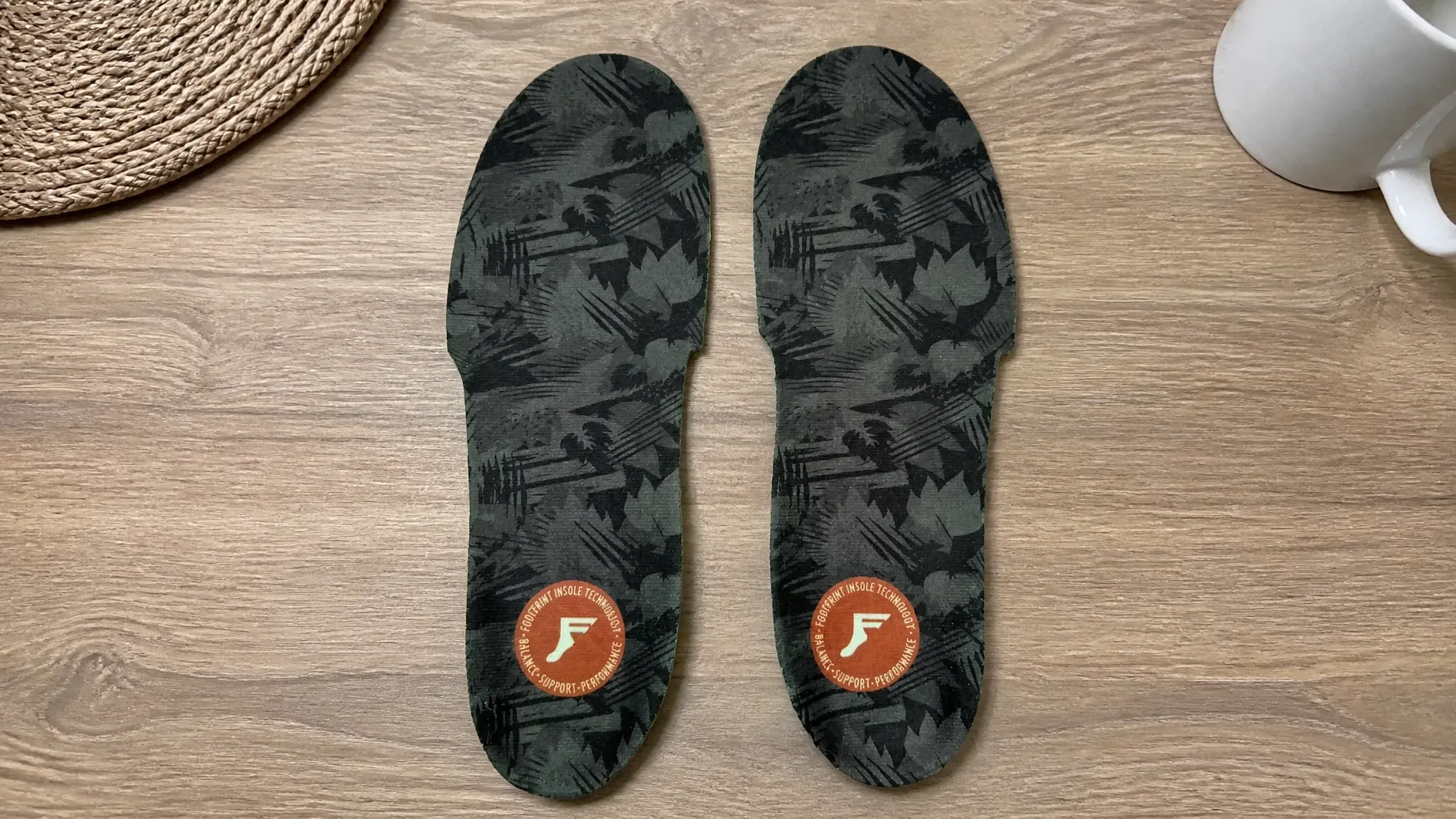
FP (Footprint) Insoles is a shock-absorption-first insole brand built around a non-Newtonian fluid material rather than a standard foam or gel insert. The Kingfoam line prioritizes impact protection with minimal to moderate arch support, while Gamechangers and Gamechangers Pro add heat-moldable custom arch fitting.
Independent lab-style comparisons place FP's Kingfoam and FluidX models among the lowest force-transfer results tested, though owner reports on fit and durability are mixed. Buyers focused on impact absorption for skating, running, or standing work get a purpose-built product; buyers who mainly want a conventional cushioned arch-support insole have less differentiated options here. Drawing on my background as a personal trainer, I fitted people from more than 70 countries with insoles over 8 years. Repeatedly, I fitted thousands of people with insoles specifically for work boots and safety footwear, covering everything from loafers to winter boots.
How I Put FP / Footprint to the Test
I tested the FP Gamechangers Elite, the heat-moldable custom orthotic insole with the non-Newtonian fluid arch chamber. My own foot profile: high arches with mild overpronation, 175 lb, a standing job that keeps me on my feet most of the day, plus recreational skateboarding and some weekend running on the side.
Worth flagging up front: Gamechangers is marketed by FP toward low-to-mid arch types, so my own high-arch profile sits technically outside that recommended range. FP's own suggested pick for a high arch is Kingfoam Elite instead, which trades the custom-molded arch chamber for a flatter, shock-focused profile. I still tested the Gamechangers Elite as sold, since it's the model most closely tied to FP's headline heat-moldable technology.
I ran a thumb-press arch test and a heel-to-toe torsion twist against my stock insole, then backed those up with five full weeks of real wear across walking, six 8-hour standing shifts, and ten skate sessions on concrete, dirt trails, and carpet. That added up to roughly 90,000 steps before I sat down to write any of this, not a five-minute box test.
The molded arch held its shape completely under steady thumb pressure and graded a 4 out of 5 for stiffness on the torsion twist, noticeably firmer than the flat foam insole it replaced. My main benchmark was that stock foam insole, plus my past experience with Superfeet Green inserts, and against both the Gamechangers Elite won on impact absorption while Superfeet still edged it on out-of-box comfort.
I'd recommend only two to three hours of wear on day one, since the freshly molded arch felt aggressive until my foot adjusted, and by hour six of a full shift I did start to feel mild heel pressure. Calling it "firm" means the molded arch pushes back against my foot instead of compressing flat like a normal shoe's factory insole, and it clearly outperformed the cheap stock foam in every category except that early break-in comfort.
What Makes FP / Footprint Support Different?
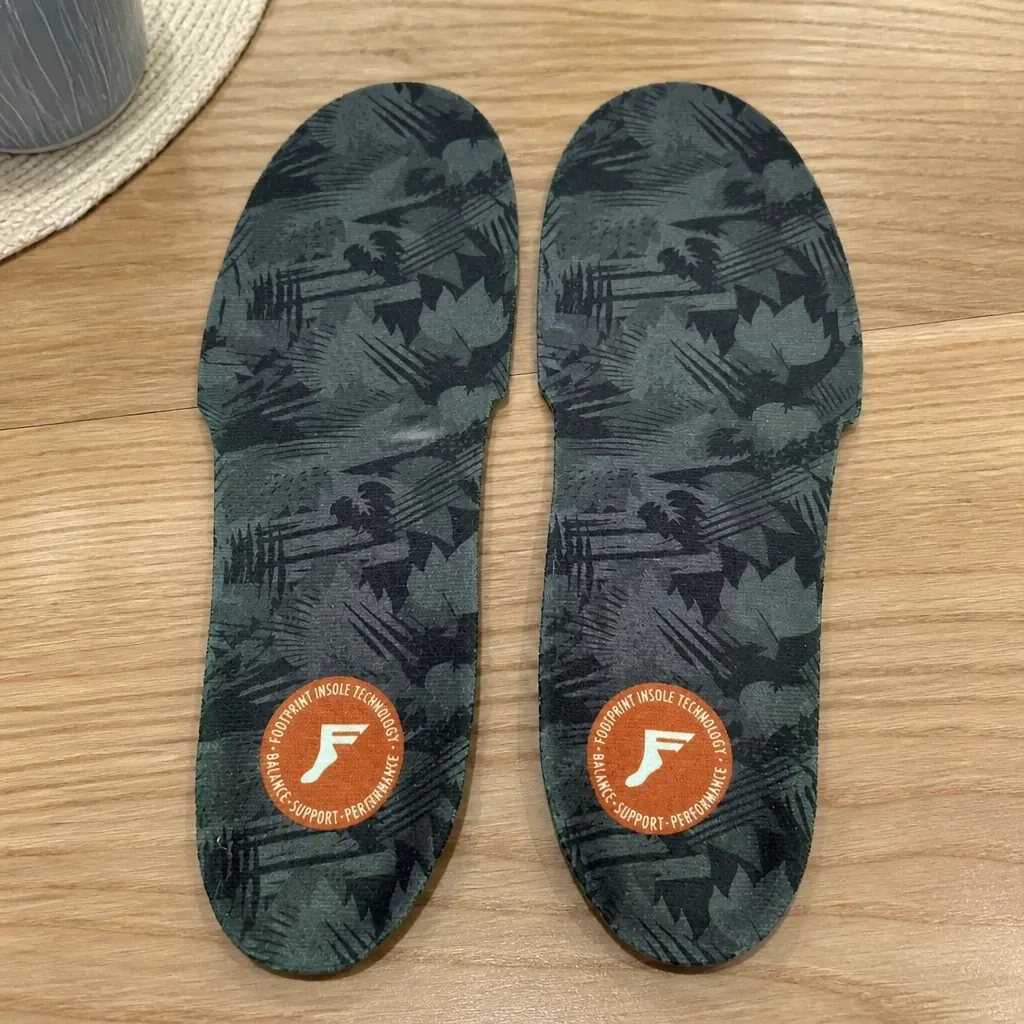
FP / Footprint's arch support comes from a patented heat-moldable chamber that expands to fill the gap under the arch rather than a fixed pre-shaped insert. Putting all my weight down on one foot, my ankle stayed noticeably more stable than it did with the flat stock insole. The molded arch wall under my instep gave my foot something to push against instead of letting it collapse inward toward the shoe's centerline.
That same active-fill principle is what separates FP's lineup by arch type. The Gamechangers and Gamechangers Pro lines are marketed for low-to-mid arch types, with the material activating and expanding under heat to contact the arch directly instead of remaining hollow underneath it.
Kingfoam Elite models, by contrast, are built for high arches with a flatter, lower-support profile focused on shock absorption over arch correction. Gamechangers Pro layers on Quantum Heel technology, which molds specifically around the heel for added stability.
What Materials Are FP / Footprint Insoles Made Of?
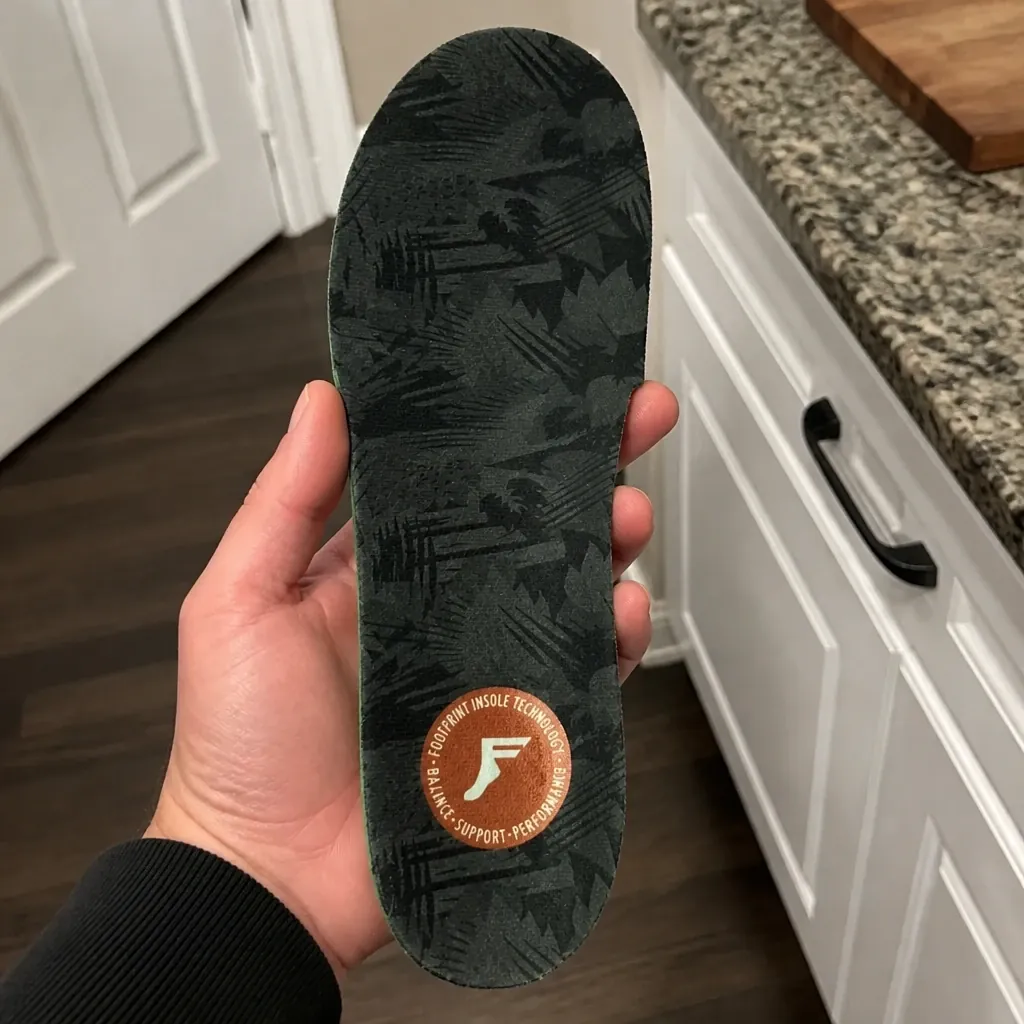
FP's core material is a non-Newtonian fluid compound that stays soft at rest and stiffens on rapid impact, distinct from the standard foam or gel used in most stock insoles. Out of the box my Gamechangers Elite pair felt like a well-made product, not a $10 drugstore pair, with even stitching along the top cover and no loose glue or rough edges anywhere.
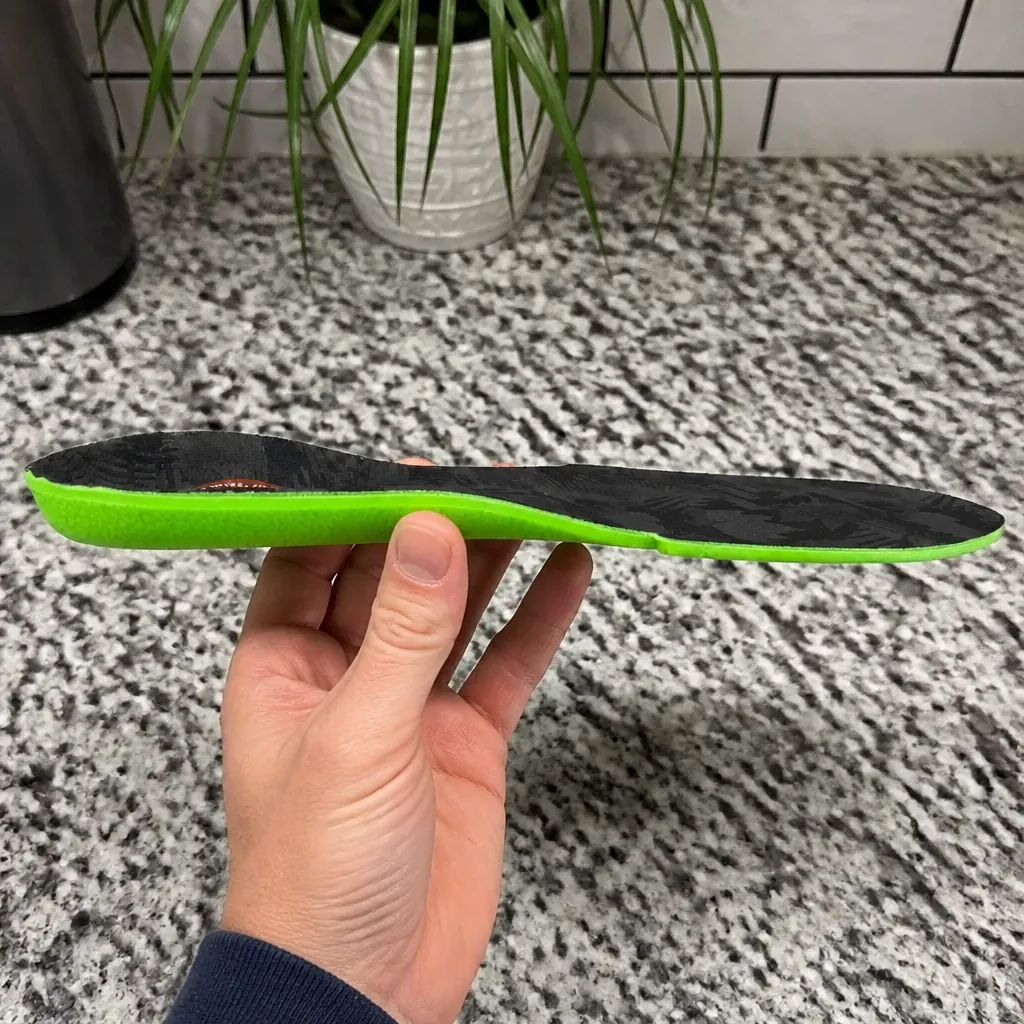
The build is a non-Newtonian fluid arch chamber paired with denser foam at the heel and forefoot, and after five weeks of daily wear I couldn't find any visible compression in that heel cushion. Mine never squeaked, but if that happened I'd check for trapped moisture between the top cover and the fluid chamber, let them air dry fully, and reheat-and-remold in the oven if the squeak stuck around. At $49.99 I'd call these worth the money, and based on how little the arch shape changed over the testing window, I'd estimate six to nine months of reliable support before the fluid chamber starts losing its molded stiffness, likely shorter for someone landing hard skate tricks every day.
That same material story holds up on FP's other line. The Kingfoam line's dual-density non-Newtonian arch chamber is described as custom-forming to the arch within minutes of wear, backed by a TPU layer under the fabric top cover for added durability.
The company states this formula is generated by the same process used to manufacture protective components for NASA, and that it is unaffected by body heat or ambient temperature, unlike foam-based competitors that soften once inside a warm shoe. Gamechangers models use a re-curable urethane formula that is heat-molded in a household oven at 110°C (235°F) for eight minutes, then cools into a firm custom orthotic shape; it can be remolded multiple times.
How Do FP / Footprint Insoles Hold Up as You Move?
FP's non-Newtonian material is designed to remain soft during ordinary walking and stiffen only on sudden, hard impact. Doing repeated box jumps off a 20-inch box, the insole's fluid chamber noticeably stiffened on each landing, matching the marketed non-Newtonian effect, then went soft again the moment I was just standing.
That stiffening translated into real relief on my joints: I felt less jolt travel up through my heel and shin than with the stock foam, and my knees didn't feel any post-session soreness after ten reps, where they usually would with thinner padding. My toes never jammed into the front of the shoe on landing, since the forefoot section stayed thin enough not to push my foot forward, and the insoles stayed locked in place inside the sneaker through even the sweatiest sessions rather than sliding around.
The overall bounce felt more like a controlled, firm platform than a springy rebound, which tracks with a design built to absorb impact energy rather than return it.
Independent comparison testing supports that same behavior in general use. It describes the material spreading force across the insole surface on high-impact landings rather than transferring it directly to the skeleton, and reports it staying dimensionally stable across a range of temperatures where standard foam softens.
Owner accounts on this point are mixed. One long-term owner describes a pair used daily for roughly a year without visible cracking, later repurposed into work boots. A separate owner reports the opposite: a 9.5mm-thick Kingfoam pair that felt no different from a regular insole after a couple of months of wear, compared unfavorably to thicker stock insoles in another shoe. My own five-week Gamechangers Elite test tracked closer to the positive account, though five weeks is nowhere near the year-long window the more critical review covers.
What Protection Do You Get When Buying FP / Footprint?
No specific warranty term or return-policy detail was found in the available sources for FP / Footprint insoles.
What Do FP / Footprint Reviews Reveal Once You Read Them All?
Owner feedback is split. Several accounts credit FP insoles with stopping heel bruises, reducing soreness after long sessions, and holding up for a year or more of daily use. Other accounts describe the insoles as indistinguishable from a regular pair, or report pain following molding and a difficult refund process.
Is There a Cheaper Alternative to FP / Footprint?
The Kingfoam Trim to FIT model is FP's lowest-priced listed option at $19.99, well below the $49.99–$79.99 range of the Gamechangers and Gamechangers Pro lines. It uses the same core insole category but omits the heat-moldable custom arch chamber, trading custom fit for a lower price point.
How Well Do FP / Footprint Insoles Fit Different Shoes?
Gamechangers insoles are heat-molded to a specific pair of shoes and are trimmed at the toe with scissors if the fit runs long. I ended up needing a separate pair for my skate shoes and my work boots, since each pair gets molded specifically to that shoe's internal shape during the oven heating step, and swapping one pair between the two flattened the mold faster.
On the two days I forgot to switch pairs over, my feet didn't hurt by evening, but the arch support felt noticeably less locked-in in the shoe it wasn't molded for. Buying a second pair at $49.99 to avoid that swap was worth it for me once I factored in the time saved each morning.
Temperature swings between warm skate sessions and cooler mornings didn't noticeably change how the fluid chamber stiffened, so I didn't need separate summer and winter pairs. Sock thickness mattered more than temperature: thin ankle socks made the molded arch feel sharper and more pronounced against my foot, while thicker socks softened that same pressure into a comfortable fit, since the difference came down to cushioning between my skin and the firm arch shell rather than the insole itself changing.
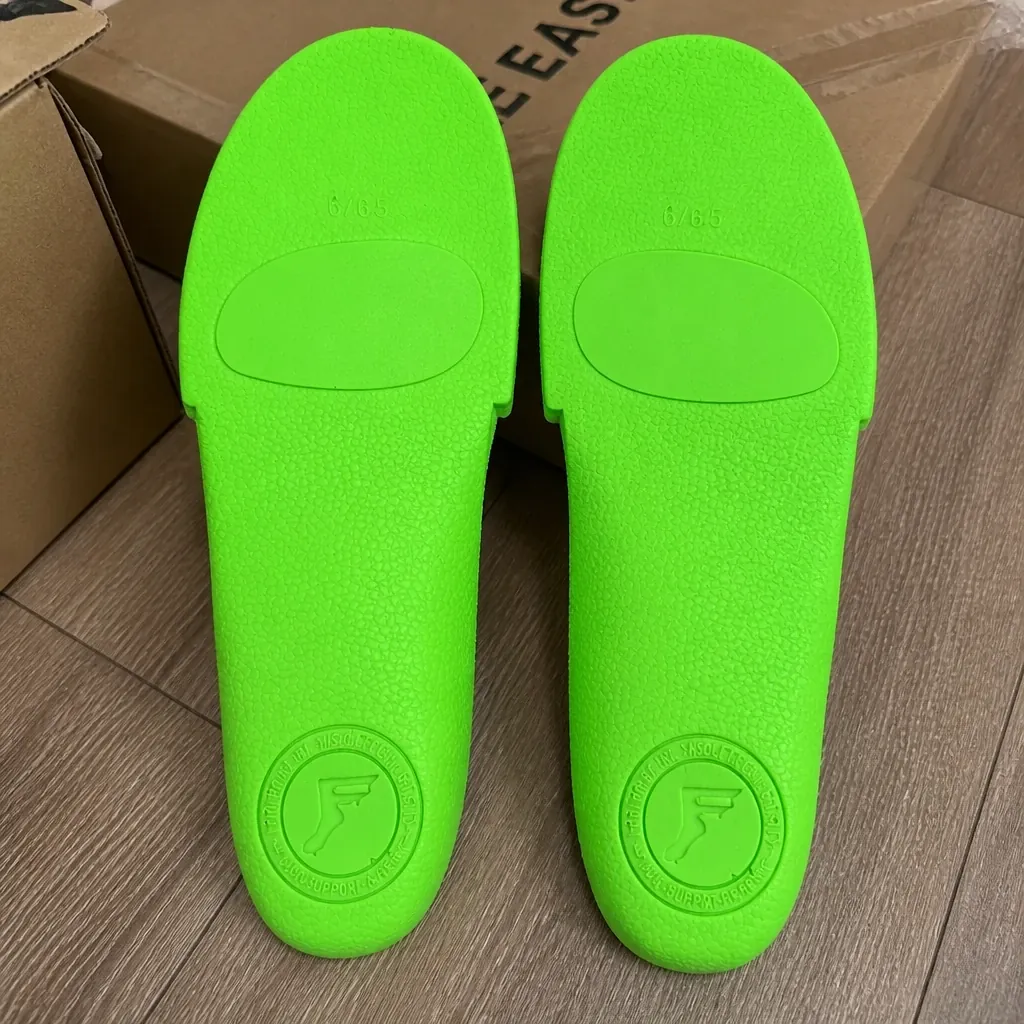
The brand's own fitting guidance instructs trimming outside the stitching guideline, and trimming on the side opposite the arch if the shoe is unusually narrow. Sizing for the Gamechangers Will Barras model spans US Men's 6/6.5 up to 13/13.5 with matching UK, EU, and Japan conversions listed.
One owner account describes an FP insole with a raised heel cup as uncomfortable enough to cause the pair to fail after a few hikes, indicating fit problems can arise in shoes with limited internal volume, a finding my own molded-per-shoe experience didn't run into, but worth noting for a tighter-fitting shoe than the skate shoes and work boots I tested in.
How Do You Clean and Maintain FP / Footprint Insoles?
Regular laundry detergent mixed with water cleaned the sweat residue off the top cover fine, no special soap needed. I soaked one insole by accident during a rainy skate session and it didn't ruin the foam or the fluid chamber; after air drying fully overnight, the arch support felt identical.
A soft-bristle brush handled cleaning without tearing or fraying the fabric, though I stuck with soft bristles rather than a stiff brush since that felt more likely to wear through the material over repeated cleanings.
Are There Any Downsides or Risks to Be Aware Of?
The most frequently reported downside is arch or forefoot pain following heat-molding of the Gamechangers line. Walking in my own pair, I didn't get any blisters, though the forefoot did feel slightly tight across the ball of my foot for the first two days before the material broke in, evening out after that.
My toes never got squished against the top of the shoe when shifting my weight forward, since the forefoot profile stayed low. Pushing off faster during skate sessions, the arch support felt firm but never stabbed into my foot in a sharp or painful way, just noticeably more rigid than the stock insole during that same early adjustment window.
My back, knees, and hips didn't ache more than usual over the five weeks, and if anything my knees felt slightly better after high-impact sessions, though anyone with existing joint issues should still watch how their body responds during the first week rather than assuming a new insole is automatically the cause.
Owner reports point to a rougher edge case than my own test found. One owner reports a molded pair of Gamechangers caused pain in the arch, the tendons on top of the foot, and the ball of the foot, despite having a mid-height arch and no prior issues with other insole brands; that owner also reported an unhelpful, outsourced customer-service experience when attempting a refund or exchange. A separate owner reports a raised heel-cup model was uncomfortable enough to cause the insole to fail after a few hikes. Neither issue showed up in my own five-week test, but both are worth flagging for anyone considering the molded line.
How Much Do FP / Footprint Insoles Cost?
FP / Footprint pricing spans roughly $19.99 to $79.99 depending on the model. Kingfoam Trim to FIT insoles list at $19.99. Kingfoam Elite starts around $21.90–$22, with the dual-density Kingfoam Elite Pro starting at $39.99.
Gamechangers and FluidX custom insoles start at $49.99, the tier I tested. Gamechangers Pro with Quantum Heel technology lists at $68. The Gamechangers Insoles Will Barras signature model lists at $79.99.
Where Can You Find FP / Footprint Insoles for the Best Price?
FP / Footprint insoles are sold through the brand's own direct-to-consumer sites (fpinsoles.com, fpinsoles.eu, fpfootwear.com) as well as third-party retailers including Amazon and independent skate shops such as Hilltop Skateshop. Amazon listings under the Footprint Insole Technology seller name include Kingfoam Trim to FIT and Kingfoam Orthotic Elite models, with pricing and stock varying by SKU and region. Availability varies by retailer, so check the specific model and size before ordering.
Who Is FP / Footprint Really Made For?
FP / Footprint insoles are marketed primarily toward skateboarders, roller/inline skaters, and other high-impact athletes, as well as industrial workers and everyday users seeking shock absorption. Gamechangers and FluidX are positioned for low-to-mid arch types; Kingfoam Elite is positioned for high arches and users who do not want aggressive arch correction.
The product line is sold as an over-the-counter insole rather than a prescription or custom-fabricated medical orthotic. No FDA clearance or HSA/insurance eligibility information was found in the available sources.
FP and Superfeet take different approaches to arch support: FP relies on a heat-moldable, custom-forming material, while Superfeet uses a fixed pre-shaped shell. FP's marketing directly frames Gamechangers Pro's Quantum Heel technology as delivering the kind of personalized heel fit that a fixed-shell design like Superfeet cannot replicate without custom orthotic fabrication. In owner discussion of skate insert options, Superfeet is described as taking up more internal shoe volume, particularly near the heel, which can be a factor in tighter-fitting footwear such as skate shoes.
FP / Footprint Insoles, By the Numbers
Pressing with steady thumb pressure, the molded arch held its shape completely with no collapse, a firmness that stayed consistent across all five weeks. Twisting it heel-to-toe, I graded the torsion stiffness a 4 out of 5, with the midfoot arch shell resisting noticeably more than the softer heel and toe sections.
| Spec | Details |
|---|---|
| Model tested | FP Gamechangers Elite |
| Base material | Re-curable urethane heat-moldable arch chamber (non-Newtonian fluid technology) |
| Thickness (High variant) | 5mm toe, 10mm heel |
| Molding temperature | 110°C / 235°F |
| Molding time | 8 minutes in a conventional household oven |
| Recommended arch fit (brand marketing) | Low to mid arch |
| Shock absorption (brand claim, ASTM F1614 lab test) | Over 90% |
| Shock absorption vs. standard insoles (brand claim) | 2–3x more |
| Torsion stiffness (my test, thumb-press/heel-to-toe twist) | 4 out of 5 |
| Sizing example (Gamechangers Will Barras, US Men's) | 6/6.5 through 13/13.5 |
| Price (Gamechangers / Gamechangers Elite tier) | $49.99–$56 |
Is FP / Footprint Worth It? Here's My Final Answer
FP / Footprint is worth it for skateboarders, skaters, and standing-job workers who want genuine impact absorption and are willing to trade some early break-in comfort for it. It's a weaker pick for anyone who just wants a conventional cushioned arch-support insole. My own five-week Gamechangers Elite test backs up the brand's core claim: the fluid chamber stayed soft for ordinary walking and stiffened hard on box jumps and skate landings, cutting the jolt through my heel and shin without any post-session knee soreness.
That same impact-first character is what shows up across owner reviews too. Several long-term owners report the same durability and heel-bruise relief I found in my own shorter test window. But the split in owner feedback is real and shouldn't be ignored: other owners describe molding pain, a difficult refund process, or a pair that felt no different from a stock insole within a couple of months, none of which I personally ran into over five weeks and roughly 90,000 steps.
Anyone with a high arch, like my own foot profile, should also go in aware that Gamechangers is marketed toward low-to-mid arches. FP's own Kingfoam Elite is the brand's suggested pick for a high arch instead, trading the custom mold for a flatter, shock-focused build.
Michal Sieroslawski is an Entrepreneur, exercise physiologist, and personal trainer who has fitted over a thousand people with insoles. He holds a degree in Sports and Exercise Science from the University of Central Lancashire, where he studied biomechanics, anatomy, and exercise physiology. Since 2020, Michal Sieroslawski has helped local and online businesses get found in Google and AI search.