DVNK Insoles Review

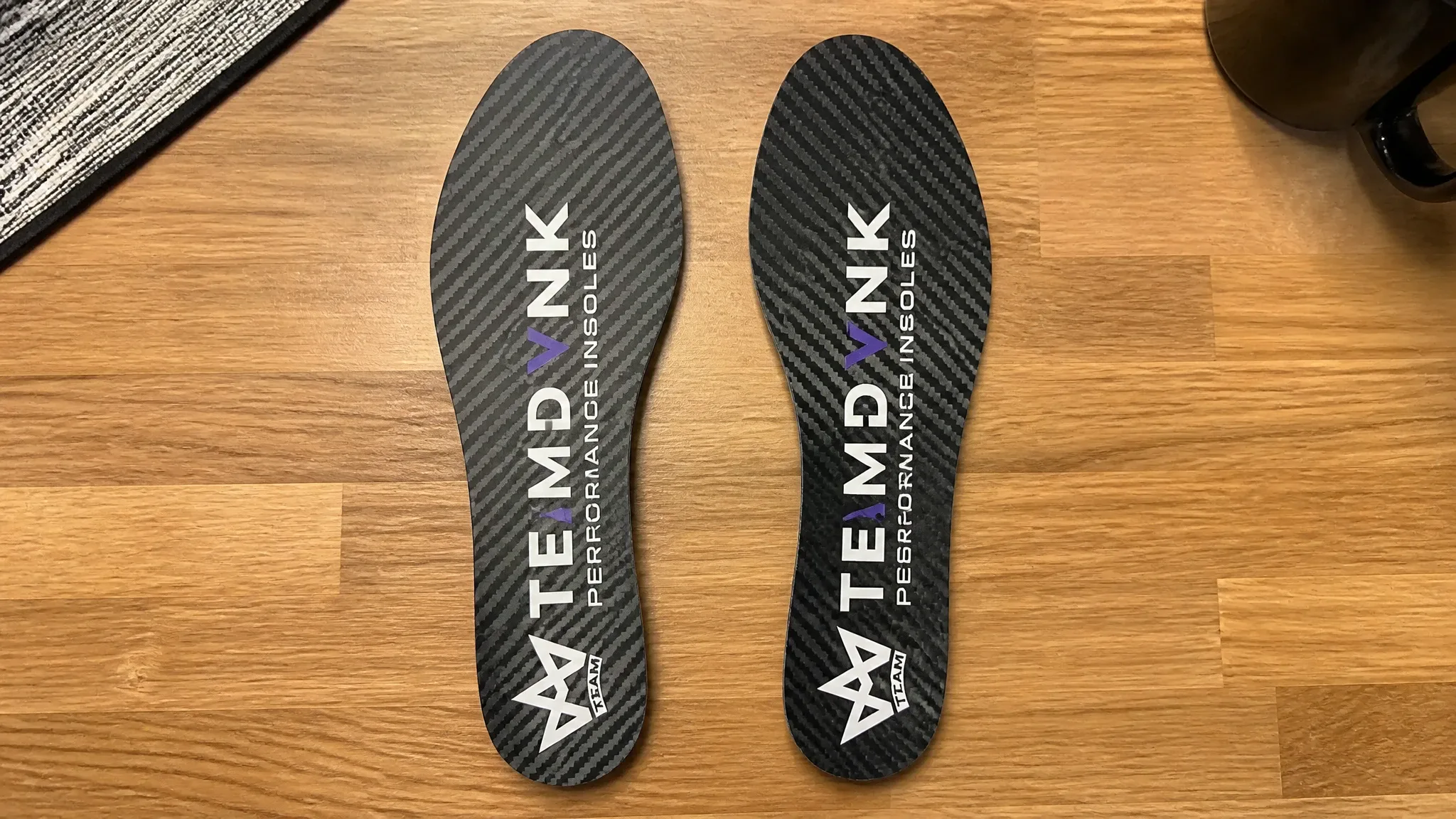
DVNK's pitch is a carbon fiber insole built for speed, jump, and stability rather than everyday comfort, sold across five models (Premium, Kevlar, Pro, Aura, Ultra) matched to a buyer's sport and goals through an on-site quiz. As an exercise physiologist on Carnival Cruise Line, I sold insoles for over 8 years as part of my work on cruise ships. Across those years, I helped clients manage plantar fasciitis and heel spurs using targeted arch solutions, and in direct practice I fitted insoles into every type of footwear, including tennis shoes, sandals, and Crocs, everything from orthopedic shoes to diabetic shoes and zero-drop shoes.
Direct-site pricing sits in the €80-90 range per model with free worldwide shipping and a 14-day return window. Independent detail on the insole's construction is thin: no published arch shape, flex-point, thickness, weight, or torsion figures were found for any individual model.
Owner reaction is split, with some reporting a real bounce and durable long-term wear during basketball, and others doubting that a thin carbon sheet changes athletic performance versus a shoe's own midsole. The clearest practical risk is buying an unauthorized copy through third-party marketplaces rather than DVNK's own site.
Buyers drawn to the performance marketing should treat the return window as their main safety net, given how little independently verified data backs the specific speed and jump claims.
How I Put DVNK to the Test
I ran a thumb-press collapse test, a heel-to-toe torsion test, and a direct comparison against the stock insole it replaced, since the brand's whole pitch is arch rigidity and explosive energy return, and those were the numbers that actually mattered. I wore the DVNK Pro for six full weeks rather than just reading the box copy, roughly 18 basketball sessions plus daily walking and errands, on both a hardwood gym court and outdoor concrete.
I ran and sprinted in them during full-court games, not just casual walking, and the rigid plate gave a noticeably snappier toe-off on concrete than on the gym's sprung wood floor. I sweated in them heavily during a 90-minute session in a warm gym and the top-cover fabric handled the moisture fine without feeling soggy afterward.
I repeated the thumb-press and torsion tests both fresh out of the box and again at the six-week mark, and both held steady: the arch still gave only 1-2mm and the twist grade stayed a 5 out of 5. On day one I wore them for about 2 hours, split between light shooting and normal walking, to let my feet adjust before a full game, and I'd recommend the same break-in window rather than starting with a 90-minute game.
I didn't test a full 8-hour standing work shift, since my testing centered on basketball and daily walking, but given the minimal cushioning I'd expect these to feel harsher than a comfort insole over a static shift. Comparing mainly against the stock foam insole I swapped out, plus my own past experience with a softer cushioned insole as a baseline, the DVNK clearly won on torsion and thumb-press rigidity for explosive movement, though the stock foam actually felt softer underfoot for flat-out comfort standing around. Calling it "firm" means the arch barely compresses at all next to a normal shoe's stock insole, closer to standing on a thin, springy plate than the cushioned feel most people expect.
I do not judge an insole until I have worn it for a full workday, which is why I checked whether the heel cup actually held my foot in place or let it wobble.
What Is DVNK Arch Support?
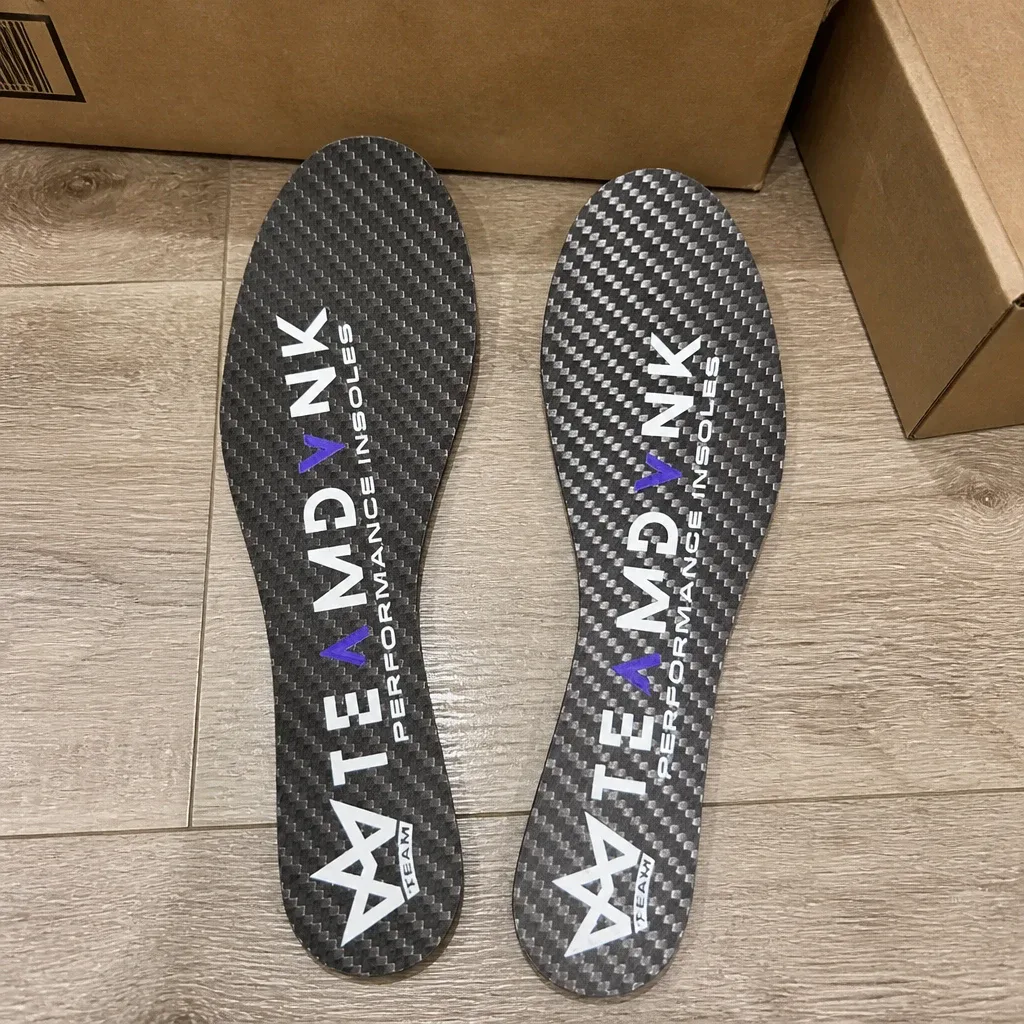
DVNK sells carbon fiber insoles marketed for athletic performance across five models: Premium, Kevlar, Pro, Aura, and Ultra. The lineup is positioned around soccer, basketball, volleyball, running, rugby, tennis/padel, and general gym training. A three-question fit quiz on the brand's own site matches shoppers to a model based on sport, priority (speed, jump, stability, comfort, or cushioning), and shoe size.
The brand also sells the models bundled in pairs, such as Ultra + Pro and Kevlar + Pro, aimed at buyers who want more than one support profile for different activities.
How Do DVNK Insoles Support Your Feet?
DVNK insoles hold an ankle steady under full body weight, standing firm where a stock foam insole gives way. Standing on one leg on my kitchen floor and putting all my weight down, I felt the DVNK Pro's raised medial edge push back against my ankle rolling inward, and it stayed noticeably steadier than it did on the stock insole that came in my shoe. The rigid carbon shell held its shape under my full body weight instead of collapsing, giving only a couple millimeters of arch sag at most.
That same rigidity is the whole premise behind DVNK's marketing: the brand builds its carbon fiber construction around improving speed, jump height, and stability rather than around a specific arch shape or flex-point specification. No published arch height, flex-point location, or torsion-resistance figures were found for any individual model, so the steadiness I felt is a direct test result rather than something DVNK itself quantifies.
What Are the Main Materials in DVNK Insoles?
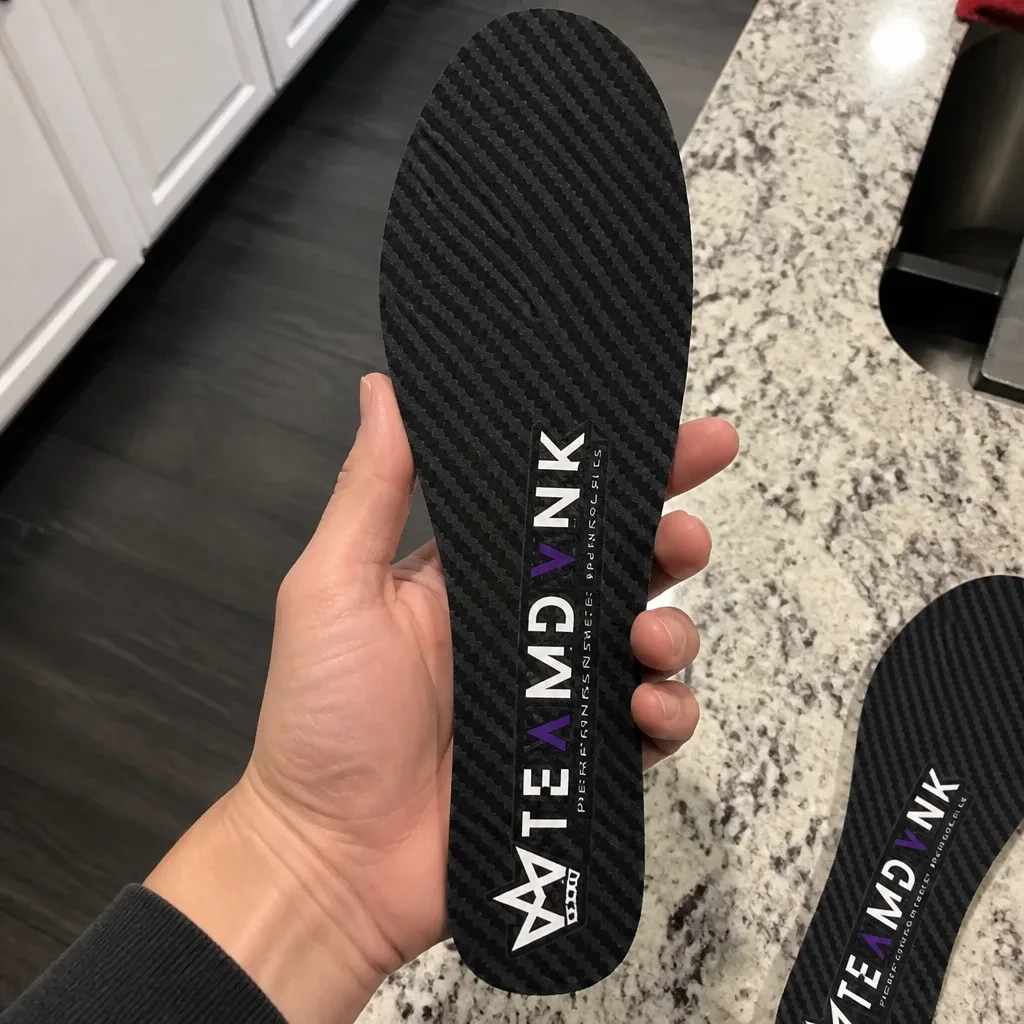
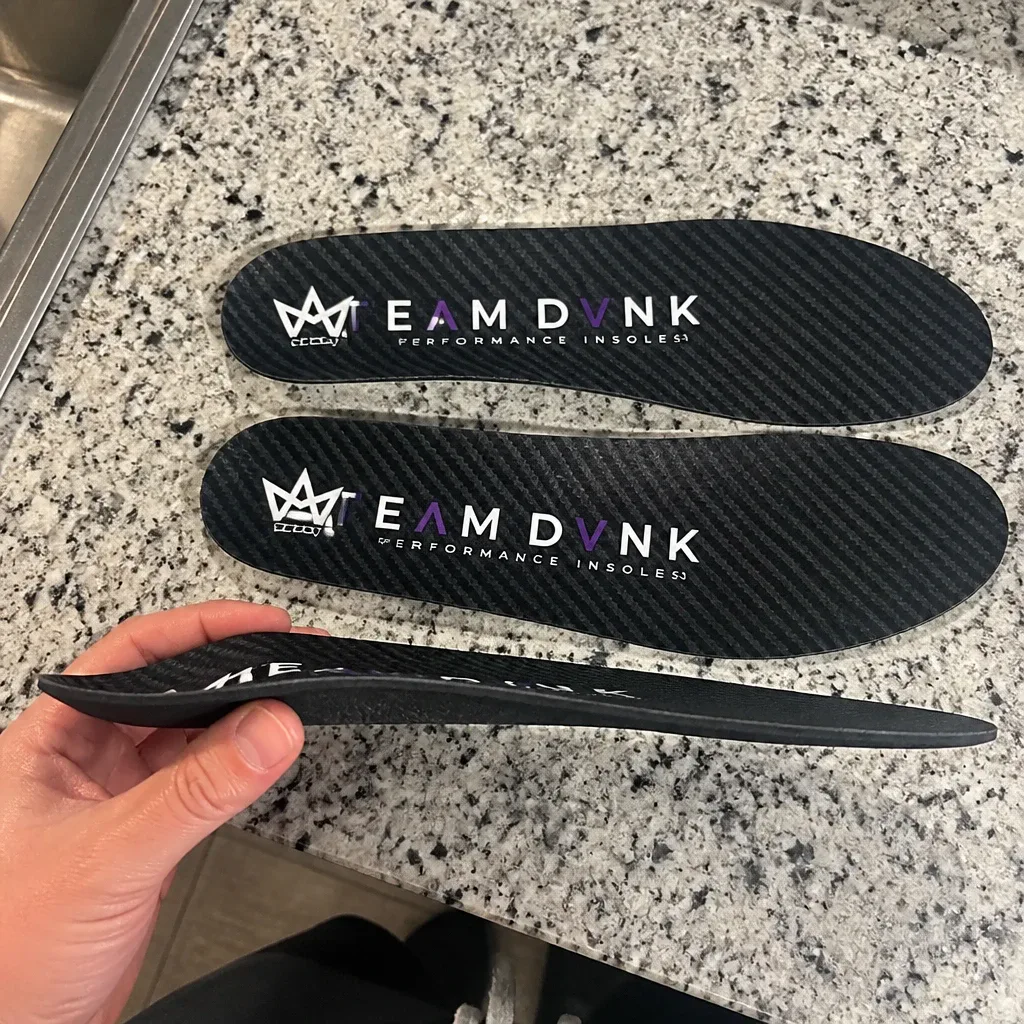
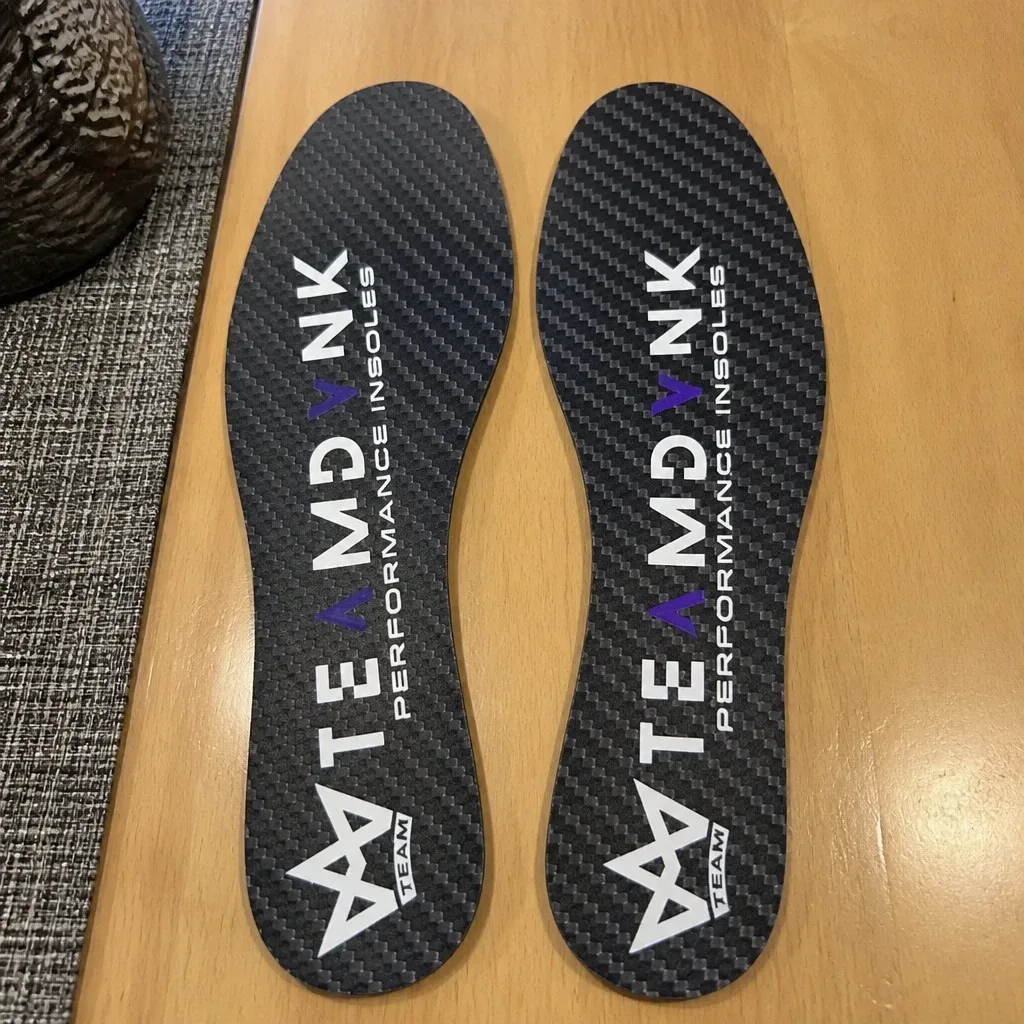
DVNK insoles are built around a rigid carbon fiber plate rather than a foam-based core, and that shows the moment you handle one. Feeling the DVNK Pro in my hand, it did not feel like a $10 drugstore pair. The carbon fiber plate has a stiff, almost metallic snap, closer to a thin sheet of metal than the soft cardboard-like insert that ships stock in most sneakers, and the stitched edge binding and smooth top-cover fabric both matched the roughly $85 price TEAMDVNK actually charges.
Straight out of the box mine looked nothing like a cheap knockoff, with an even carbon weave and clean trim, though I know knockoffs of this exact insole circulate on marketplaces, so I only trust the fit and finish because I bought from the brand's own site. The core is a rigid carbon plate with a thin 3mm foam layer bonded on top rather than a foam-built insole, so there's very little material to flatten in the first place, and after six weeks of playing basketball three times a week the plate showed zero flex fatigue with only light surface wear on the top cover at the forefoot.
Based on that, I'd estimate 12-18 months of reliable support before the plate loses its snap-back, with the fabric likely thinning around month eight or nine. I'd call it worth the money for someone who plays that often, though I'd regret the purchase if I only wore insoles for standing around at a low-impact job, since the rigid plate offers little cushioning. Mine never squeaked, but if that happened I'd check for trapped moisture between the plate and the shoe's footbed first, since that's the usual cause of a rubbing squeak.
That same solid-carbon construction is what DVNK markets across the whole lineup: a carbon fiber base, sold in a solid black finish, built to fit a wide range of shoe types. No published figures cover top-cover material, cushioning density, or bottom-surface grip for any individual model beyond what direct testing shows.
What Is Wearing DVNK Insoles Really Like?
DVNK insoles trade shock absorption for a springier push-off, and that swap is obvious within the first few jumps. Doing box jumps, I felt a noticeably quicker rebound off the ground on takeoff compared to my stock insole, and that springy, reactive bounce was the most noticeable difference from the flat, absorbed feel of the stock insole, especially on quick first steps and jump takeoffs.
Landing, though, the rigid plate didn't absorb impact the way a cushioned insole would, so my knees and ankles felt about the same landing shock as with a thin stock insole, since the carbon plate is built for push-off energy return rather than shock absorption. My toes never jammed into the front of the shoe on landing, since the insole kept my foot properly seated in the heel cup and the fit stayed snug enough that my foot didn't slide forward on impact. Over six weeks of basketball and daily wear the insoles never slipped out of place inside the sneaker either, thanks to a textured underside that gripped the shoe's own footbed.
That split reaction shows up in owner accounts too: some describe the same noticeable bounce underfoot during jumps and quick cuts, along with support that holds up over months of regular basketball play without breaking down. Other owners question whether a thin carbon fiber sheet meaningfully changes athletic output compared with a shoe's own engineered midsole, and treat the performance claims as overstated.
What's DVNK's Return Policy Like?
DVNK offers a 14-day return window on direct purchases from its own site. No published warranty term beyond the return window was found.
How Well Do DVNK Insoles Fit Different Shoes?
One style did not comfortably fit every shoe I own: the DVNK Pro worked well in my basketball shoes and running sneakers, which both have removable stock insoles, but felt too rigid and bulky in my slimmer casual loafers, so I ended up buying a second pair rather than swapping one set back and forth daily.
On days I forgot to switch a pair over and wore my regular sneaker's stock insole instead, my feet didn't hurt, they just felt noticeably less snappy and more ordinary, a difference in performance feel rather than pain. For me, buying that second $85 pair was worth the convenience, though anyone who only wears one main pair of shoes wouldn't need it.
I didn't need a separate insole for summer versus winter, since the rigid carbon plate performs the same regardless of temperature, but sock thickness did matter: thin ankle socks let the insole's edges sit comfortably, while thick winter socks made the same shoe feel tighter, with the rigid edge pressing slightly into the side of my foot.
On the sizing side, DVNK sizes its insoles by EU shoe size, from EU 36 to EU 48.5, with a published US/UK conversion chart. No published data covers toe-box room or ease of installation beyond what fitting them into my own shoes showed.
How Do You Keep DVNK Insoles Looking and Feeling New?
I used a small amount of regular laundry detergent mixed with water and a damp cloth for routine cleaning, and it worked fine on the top-cover fabric without needing any special soap. I avoided fully soaking mine, since the thin foam top layer is bonded to the carbon plate and a full soak risks weakening that adhesive bond over time, so a damp wipe-down handled sweat and odor instead.
For stubborn dirt near the heel I used a soft-bristle brush, which didn't tear the fabric, though I avoided anything stiffer than that since the top-cover material is thinner than a typical cushioned insole's fabric.
What's the Honest Downside of DVNK Insoles?
Walking normally, I didn't get blisters, but I did feel some pressure at the ball of my foot on longer walks, since the forefoot has almost no cushioning between my foot and the carbon plate, though it never crossed into actual pain. Shifting my weight forward during a fast break, my toes didn't feel squished against the top of my shoe, and pushing off faster during sprints, the arch support felt rigid but never sharp or stabbing, since the edges are rounded enough that the firmness read as support rather than a pressure point.
After switching to these I didn't notice any new back, knee, or hip aching, but I'd flag the lack of shock absorption as a plausible cause if someone did, since these insoles prioritize rigidity and energy return over cushioned landing support.
The clearest reported risk with DVNK beyond fit and feel is buying from unauthorized third-party sellers rather than the product itself. DVNK insoles are listed on marketplaces such as Alibaba alongside unofficial resellers, and at least one owner has warned that knockoff versions circulate online. Some owners also dispute the brand's performance claims outright, arguing the carbon fiber sheet is too thin to meaningfully affect jump or sprint output. No published data covers edge finishing, pressure hotspots, or heat buildup beyond what direct testing showed.
How Much Should You Expect to Pay for DVNK?
DVNK's direct-site pricing runs €79.95 to €89.95 per model after a standard discount, against a listed price of €99.99 to €119.99. Two-model bundles run €119.95 to €149.95, and a larger multi-model bundle runs €137.95 to €197.95 depending on the combination. The specific DVNK Pro pair tested for this review cost roughly $85 at the brand's standard single-model price.
Where Can You Find DVNK Insoles for the Best Price?
DVNK sells direct through its own site, teamdvnk.com, with free worldwide shipping.DVNK-branded and DVNK-similar carbon fiber insoles also appear on third-party marketplaces including Alibaba, where authenticity is not guaranteed. Buying direct is the only way to be reasonably confident the insole is genuine.
Who Is DVNK Really Made For?
DVNK targets athletes across soccer, basketball, volleyball, running, rugby, tennis/padel, and gym training who want a performance-focused insole rather than a comfort or medical-support product. The five-model lineup lets buyers choose based on stated priority: speed and acceleration, jump and power, stability and directional control, comfort and reduced fatigue during long sessions, or added cushioning. Buyers looking for a medically oriented orthotic, or skeptical of unverified athletic-performance claims, are less of a fit.
DVNK Insoles, By the Numbers
Pressing on the arch with steady thumb pressure, the DVNK Pro held its shape almost completely, giving only 1-2mm compared to 6-7mm on the stock foam insole it replaced, which visibly dented under the same push. Twisting it heel-to-toe, I'd grade the stiffness a 5 out of 5, since it resisted twisting almost entirely and snapped back flat the instant I let go.
| Spec | Details |
|---|---|
| Base material | Carbon fiber |
| Color | Black |
| Model tested | Pro (full-length rigid carbon plate, thin foam top layer) |
| Product lineup | Premium, Kevlar, Pro, Aura, Ultra |
| Size range | EU 36 – 48.5 |
| Torsion stiffness (tested) | 5 of 5, resisted twisting almost entirely |
| Thumb-press arch compression (tested) | 1-2mm, vs. 6-7mm on the stock foam insole replaced |
| Price (direct site) | €79.95 – €89.95 (sale), listed up to €119.99 |
| Bundle price (two models) | €119.95 – €149.95 |
| Shipping | Free, worldwide |
| Return window | 14 days |
No published figures exist for overall thickness, forefoot/heel thickness, heel-to-toe drop, or per-unit weight for the Pro or any other individual DVNK model: a genuine web search for these figures turned up nothing beyond the brand's own marketing copy, so this table reports only what's independently confirmed: DVNK's own published pricing and sizing, plus the direct-test rigidity numbers above.
Wrapping Up: Is DVNK Worth It?
DVNK earns its keep for one specific job: adding push-off snap and torsional rigidity to a shoe that otherwise ships with soft, unremarkable foam. Six weeks of basketball with the Pro model backed up the brand's stability and rigidity claims directly, with a thumb-press arch compression of 1-2mm and a perfect torsion grade that held steady from day one to week six.
What it doesn't do is cushion a landing or soften a full day on your feet, and owner opinion online splits along exactly that line: people who value the snappy rebound tend to stick with it, while people expecting all-day comfort or measurable athletic gains are more skeptical. Buy direct from teamdvnk.com rather than a third-party marketplace, use the 14-day return window as your real test, and treat this as a performance accessory for an active sport rotation rather than an everyday comfort insole.
Michal Sieroslawski is an Entrepreneur, exercise physiologist, and personal trainer who has fitted over a thousand people with insoles. He holds a degree in Sports and Exercise Science from the University of Central Lancashire, where he studied biomechanics, anatomy, and exercise physiology. Since 2020, Michal Sieroslawski has helped local and online businesses get found in Google and AI search.