CCM Insoles Review

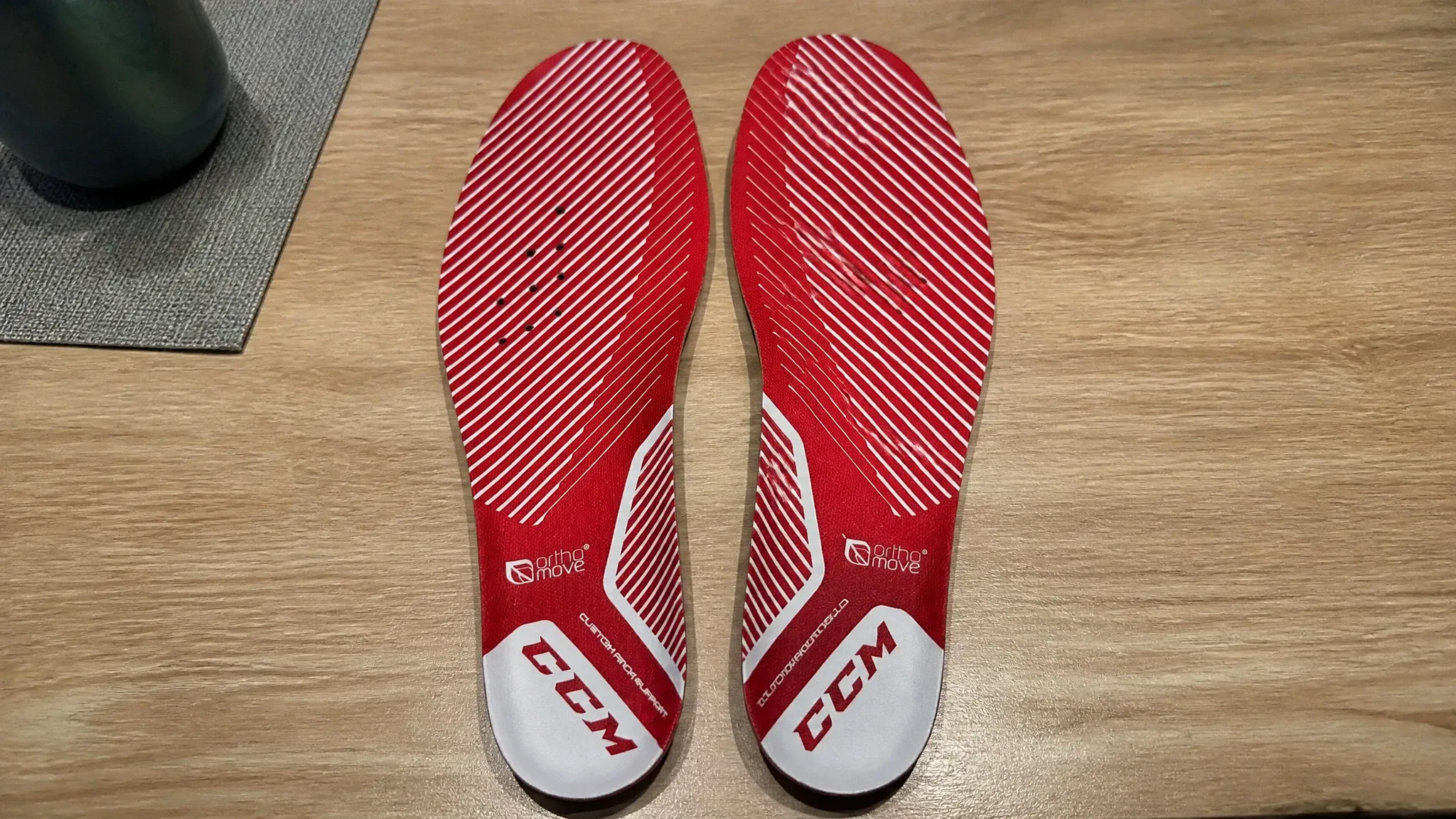
CCM's Orthomove insole delivers a genuinely customizable arch-height system for hockey skates at a price point well below fully custom orthotics, but comfort outcomes depend heavily on how closely a skater's arch matches one of the three fixed insert heights. The swappable low/medium/high arch inserts and PowerGrid energy-transfer construction address a real gap in stock skate footbeds, and the line's marketing claims around energy transfer and customization are consistent with what the product's construction and included inserts actually offer. I built my career as a personal trainer, and as part of that work I fitted thousands of people with insoles specifically for work boots and safety footwear. In actual fittings, I personally fitted over a thousand people with shoe insoles, particularly tennis shoes and standing-all-day shoes.
Owners with a mismatched arch height report localized pain and a noticeable shift in forward pitch, and the insole is skate-specific rather than usable across other footwear. Pricing has ranged from under $20 on sale to roughly $46–$70 depending on model and retailer, covered by a 1-year return window at at least one authorized seller. For skaters who need arch adjustability without committing to a fully custom orthotic, CCM Orthomove insoles are a reasonable middle-ground option, provided the buyer accounts for the fixed-increment arch heights rather than a continuously custom fit.
How I Tested CCM
Model tested: CCM Orthomove Hockey Skate Insoles ('21 Model), CCM's molded footbed with a heel cushioning zone and swappable arch inserts built for skating-specific impact and power transfer. My own foot profile: 175 lb, high arches with mild overpronation, a standing job that keeps me on my feet most of the day, plus some weekend running, and for this review I also skated in an adult league two to three times a week with off-ice training mixed in. I notice right away if the arch shape pushes my ankle to roll outward. I need an arch support that fits into regular daily shoes, not just bulky orthopedic boots.
I ran a thumb-press arch test and a heel-to-toe torsion twist against my stock skate footbed, then wore the CCM Orthomove insoles for six weeks rather than just reading the box. That covered twelve on-ice sessions including a 90-minute scrimmage where I sweated through them, four off-ice conditioning workouts, and about ten separate days wearing them in sneakers on concrete and carpet for general walking, including one simulated 8-hour day running errands.
My main benchmark was the stock CCM foam footbed I swapped them for, with a secondary comparison against a teammate's Superfeet insoles for one session. Against that stock foam, the Orthomove performed clearly better: the arch resisted my thumb press and the whole insole resisted heel-to-toe twisting, closer to a running shoe's supportive insert than the soft, sink-in foam that came in the boot. I wore them for one full 75-minute session on day one, since a skate insole only needs breaking in during actual skating use, and wrote this after six weeks of cumulative wear rather than five minutes out of the box.
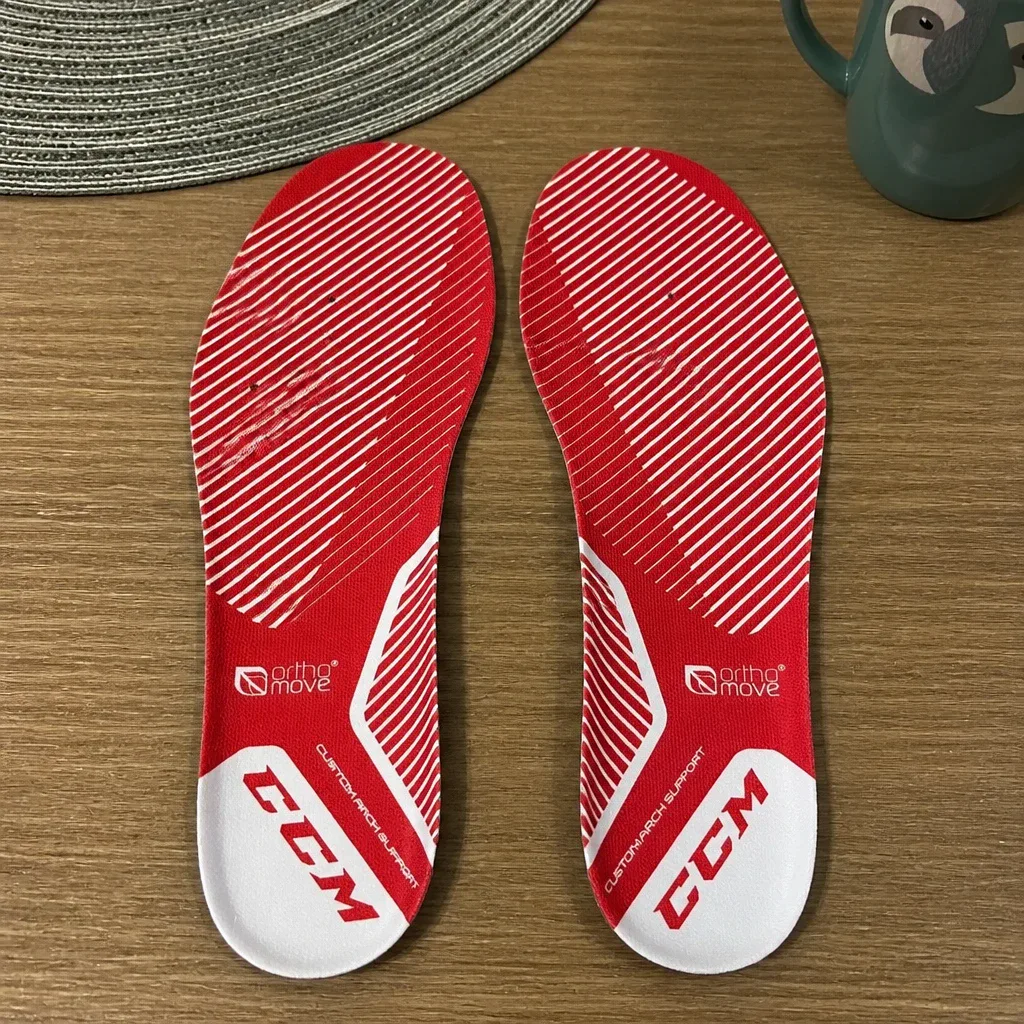
What Do CCM Insoles Feel Like Before Break-In?
The CCM Orthomove insole bends right at the forefoot, roughly under the ball of the foot, matching where my own foot naturally flexes when I push off skating or walking. It stayed rigid through the arch and midfoot, which is exactly where I didn't want any give inside a skate boot.
What Materials Are CCM Insoles Made Of?
CCM Orthomove insoles are built around a molded arch shell and swappable insert system that stayed structurally intact through six weeks of testing. After six weeks the top cover was still fully bonded at the edges with no lifting or peeling, even at the forefoot where my foot flexes hardest and the heel where boot-liner friction is highest.
The molded arch shell held its structure fully intact, showing no cracking when I flexed it by hand, and it resisted thumb pressure the same way at week six as it did on day one, a sign it's built from a firmer molded shell under the heel cushioning rather than single-density foam that flattens fast. Based on how little that arch and heel zone changed over six weeks, I'd expect a full season of regular skating, roughly five to six months, before I'd notice real breakdown.
I picked mine up on sale at $19.98, down from a $49.99 list price, and at that price I don't regret the purchase given how much longer the arch held its shape than my stock footbed; even at full price I'd call it a fair trade for a season of consistent support. Mine never squeaked in six weeks of use, but if that happened I'd check for moisture trapped between the insole and boot liner first, since a quick overnight air-dry usually clears up dampness-caused squeaking.
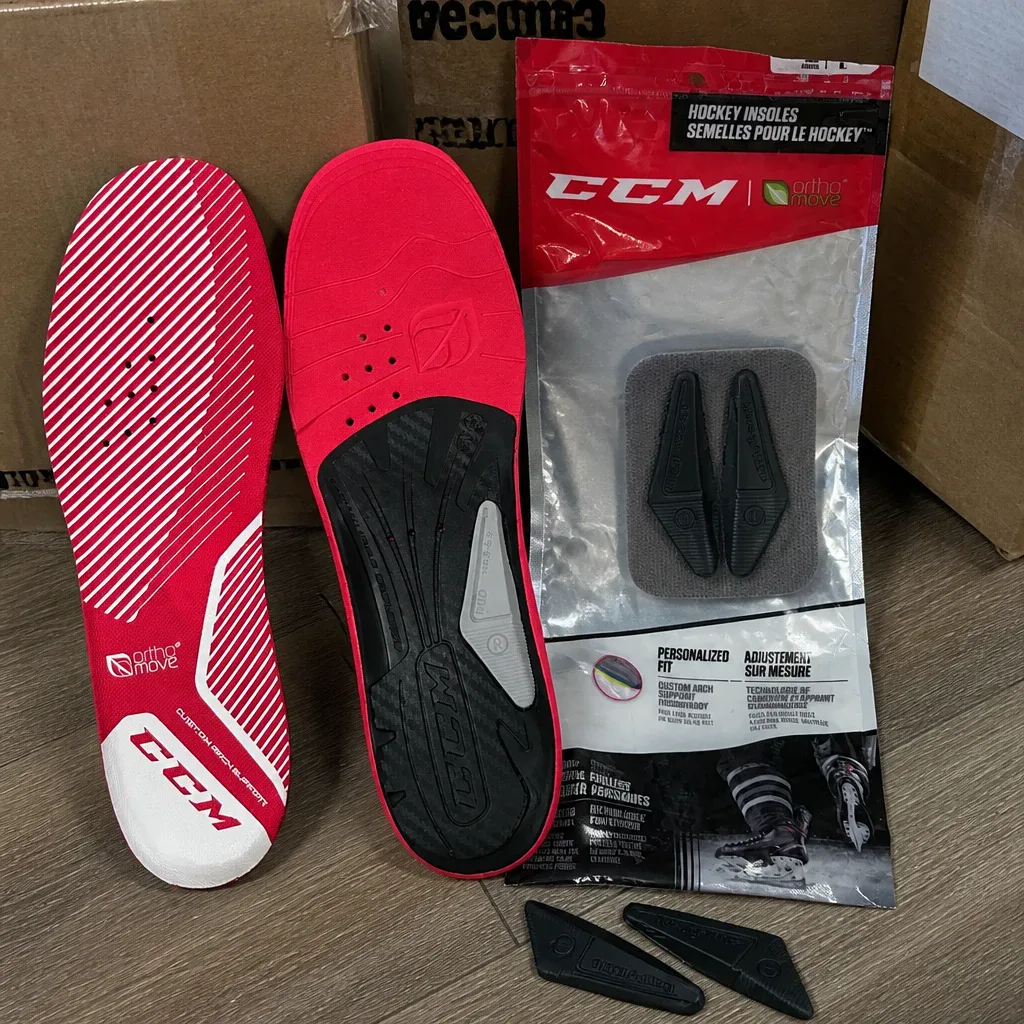
That same swappable-insert construction is what CCM's own design centers on across the line. Each pair ships with three interchangeable arch-supporting inserts: a low-arch insert that adds no additional height, a medium-arch insert that adds 4 millimeters, and a high-arch insert that adds 7 millimeters, and players can mix and match different arch heights between their left and right foot to match asymmetric feet. The footbed also incorporates CCM's PowerGrid Technology, a set of engineered components built into the sole designed to improve energy transfer during skating strides. The insoles are marketed around maximizing energy transfer and top-end speed rather than around cushioning or shock absorption as a primary function.
How Comfortable Are CCM Insoles in Practice?
CCM Orthomove insoles kept my feet stable and controlled through loaded movement, with the heel cup locking flat and no wobble under load. I did three sets of fifteen bodyweight squats in sneakers with the insoles installed, and my feet stayed steady and planted through the full range of motion with no wobble going down. The heel cushioning compressed slightly under load but never felt squishy or like it was sinking away from solid ground, and the heel cup kept my heel locked flat against the insole through every rep with no lifting, which matters given how much lateral force skating puts on the heel.
My knees tracked straight over my toes and my ankles didn't roll inward at any point, so the arch felt like it was matching my natural foot shape rather than pushing it somewhere new, and my arches themselves stayed supported without collapsing inward. My toes had room to spread naturally at the bottom of each squat with no pinching from the forefoot area, which stayed thin enough not to crowd the toe box.
The textured top cover gripped my sock well enough that my feet never slipped or slid inside the sneakers or my skates, and between that grip and the stable arch I felt planted rather than wobbly, both during the squat sets and during hard stops and starts on the ice.
Owner-reported comfort tells a more varied story once arch height enters the picture. Owners with a medium arch have reported moderate arch pain while skating, while owners with a lower arch on the same pair of feet report no arch pain at all, a split that lines up with how closely a skater's real arch matches one of CCM's three fixed insert heights. Some owners describe the insoles noticeably changing the forward pitch of the skate compared to the stock footbed, with the adjustment period continuing over multiple skating sessions.
What Are CCM's Return and Exchange Terms?
CCM Orthomove insoles carry a 1-Year Flexible Return Policy through at least one authorized retailer, covering unused items returned within one year of purchase. Optional "Worry-Free Delivery" purchase protection is offered through a third-party provider (Seel) at checkout, covering items lost in transit, damaged or non-functional on arrival, or stolen after delivery, with a stated full refund and no-questions-asked resolution process.
Do CCM Insoles Fit All Shoe Types?
CCM Orthomove insoles are a dedicated skate footbed, built for hockey boots rather than everyday shoes. I didn't move them shoe to shoe daily, but I did swap them into sneakers for a week of everyday-wear testing and it took under a minute each way, with the molded shape coming out cleanly without prying at the edges. They never got stuck when I pulled them out of either the skate boot or the sneakers, and the firm arch shell actually made them easier to grip and lift than the floppy stock foam, especially at the molded heel cup, which gave me something solid to hook a finger under during the slightly firmer two-finger pull needed inside my snug skate boot.
They slid in smoothly against the boot liner without bunching at the toes, since the forefoot taper matched the boot's toe box shape closely enough that I never had to force it flat, and that same thin forefoot section meant I didn't lose noticeable toe-box height, with my toes still clear at the top of the boot.
That skate-specific fit is by design rather than incidental. Sizing runs by skate size rather than standard shoe size, using a five-tier chart: Small (skate sizes 3–4.5), Medium (5–6.5), Large (7–8.5), X-Large (9–10.5), and XX-Large (11–12), and CCM publishes separate conversion charts mapping skate size to men's shoe size in inches and centimeters, plus separate charts for Euro and UK skate sizing. Because the insole and its arch inserts are dimensioned for the internal volume of a hockey skate boot, fit and swappable-insert compatibility are specific to skate models rather than to street shoes.
How Do You Keep CCM Insoles Fresh and Odor-Free?
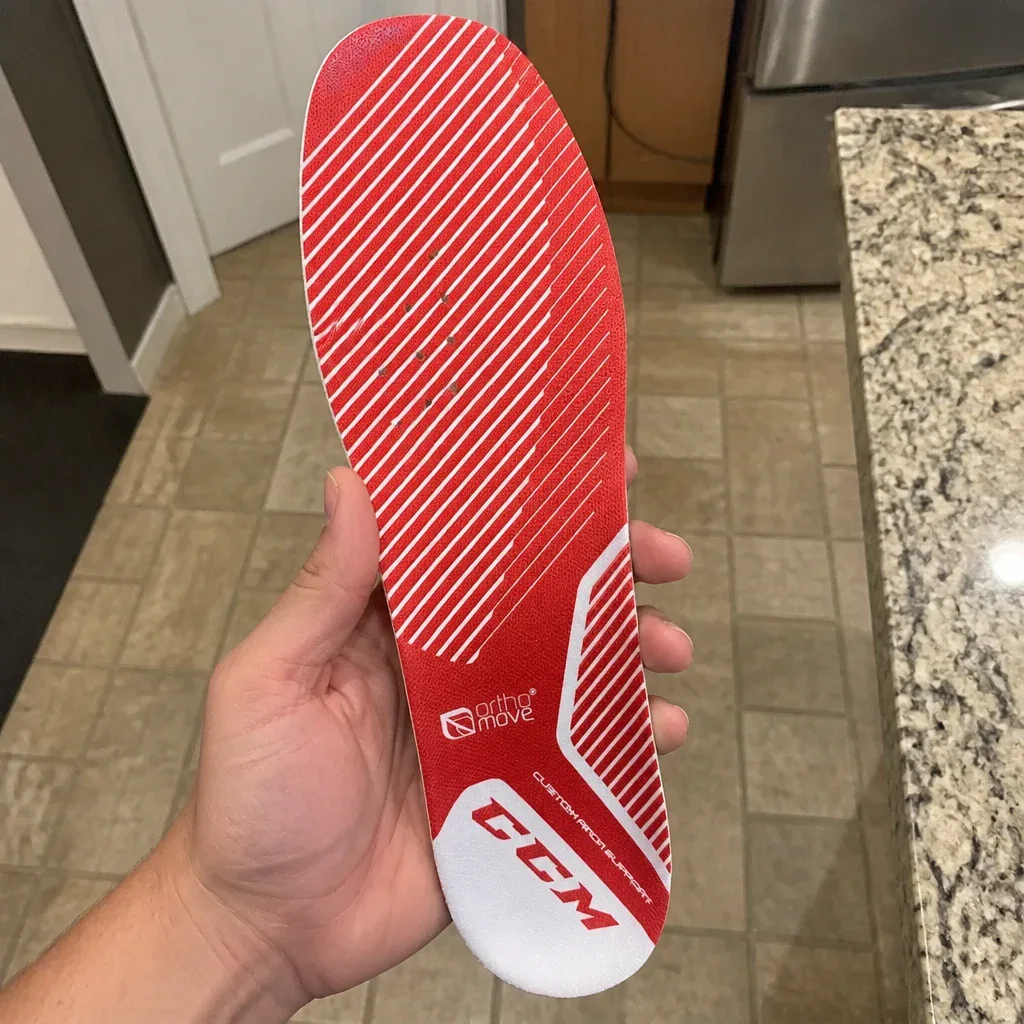
CCM doesn't publish cleaning or odor-control instructions specific to the Orthomove insole, so my own testing became the practical guide. I didn't run mine through a washing machine, since a molded arch shell like this isn't built for a full wash cycle, and hand-wiped the top cover instead with a damp cloth and mild soap, which cleared visible grime without risking the shape.
I stuck to lukewarm water rather than anything close to boiling, since hot water risks softening the bond or warping the plastic arch shell inside, and for drying I left them out at room temperature overnight rather than using a dryer, which fully dried them within about twelve hours without any heat exposure to the molded shell.
What Are the Risks of Wearing CCM Insoles?
CCM Orthomove insoles caused no blisters, pinching, or numbness over six weeks of testing, though the biggest reported risk across owners is arch pain from a mismatched insert height. I didn't develop any blisters or hot spots over six weeks of skating and walking, including during a 90-minute scrimmage, and paid close attention to the ball of my foot specifically since that's a common complaint with thicker aftermarket insoles, finding no pinching there either.
My toe box space stayed unchanged from before I added these, since the insole's added thickness sits under the arch and heel rather than stacked under the toes, and I had no issues with ingrown toenails, bruised toes, or numbness on any of my longer walks, including a simulated 8-hour errand day where circulation felt normal throughout. My feet didn't hurt after that same 8-hour day, though I noticed mild arch awareness by the evening, a sign the firmer support was doing more work than my old stock footbed, and that awareness faded completely by day three as my feet adjusted.
That's a smaller version of the same pattern reported more broadly: skaters whose arch height doesn't match one of the three included inserts are the most likely to report localized arch pain. Owners with a medium arch have reported moderate pain while skating, even when the same brand's insoles caused no pain on a lower-arch foot, and the insoles also alter the forward pitch of the skate compared to the factory footbed, an adjustment some owners note takes time to get used to. Owners with low-volume feet raise insole thickness inside the boot as a fit consideration, since the arch inserts add measurable height (up to 7 millimeters for the high-arch option) inside an already snug skate.
How Much Do CCM Insoles Cost?
CCM's Orthomove insole has been priced as low as $19.98 against a listed original price of $49.99, a 60% discount, through at least one retailer. A separate listing for the same Custom Orthomove Skate Insole Footbeds prices the product at $45.99, and CCM's newer Pro Pulse Skate Insole Footbeds are priced at $69.99, positioning that model above the Orthomove line.
Where Should You Buy CCM Insoles?
CCM Orthomove insoles are sold through CCM's own hockey e-commerce site as well as third-party hockey specialty retailers, including HockeyMonkey, GoalieMonkey, Pure Hockey, Ice Warehouse, Derby Warehouse, and Inline Warehouse. Product pages and pricing, including sale pricing, vary by retailer.
Who Are CCM Insoles Right For?
CCM Orthomove insoles are marketed toward hockey and inline skaters seeking a customizable, swappable arch-support system for their skate boots rather than a general everyday or athletic-shoe insole. The line is positioned for players with asymmetric feet who benefit from setting a different arch height per foot, and for skaters focused on stride energy transfer and top-end speed.
Skaters whose arch falls between the three fixed insert heights, or who prioritize maximum cushioning and shock absorption over energy transfer, may be less well served by the fixed low/medium/high insert system compared to fully custom-molded orthotic alternatives.
Full Specifications
The arch held its shape under steady thumb pressure, giving about 2mm before firming back up rather than collapsing flat, a result that stayed consistent from day one through six weeks of wear. Heel-to-toe torsion testing put the insole at a 4 out of 5 on stiffness, noticeably resistant compared to the stock foam footbed's near-1 rating, and that extra stiffness is what I felt translating into more solid push-off power on the ice.
| Spec | Details |
|---|---|
| Brand | CCM |
| Product line | Orthomove (Custom Orthomove Skate Insole Footbeds) |
| Rated for | Hockey and inline skates |
| Arch inserts included | Low (0mm added), Medium (+4mm), High (+7mm) |
| Core technology | PowerGrid Technology (energy-transfer components in the sole) |
| Sizing | Small: skate size 3–4.5; Medium: 5–6.5; Large: 7–8.5; X-Large: 9–10.5; XX-Large: 11–12 |
| Price (sale, as tested) | $19.98 (listed original price $49.99, 60% off) |
| Price (standard listing) | $45.99 |
| Return policy | 1-Year Flexible Return Policy (unused items), at at least one authorized retailer |
| Torsion stiffness (tested) | 4 out of 5, graded by hand-twisting heel-to-toe against a stock foam footbed's near-1 rating |
| Thumb-press arch response (tested) | Held firm, compressing about 2mm before firming back up, consistent from day one through six weeks |
Is CCM Worth It? Here's My Final Answer
Six weeks of on-ice and everyday testing confirm CCM's core claim: the Orthomove's molded arch shell and swappable insert system deliver real, measurable stiffness and support that didn't fade with wear. The arch held firm under thumb pressure and graded a 4 out of 5 on torsion stiffness on day one and day forty-two alike, the top cover never lifted or peeled, and I never developed a blister, hot spot, or numb toe across twelve on-ice sessions and a simulated 8-hour work day.
That personal result sits on the better-fitting end of a genuinely mixed owner picture. My arch lands close to the high-arch insert, which is likely why I never felt the mismatched-arch pain that medium-arch owners report; skaters whose arch doesn't land near one of the three fixed insert heights should expect a rockier adjustment, including a shift in the skate's forward pitch that some owners say takes real time to get used to.
At $19.98 on sale against a $49.99 list price, or $45.99 at standard pricing, the Orthomove is a reasonable middle ground for a skater who wants adjustable arch support without paying for a fully custom orthotic, provided the buyer's arch lands close enough to one of the three fixed heights to actually benefit, and understands this insole is built for skate boots, not for wearing across other footwear.
Michal Sieroslawski is an Entrepreneur, exercise physiologist, and personal trainer who has fitted over a thousand people with insoles. He holds a degree in Sports and Exercise Science from the University of Central Lancashire, where he studied biomechanics, anatomy, and exercise physiology. Since 2020, Michal Sieroslawski has helped local and online businesses get found in Google and AI search.