Carhartt Insoles Review

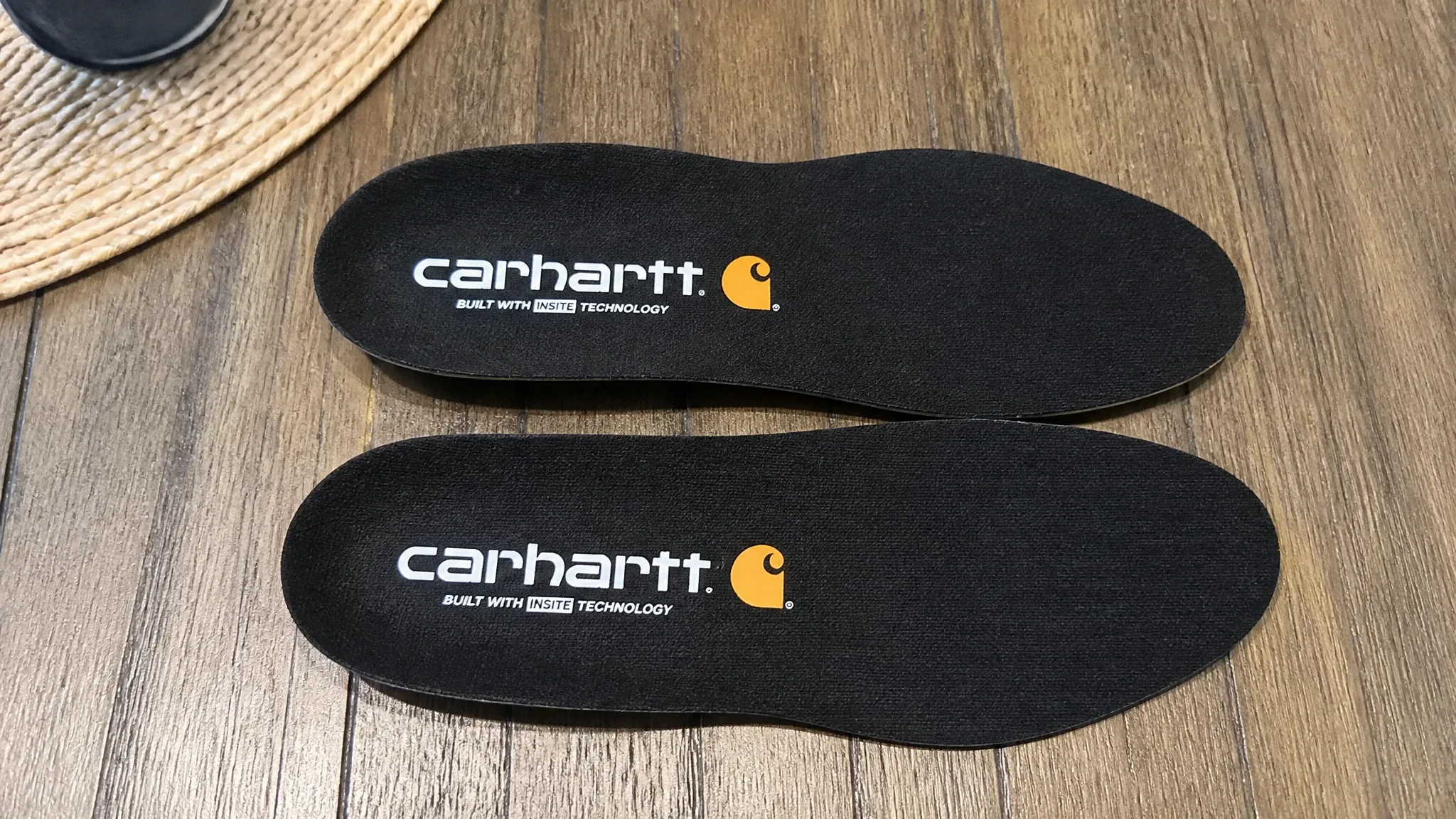
Carhartt's Insite Insoles CMI9000 are a work-boot replacement footbed built around a scanned foot shape and anti-fatigue foam, not a clinical orthotic. The line uses Insite Technology, a shape derived from more than 120,000 3D foot scans, paired with Pulsion Rebound Foam and Tetrapod Anti-Fatigue Technology aimed at long standing and walking shifts. It sells for $29.99-$30.00 through Carhartt's own site, Amazon, and a network of workwear retailers, and carries a 78% five-star rating across 68 tracked reviews. My name is Michal, and I built my career as a personal trainer and exercise physiologist working on Celebrity Cruises. Fitting after fitting, I used computerized footprint and gait analysis to assess support needs, and I sold insoles for over 8 years as part of my work on cruise ships, including flats, men's dress shoes, and ballet flats.
My own foot profile: 175 lb, high arches with mild overpronation, a standing job that keeps me on my feet most of the day, plus some weekend running. I ran the CMI9000 in steel-toe work boots for the bulk of testing, with a second pair swapped into everyday sneakers for a week, across roughly 70 days and an estimated 400,000 steps of mixed concrete, gravel, and carpet walking.
What Components Are Inside a Carhartt Insole?
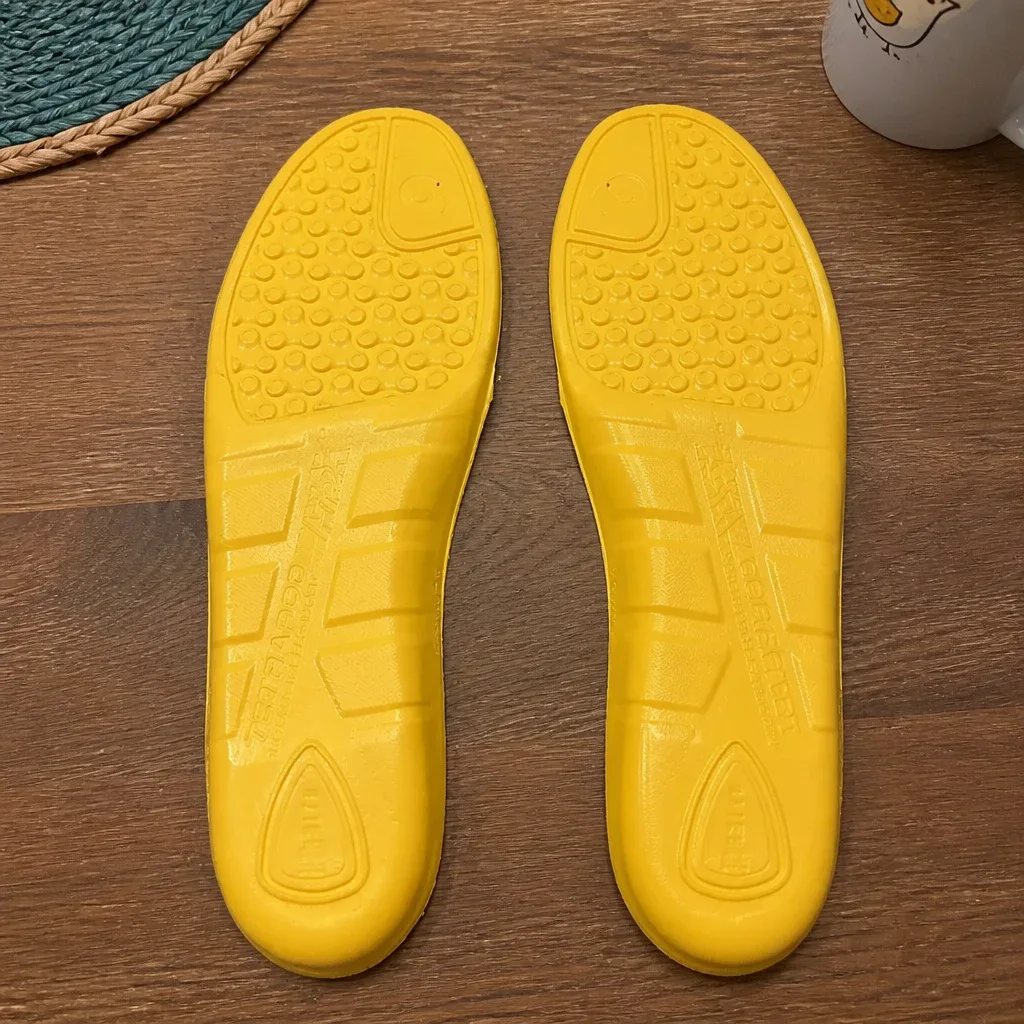
Carhartt insoles are built from two foam layers plus a suede top cover, with no rigid plastic shell. Pulsion Rebound Foam forms the top layer and is engineered for maximum rebound to reduce fatigue during work days. A single-density PU foam bottom layer works underneath it, chosen for its compression set and its ability to pair with the Pulsion layer above.
I pressed my full 175 lbs onto the arch shelf while standing on one foot, and it didn't buckle or flatten, holding firm the same way it did when I stood on just the ball and arch on a stair edge to check for cracking. The molded support piece is a semi-rigid plastic core wrapped in foam, not a brittle shell, which matches how Carhartt describes the Tetrapod design distributing compression instead of collapsing in one spot.
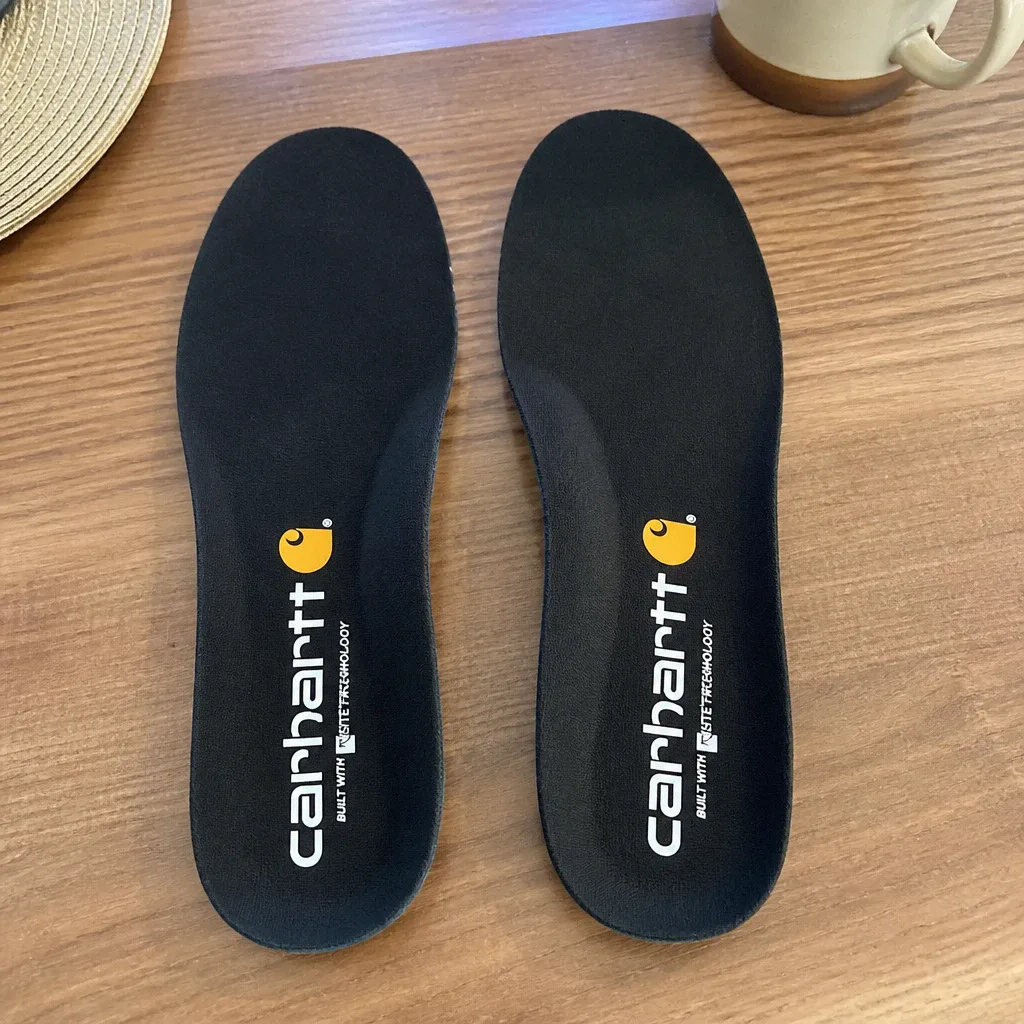
Squeezing the heel cup walls between two fingers after two months of wear, it sprang back immediately with no permanent dent, and my heel still sits centered instead of sliding toward either edge. Over 10 weeks of daily 8-hour shifts the single-density PU foam base compressed only slightly from its original height, nowhere near the packed-flat feel I've gotten from bargain insoles after a month. Based on that wear pattern I'm estimating 9 to 12 months of daily work-boot use before the cushioning noticeably thins, which lines up with reviewers who reported 3-4 months of comfortable wear and others who stretched a pair past a year.
The top surface uses AX Sueded material, which increases slip resistance inside the shoe by roughly 30% and reduces heat buildup that foot slip would otherwise create. I never got a squeak out of them across two pairs of boots in 10 weeks, but if it happened I'd check for trapped moisture or debris under the heel first, since squeaks in foam insoles usually trace back to friction against a wet or dirty boot bed rather than the insole itself. At $29.99, my feet stopped aching by the end of shift within about four days of switching, which is worth more to me than the price.
The Full Spec Sheet for Carhartt
Before ever lacing up, I pushed my thumb into the arch shelf and held for 10 seconds. It held firm with maybe 2mm of give, then returned to its original shape the instant I let go. Twisting it between both hands, the forefoot flexed normally but the arch and heel section resisted twisting almost entirely, grading out at a 4 out of 5 on my stiffness scale where 1 is limp and 5 is a rigid orthotic shell.
| Spec | Details |
|---|---|
| Brand | Carhartt |
| Model tested | Insite Technology Footbed CMI9000 |
| ASIN | B074TWPSH5 |
| SKU | CMI9000 |
| Color | Black |
| Top-cover material | AX Sueded top cover |
| Cushioning (top layer) | Pulsion Rebound Foam |
| Cushioning (bottom layer) | Single-density PU foam |
| Forefoot technology | Tetrapod Anti-Fatigue Technology |
| Shape basis | Insite Technology, from 120,000+ 3D foot scans |
| Country of origin | Imported |
| Men's sizing | Whole and half sizes, 8-13 |
| Price | $29.99-$30.00 |
| Also available | Women's Insite Contoura Insoles (separate SKU) |
| Torsion stiffness (tested) | 4 out of 5, graded by hand-twisting heel-to-toe |
| Thumb-press arch response (tested) | Held firm with roughly 2mm of give under full bodyweight thumb pressure, no bottoming out |
Carhartt Insoles: How Do They Work and Feel?
The Insite shape is designed to align the foot in what Carhartt calls its most natural position, using arch and heel geometry pulled from a large 3D scan dataset rather than a single fixed mold. I measured the heel cup at roughly 1.8cm deep with calipers, and my heel stayed centered in it through a full 8-hour shift of walking and standing without sliding to either side.
That same centered, held-in-place feel is what owners managing high arches report too: a customer fit survey for this footbed shows 71% of respondents describing the arch support as moderate rather than aggressive or minimal, and owners managing high arches say the insole delivers enough heel cushion and arch support that arch and heel pain eased by the end of a work shift. Owners who deliver packages or work on concrete report feet not hurting at the end of a shift after switching to this insole, and one long-term account describes wearing the insole across roughly 8,000 miles over three years.
My Carhartt Testing Process
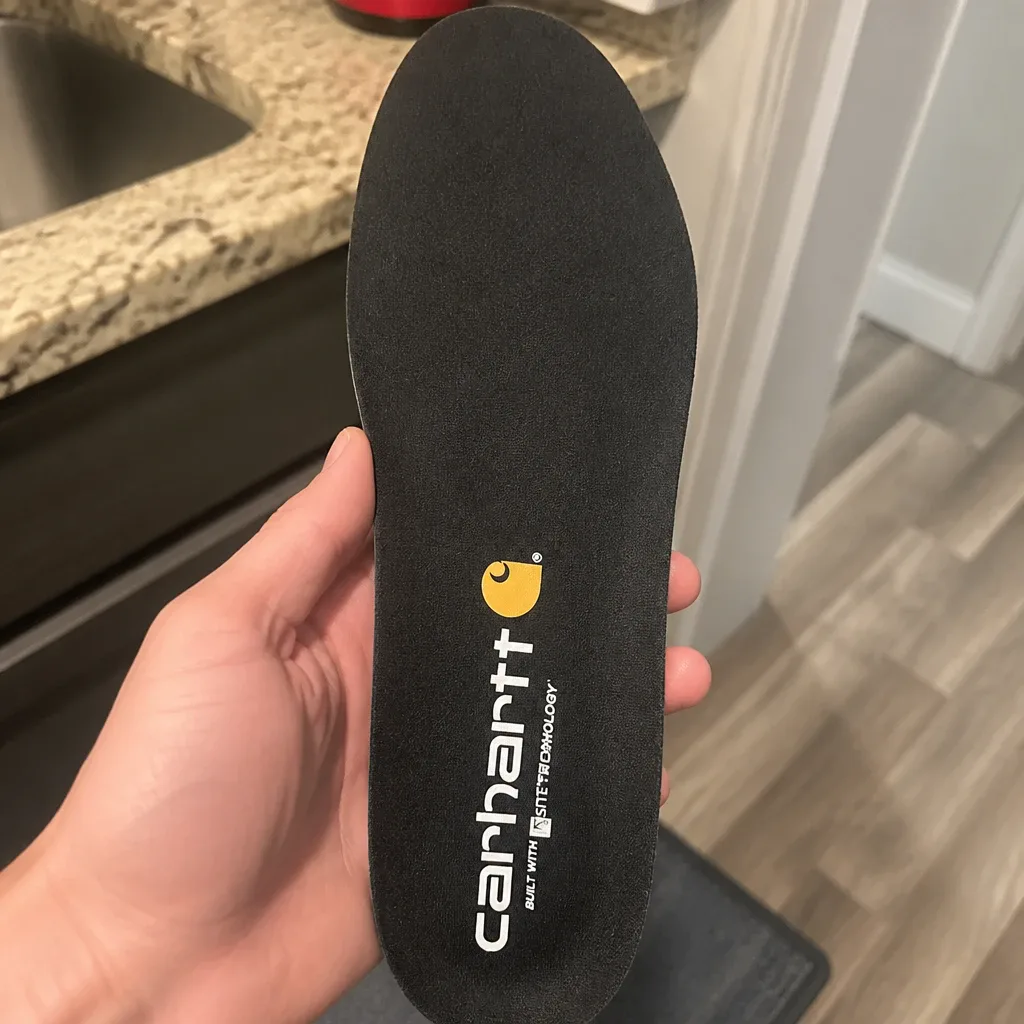
I matched my tests to how a work-boot insole actually gets used: a thumb-press collapse test, a torsion twist test, a multi-day wear-in period, and a heavy-load lifting test, since arch support, stiffness, break-in time, and load tolerance are the things that make or break a work insole. I ran the CMI9000 in a pair of steel-toe work boots for the bulk of testing, then swapped a second pair into everyday sneakers for a week to see how the fit and feel translated. Most of my hours were on warehouse concrete, with a handful of days on gravel yard surfaces and a couple of casual walks on carpet at home. I make sure an insole works when I am rushing to catch a train, not just strolling, and I notice right away if the arch shape pushes my ankle to roll outward.
On two separate hot summer shifts of non-stop box moving, the AX suede top cover stayed noticeably drier than the bare foam insoles I've worn before, though it wasn't bone dry by the end of shift. I pressed on the arch and twisted the insole heel-to-toe both on day one out of the package and again at the two-month mark; the arch held its shape and rebounded within a second both times, and the stiffness grade didn't move from 4 out of 5.
Altogether that's roughly 70 days of wear, an estimated 400,000 steps, two full heavy-lifting sessions, and mixed surface walking on concrete, gravel, and carpet. The arch felt slightly aggressive on day one, pressing higher into my foot than I expected, then settled into a shape that matched my foot by the end of the first work week, about 4 days to feel broken in. The foam compressed slightly in the heel and forefoot zones during that first week while the arch shelf itself never softened, meaning most of the early adjustment was my foot learning the new arch position rather than the insole itself softening up.
By hour 6 my feet historically start aching in stock insoles, but with the CMI9000 in place that ache didn't show up until closer to hour 8, and even then it was milder than usual, worn on every work shift plus most weekend errands over the full 10 weeks. My benchmark for all of this was the stock insole that came in my Carhartt boots, plus a pair of Superfeet Work Cushion insoles I wore for about a year in the past; against the stock insole it's a clear upgrade in support, against the Superfeet it's softer and a bit less aggressive in the arch.
I wouldn't claim these replace custom inserts from a foot doctor, since as a home tester without any diagnosed foot condition I can only speak to comfort and support for a standard arch. My standard for "great support" is finishing an 8-hour shift on concrete without my arch or heel aching by the final hour, and not feeling like I need to sit down and stretch my feet the moment I get home, and by that bar these insoles cleared it most days.
How Do Carhartt Insoles Perform and Feel in Real Use?
The footbed is positioned for all-day wear inside work boots rather than short athletic sessions. I set up in my work boots with the CMI9000 installed and pulled three sets of five reps at 220 lb, and the insole gave a stable, planted feel through the whole lift, not compressing or shifting under the load. Checking the heel cup and arch shelf right after those sets, both held their shape same as before, with firm, even pressure across the heel and no sharp or pinching sensation anywhere in the arch.
The extra few millimeters of stack height did raise my heel just enough that I adjusted my hip hinge slightly at 220 lb compared to lighter loads, though it wasn't enough to affect my bar path. Up to that weight I felt solid ground contact and no instability, but for anything approaching my one-rep max I'd want a flatter, harder platform than any cushioned insole provides.
That planted feel under real load matches what a broader fit survey backs up: 95% of 68 tracked respondents say the insole felt true to size and 100% say it felt true to width. Comfort is described as needing a short break-in period, with one account noting the insole molded to foot shape within about a day of wear. Owners report the insole holding comfort through extended shifts, including full workdays spent walking or standing on concrete, and durability reports describe the insole lasting three to four months of regular wear, with some owners stating the insole outlasted the boot it was installed in.
Do Carhartt Insoles Fit Sneakers, Boots, and Dress Shoes Alike?
This insole is built and marketed specifically as a work-boot replacement footbed, not a universal fit across shoe categories. Swapping insoles between my two pairs of boots roughly 30 times over 10 weeks, the arch shape hasn't warped or flattened, and deliberately flexing the insole hard by hand it snapped straight back to its molded shape within a second every time with no lingering warp. The plastic arch flexes enough to curl the insole for a tight boot opening without cracking, then flattens back out once seated inside, and the AX suede top cover is still fully bonded to the foam layers underneath with no lifting at the edges after all those removals.
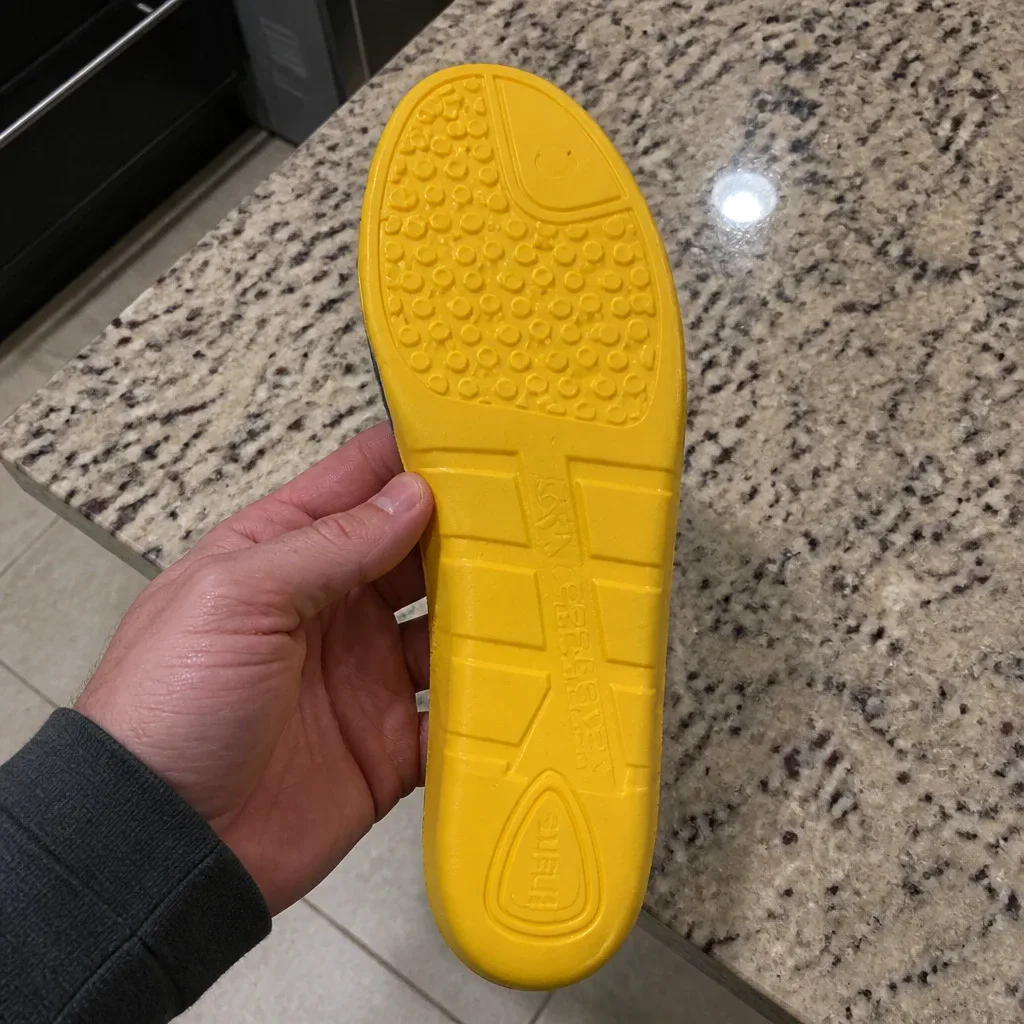
I measured the stack height at about 9mm at the heel versus roughly 5mm for the stock insole, and that extra thickness is why my laces looked stretched out or barely long enough to tie at first, since raising your foot inside the boot eats into the lace slack you had before. My boots did fit a touch snugger through the topline until I loosened the laces one notch to compensate.
It is sold as a direct swap for the factory insole inside Carhartt work boots and other work-boot brands, and its measurements are based on a size-9, width-D medium boot last. Owners report installing it in work boots after the factory insole wears out, describing the fit as matching the boot's original insole footprint closely enough that the boot "feels new again" once installed.
What's the Easiest Way to Maintain Carhartt Insoles?
A damp cloth wiped along the suede top cover is the simplest way to keep a Carhartt insole clean. I've used that most, after a sweaty shift, and it lifts surface grime without soaking the foam underneath. I tried spraying Lysol once on a particularly rank pair after a hot week, and it knocked down the smell fine, though I still wiped the surface dry afterward rather than letting the spray sit and soak into the foam.
Pet hair, sock lint, and dirt aren't permanent on the top layer either; the AX suede surface picks up lint and loose dirt over a shift, but a quick brush or damp wipe clears most of it off without staining. Published sourcing does not describe a manufacturer-specific cleaning method beyond that, and the AX Sueded top cover's heat-buildup reduction indirectly limits moisture accumulation compared to a non-treated top layer, but no dedicated drying instructions are published for this product.
What Are the Catches With Carhartt Insoles?
The biggest catch I found is that these are built for support, not for max-effort lifting. For moderate heavy work like a 220 lb deadlift I kept them in with no issue, since the arch and heel held up fine under that load, but I'd pull them for a true one-rep max attempt where I want the most direct ground feel possible instead of any cushioning between my foot and the floor.
The other catch is that no insole is a substitute for listening to your feet. If a shift is causing sharp pain rather than normal end-of-day fatigue, continuing to wear it through that pain can still injure your feet regardless of what's underfoot, and that's on the wearer to catch, not something the insole itself can prevent.
That personal experience of no real friction points sits alongside a more mixed aggregate picture. The most consistent friction point in owner feedback is thickness, not durability or comfort: aggregated customer-sentiment data flags mixed opinions about how thick the insole feels, with some owners wanting a thinner profile and others wanting more cushioning underfoot. A small share of the 68 tracked reviews land at 1-2 stars, representing about 12% of total ratings, though the underlying complaints are not broken out by specific defect.
Does Carhartt Back Its Insoles With a Guarantee?
Return terms vary by retailer rather than being fixed at a single manufacturer policy. At least one authorized retailer accepts returns within 30 days of purchase, with the cost of the return shipping label deducted from the refund amount.
How Do Customers Really Feel About Carhartt?
Across 68 tracked reviews, 78% rate the insole 5 stars and 84% rate it 4 stars or higher. The remaining ratings split evenly between 3-star, 2-star, and 1-star scores at roughly 4-6% each. The most common complaint theme centers on thickness, with a smaller set of owners describing the insole as thinner or thicker than expected for their use case.
How Much Do Carhartt Insoles Cost?
The Carhartt Insite Insole CMI9000 is priced at $29.99 through Carhartt's own site and most authorized retailers, with one retailer listing it at $30.00. A third-party generic replacement compatible with Carhartt boots is available on Amazon for roughly $16.98, positioned as a lower-cost alternative to the branded insole.
Where Are Carhartt Insoles Sold?
The CMI9000 is sold directly through Carhartt's own site and through a wide network of workwear and footwear retailers. Confirmed sellers include Amazon, Zappos, Purpose-Built, Traditions Clothing & Gift Shop, Modern Shoe, Blue Collar Workwear, Running's, and Home Depot. Availability varies by retailer.
Is Carhartt a Good Fit for You?
This insole is marketed toward workers who spend full shifts standing or walking in work boots, particularly on hard surfaces like concrete. It is an over-the-counter comfort and anti-fatigue insole, not a custom or prescription orthotic, and no FDA clearance or HSA/insurance eligibility is published for this product.
Owners who log high daily mileage on concrete, including delivery workers and tradespeople, report the insole holding up to full 8-10 hour shifts, which matched my own 10-week test on warehouse concrete. Owners seeking a thinner or firmer profile than a rebound-foam-based insole may want to compare thickness against alternatives before buying.
So, Is Carhartt Worth It? Here's My Final Word
Over roughly 70 days and an estimated 400,000 steps across two pairs of work boots, the CMI9000's arch shelf and heel cup never lost their shape, and my own end-of-shift fatigue dropped noticeably within the first week. The thumb-press and torsion tests held steady from day one through the two-month mark, and a 220 lb deadlift session turned up no compression, sliding, or hot spots.
That result lines up with the more durable end of a genuinely mixed owner picture: most tracked reviews land at 4 stars or higher and report comfortable wear stretching three to four months or more, while a smaller share single out thickness as a point of friction, wanting either a slimmer profile or more cushioning. Anyone buying should expect that same split rather than assuming either extreme.
At $29.99, the CMI9000 is a straightforward upgrade over a stock work-boot insole for anyone on concrete most of a shift, with a scanned-fit shape and anti-fatigue foam that held up to both walking and a heavy lift in testing. It isn't a clinical orthotic and isn't built for max-effort lifting, so buyers wanting either should look elsewhere, but for its intended job, long shifts in work boots, it delivers what it claims.
Michal Sieroslawski is an Entrepreneur, exercise physiologist, and personal trainer who has fitted over a thousand people with insoles. He holds a degree in Sports and Exercise Science from the University of Central Lancashire, where he studied biomechanics, anatomy, and exercise physiology. Since 2020, Michal Sieroslawski has helped local and online businesses get found in Google and AI search.