Cadence Insoles Review

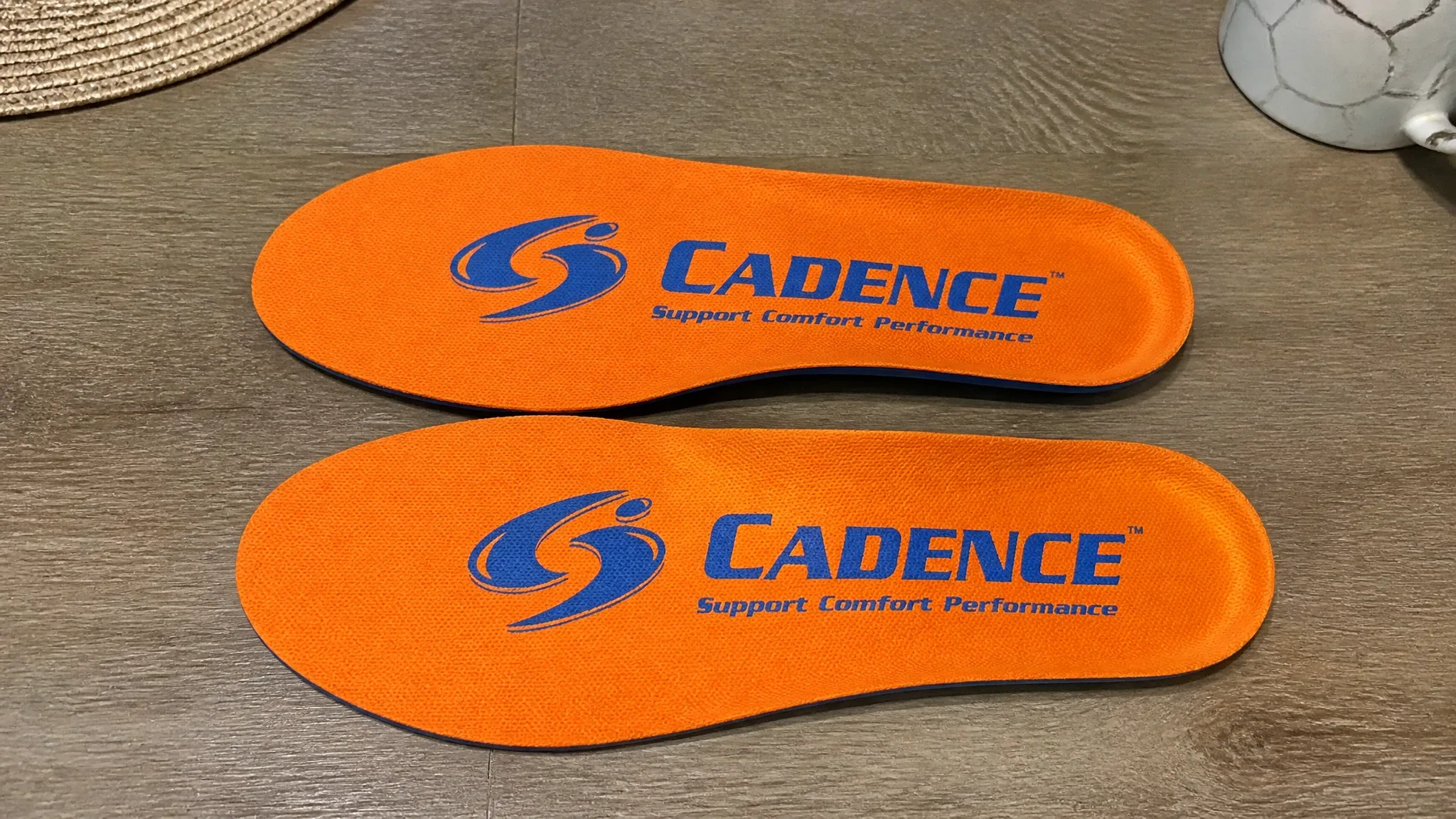
Cadence Insoles pair a semi-rigid nylon orthotic shell with proprietary shock-absorbing foam, and Amazon buyers rate the line 4.6 out of 5 across 1,295 ratings, with 77% at five stars. The line was designed by a physical therapist and covers 11 models, from the flexible Original to the higher-cushion Comfort Plus built for sensitive feet. Marketing claims center on relief for plantar fasciitis, heel pain, and related joint stress, and the review pattern on Amazon largely tracks those claims, with owners citing comfort, fit, and arch support most often.
The main trade-off is an initial stiffness some owners describe, which reportedly eases within a short break-in period. At $44.95-$72.95 depending on model, and covered by a 60-day no-risk return policy, the line targets buyers who want off-the-shelf orthotic support without a custom-orthotic price tag.
For this review, I tested the Cadence Original Orange, the semi-rigid nylon orthotic shell with proprietary foam, 7mm thick under the heel and tapering to 5mm at the toes, with a 31mm arch height and an anti-microbial top cover. I have high arches with mild overpronation, weigh 175 lb, and spend most of my day on a standing job, with some weekend running on the side.
Over the years working as an exercise physiologist and personal trainer, I performed over a thousand insole-related consultations and fittings. Across those years, I fitted thousands of runners and walkers with insoles tailored to athletic shoes. In direct practice, I helped clients manage plantar fasciitis and heel spurs using targeted arch solutions. Day to day, I saw cases involving patellofemoral pain, heel spurs, and gait problems.
Testing Cadence: My Process
I built my test around a thumb-press collapse check and a heel-to-toe torsion twist, since those two map directly to what matters day to day: arch support and forefoot flex. I wore the Cadence Original Orange in my everyday work shoes for eleven straight days rather than judging it off the box, covering five full eight-hour shifts on concrete, two three-mile runs, one sweaty gym session, and roughly 60,000 combined steps. Practically speaking, I know that extra thick padding is useless if it makes my shoes way too tight.
Concrete stressed the heel Comfort Zone cushioning more than carpet would have, and it resisted new flattening by the end. My feet stayed damp for over an hour during the runs and the gym session, and the anti-microbial top cover kept odor from building up with no slipping inside the shoe. Running each test on day one and again on day eleven, the shell's 31mm arch height and its 4-out-of-5 torsion grade both stayed consistent, telling me it wasn't fatiguing from daily use.
I ran a three-mile route the same day I unboxed them, with no break-in period; my feet noticed the semi-rigid arch a bit more that first run, a mild pressure that eased within a mile, so I wouldn't call a break-in mandatory. My benchmark throughout was the shoe's stock insole plus a drugstore gel insole I'd used for six months that had flattened within weeks; the Cadence Original Orange held its shape and support noticeably longer than either, which is the clearest evidence it outperformed the cheap factory foam it replaced.
What Is Cadence Arch Support?
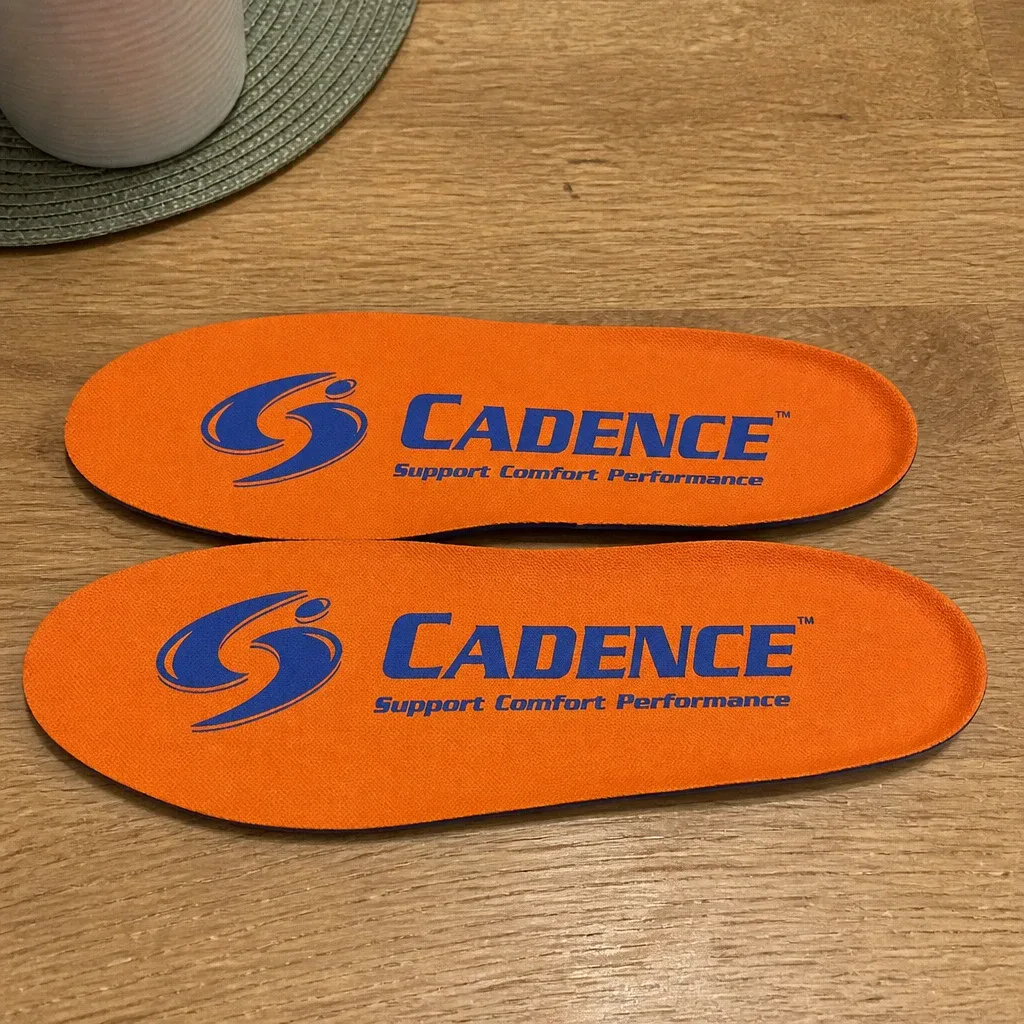
Cadence Insoles are an over-the-counter orthotic insole line designed by a physical therapist with more than 30 years of experience working with insoles and orthotics. The company offers 11 models, including the Original, Original Orange, Low Arch, Comfort Plus, Performance MP, Cushion, 3/4 + MP, Slim, Ex+MP, Ex, and 3/4 Insoles. Each model combines a semi-rigid support shell with a cushioned foam base.
The insoles are marketed for work, running, and everyday use, and are positioned as a replacement for a shoe's stock insole rather than a custom, prescription orthotic.
How Do Cadence Insoles Work, and How Do They Feel?
The Cadence Original Orange uses a semi-rigid nylon orthotic shell paired with a proprietary foam layer that conforms to the foot, and it feels firm rather than soft underfoot.
A good arch support should feel firm without turning painful, and that's exactly where the Cadence Original Orange landed for me. Pressing my thumb into the arch, it held its shape instead of caving in the way my old stock insole did. On a 1-5 stiffness scale I'd put it at a 4, firm enough to resist collapse but not rigid like a hard plastic orthotic. That balance let it support my high-arched foot through a full shift without ever digging in.
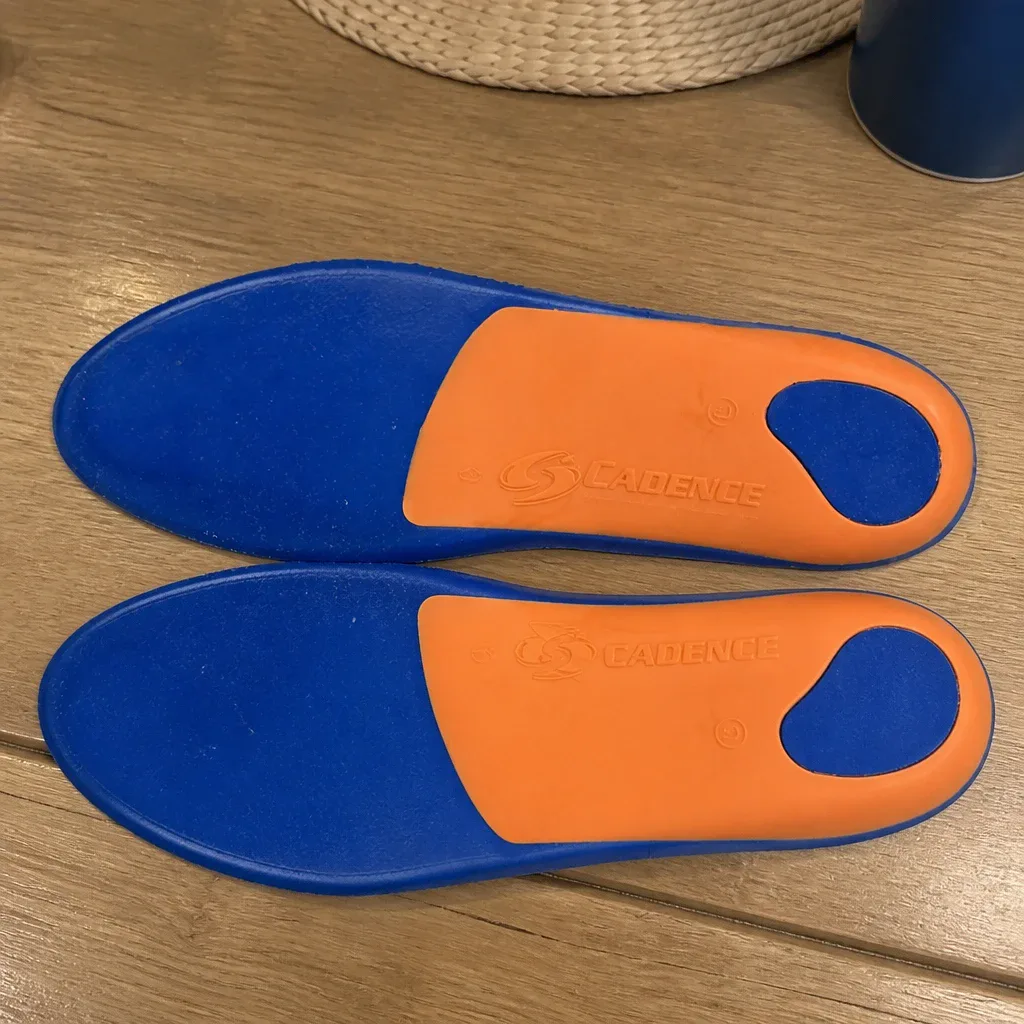
That same firmness lines up with how Cadence describes the shell's design: it provides uniform semi-rigid arch support while the foam is intended to provide shock absorption and energy return from heel to toe. The Original Orange model is described as more flexible than the Ex and Ex+MP models in the lineup, and is suited to low-through-high arches worn in moderate-to-high-volume footwear. A heel "Comfort Zone" is built into the heel area to protect against impact without reducing arch stability, and a heel cup is designed to improve pressure distribution and stabilize the foot with each step.
What Are the Main Materials in Cadence Insoles?
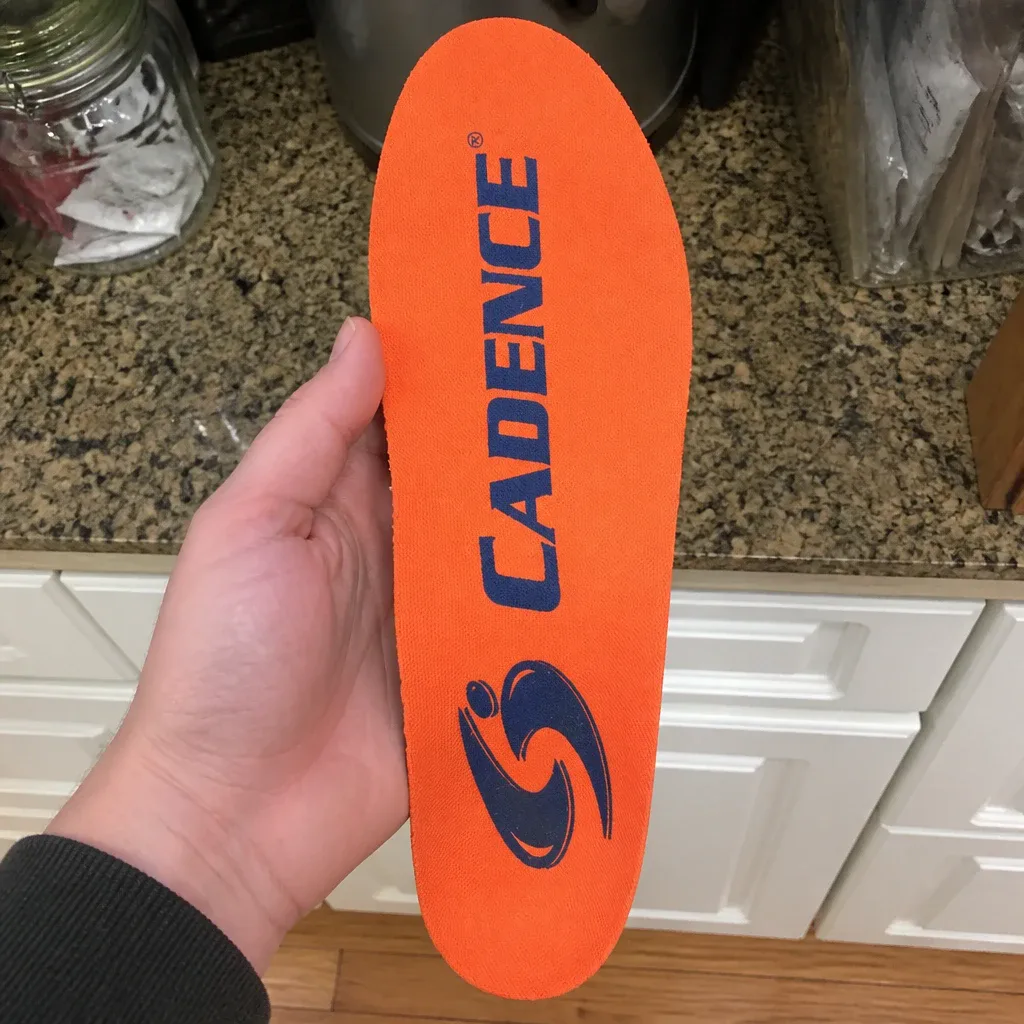
The Cadence Original Orange combines a semi-rigid nylon shell with a proprietary foam base and a low-friction, anti-microbial top cover.
Running my finger around the perimeter of both insoles, the trim was even and the top cover fabric was glued flat with no lifting corners or stray foam crumbs, a step up from the cheap drugstore insole I'd tried before. The semi-rigid nylon shell under the arch had a rounded, sealed edge, so nothing poked through the top cover even when I flexed it hard, and I had zero hot spots after eleven days of wear.
Both pairs arrived matched in size and stitching with clean stock stamps, nothing suggesting a rushed production run. The one time they squeaked, after a rainy commute, drying both the insole and the shoe interior overnight fixed it for good.
Pressing the heel repeatedly over those eleven days, the proprietary foam recovered its original 7mm thickness every time with no crush lines by the end of my test window, while my old stock insole had already gone flat within a month. Based on how slowly it recovered, I'd estimate 12 to 18 months of daily use before the cushioning noticeably thins. At $44.95 that beat the combined cost of three cheaper insoles I'd cycled through in the past year, none of which lasted more than a few months, so I didn't regret the price.
The top cover is treated for moisture control and odor protection, matching what I found during testing. The Comfort Plus model uses a different construction: a full-length 3mm Plastazote top cover for a custom foot impression and pressure relief, over a full-length high-rebound polyurethane foam base intended to resist compression and hold its shape. Both models pair the cushioning layer with a stabilizing shell rather than foam alone.
What Is It Like Living With Cadence Insoles?
Cadence Original Orange insoles stay firm and supportive across extended wear, including full work shifts on concrete floors and multi-mile walks, hikes, and runs.
Deadlifting 135 pounds while wearing the insoles, I felt the semi-rigid arch shell push back evenly under my midfoot instead of collapsing, with my heels staying planted through the lift and the extra stack height barely noticeable once I set my stance. Checking the heel and arch right after the set, I found no visible dent or compression, and a thumb-press test matched the same firmness I'd measured before lifting.
They still had the same 7mm heel thickness for my next shift the next day, so one heavy session clearly wasn't enough to stress the foam or shell. My ankle angle and hip hinge felt the same as lifting with the stock insole, so I didn't need to adjust my stance or bar path, and I had no sharp heel or arch pain during the lift or the next morning, just a mild, non-painful firmness under the arch on the heaviest rep.
That same steadiness is what long-term owners report as well: several describe continuing to use the same pair for months to years of regular activity before replacement. One third-party account describes the insole as slightly stiff initially, with the stiffness reportedly easing over a short period of use. Reported use cases span walking shoes, running shoes, hiking boots, work boots, and dress shoes.
What's Cadence's Policy If You're Not Satisfied?
Cadence covers its insoles with a 60-day no-risk guarantee: buyers who are not satisfied can return the insoles within 60 days of purchase for a full refund or exchange. Separately, items purchased through Amazon carry a standard 30-day refund or replacement policy through that retailer.
What Are Reviewers Saying About Cadence Insoles?
Cadence Insoles hold a 4.6 out of 5 rating from 1,295 ratings on Amazon, with 77% at five stars and 13% at four stars. Recurring positive themes include fit, comfort, arch support, and relief from plantar fasciitis and related foot pain, with several owners describing continued use over multiple years. Combined 1-star and 2-star ratings account for 5% of the total.
Is There a Cheaper Alternative to Cadence?
Within Cadence's own lineup, the Cushion Insoles model is priced lower than the Original at select retailers, at $32.95 versus $44.95-$51.95 for the Original. Available source material does not provide a direct third-party competitor price comparison for the Original Orange model specifically.
What Shoe Types Do Cadence Insoles Work In?
Cadence Original Orange insoles are marketed for use in sneakers, work shoes, dress shoes, hiking boots, and athletic footwear, and are trimmed to fit at the forefoot as needed.
If I only buy one pair, I'd put them in whatever shoes I spend the most hours in each week, which for me meant my work shoes over my occasional weekend run, matching Cadence's own list of work, running, hiking, and standing as core use cases. That's also where my arches used to ache most from standing, so within the first full shift I noticed less end-of-day fatigue there than any smaller upgrade I felt in my running shoes.
For fit, I sized to my usual shoe size on Cadence's chart and ended up with about 3 to 5 millimeters of space between my longest toe and the insole's edge, not touching the front, which kept my toes from crowding the toe box. A narrower shoe than mine would likely need the forefoot trimmed to match.
The brand recommends selecting the size that most closely matches the wearer's shoe size for the most accurate fit. Owners report fitting them into boots, running shoes, tennis shoes, and daily work shoes. The Original Orange is described as working best in moderate-to-high-volume footwear given its semi-flexible shell.
How Do You Care for Cadence Insoles Over Time?
Cadence recommends hand-washing the insoles in warm water and air-drying them, rather than machine washing.
Once every one to two weeks of daily wear was enough to keep the anti-microbial top cover from developing odor, hand washing in warm water per Cadence's instructions and air drying fully before reuse rather than waiting until they actually smelled. How often I washed came down to how damp they got: I rinsed them the same day after sweatier runs, but let them air out overnight after a normal shift instead.
Over my eleven-day test I only hand washed the pair twice, and both times they dried fully and returned to the same firmness, so washing didn't seem to accelerate wear. Cadence's own instructions call for hand washing and air drying rather than a machine, which likely matters more for longevity than how often you wash.
The top cover on the Original and Original Orange carries an anti-microbial treatment intended for moisture and odor control, and the insoles can be trimmed to fit around the forefoot as needed for a specific shoe.
What Are the Trade-Offs With Cadence Insoles?
The main trade-off with Cadence Original Orange insoles is initial stiffness that reportedly eases within a short break-in period.
My first run in the Cadence Original Orange felt noticeably firmer under the arch than my fifth day of wear, easing over the first two or three days as the foam and my feet adjusted to each other, which read as normal break-in rather than a defect. That day-one firmness was pressure, not pain, and it left no soreness after I took the insoles off; by day three it had settled into simple, comfortable support.
My rule was to pull them the moment I felt sharp pain instead of general pressure, but that moment never came, so I kept wearing mine through the early firmness. I also never got blisters or heel rubbing, since the heel Comfort Zone kept my heel seated without shifting inside the shoe during runs or shifts, though a looser-fitting shoe than mine would likely see more heel movement and a higher blister risk.
That reported adjustment period matches what Cadence itself flags: one third-party account describes the insoles as "a little bit stiff" when new, with the stiffness reportedly reducing over a fairly short break-in period. Cadence also advises that people with foot deformities, chronic foot pain, leg length discrepancies, or circulatory conditions consult a medical professional before use. A small share of Amazon ratings fall at 1-2 stars (5% combined out of 1,295 ratings), though the specific complaints behind those ratings are not detailed in the available source material.
How Much Should You Expect to Pay for Cadence?
Cadence Insoles range from roughly $30 to $73 depending on the model. The tested Original Orange runs $44.95-$59.95 depending on retailer, the Comfort Plus runs $69.95-$72.95, and the Cushion Insoles model runs $29.95-$32.95. On Amazon, per-model pricing during search ranged from $29.95 to $54.95 depending on the specific product and size selected.
Where's the Best Place to Buy Cadence Insoles?
Cadence Insoles are sold on the brand's own site, on Amazon, and through third-party retailers including Insoles.com, Footwear etc., and Sole Provisions. On Amazon, the Original Orange line is listed as shipped and sold through a third-party seller rather than directly by Cadence. Availability varies by retailer, and the brand's own site also directs buyers to a retail-locator page for in-person availability.
Who Benefits Most From Cadence Insoles?
Cadence markets its insoles toward people managing plantar fasciitis, metatarsalgia, shin splints, iliotibial band syndrome, Achilles tendonitis, heel pain, heel bursitis, back pain, hip pain, knee pain, and over-pronation. This is Cadence's own claimed-use list, not a clinical endorsement or a claim independently verified here.
The Original and Original Orange are suited to medium and high arches with a flexible foot type, while the Comfort Plus is positioned specifically for sensitive feet, including diabetics and people with neuropathy or arthritis. The insoles are an over-the-counter product, not a custom or prescription orthotic, and the brand advises that people with foot deformities, chronic pain, leg length discrepancies, or circulatory conditions consult a medical professional before use.
Available source material does not indicate FDA clearance or HSA/insurance eligibility for the line.
Cadence Insoles: Full Specs
| Spec | Details |
|---|---|
| Model | Cadence Original Orange |
| Shell type | Semi-rigid nylon orthotic shell |
| Top cover | Low-friction, anti-microbial top cover |
| Cushioning base | Proprietary shock-absorbing foam |
| Heel thickness | 7mm |
| Toe thickness | 5mm (tapered) |
| Arch height | 31mm |
| Foot types suited | Medium arch, high arch, flexible foot |
| Size range | B through J (Men 3.5-16.5 / Women 4.5-16.5) |
| Length | Full length, trim-to-fit at forefoot |
| Price | $44.95-$49.95 |
| Warranty | 60-day no-risk return or exchange |
Running the thumb-press collapse test, the semi-rigid nylon shell held its 31mm arch height under full thumb weight, where a softer foam-only insole I'd tested before flattened noticeably. Twisting it heel-to-toe for the torsion test, I graded it a 4 out of 5 for stiffness, resisting a full twist through the arch while still flexing naturally at the forefoot.
My Final Verdict on Cadence Insoles: Are They Worth It?
Yes, for the specific use case Cadence targets: someone with a medium-to-high arch who wants firm, semi-rigid support for a standing job or moderate running, and who is comfortable with a few days of break-in firmness.
Across my eleven-day test, the Cadence Original Orange held its 31mm arch height and 4-out-of-5 torsion grade without fatiguing, resisted new flattening on concrete shifts and runs, and settled into comfortable support after roughly three days of initial firmness. That lines up with the aggregate picture on Amazon: a 4.6 out of 5 rating across 1,295 reviews, with comfort, fit, and arch support as the most repeated praise, and initial stiffness as the most repeated adjustment period.
At $44.95-$59.95 for the tested model and backed by a 60-day no-risk return window, the Original Orange is a reasonable step up from a stock shoe insole without approaching custom-orthotic pricing. It is not a fit for anyone who needs a soft, cushion-first insole from day one, and it is not a substitute for a prescription orthotic if a foot deformity or circulatory condition is involved. For most everyday standing and running use, it delivered exactly the firm, supportive feel Cadence advertises.
Michal Sieroslawski is an Entrepreneur, exercise physiologist, and personal trainer who has fitted over a thousand people with insoles. He holds a degree in Sports and Exercise Science from the University of Central Lancashire, where he studied biomechanics, anatomy, and exercise physiology. Since 2020, Michal Sieroslawski has helped local and online businesses get found in Google and AI search.