Bauer Insoles Review

My name is Michal, and I spent 8-plus years working as an exercise physiologist and personal trainer at Canyon Ranch. In that line of work, I fitted insoles to reduce pressure points for individuals managing diabetic foot concerns and neuropathy, most often zero-drop shoes, orthopedic shoes, or diabetic shoes. In actual fittings, I fitted insoles for low-volume dress shoes, flats, and high heels. Specifically, I fitted people from more than 70 countries with insoles over 8 years.
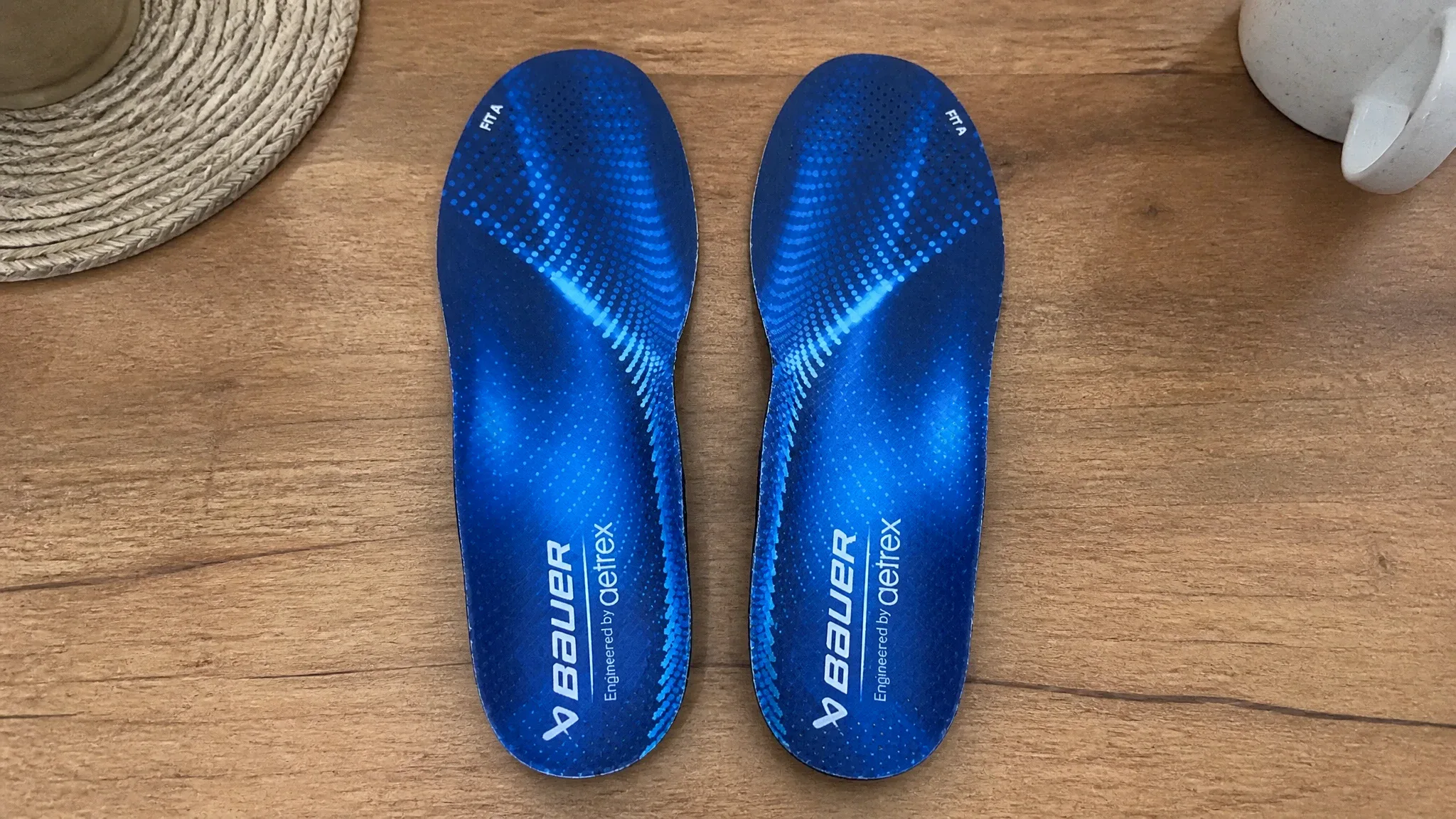
Bauer Aetrex Skate Orthotics are a fit-scanned, hockey-specific insole line offered in three arch profiles for youth and senior skaters at a flat $69.95. Construction pairs a dual-density polyurethane AeroCell base with a memory foam top cover, silicone SmartGrip traction, and a perforated, grip-printed forefoot, all built around a 0.14-inch profile sized to skate size rather than shoe size. Care is limited to spot-cleaning and air drying.
A 30-day wear test and no-hassle return policy accompany the purchase, though a $5.95 return fee applies and shipping is non-refundable. Owner outcomes vary by fit accuracy: skaters who were scanned into the correct fit report reduced negative space and pressure, while at least one owner reported no benefit and returned the product, underscoring that the pre-made fit categories are not a substitute for a true custom mold.
For this review, I tested the Fit A build, the profile designed for low-to-flat arches with heavy pronation, over six weeks of on-ice use, even though my own foot runs high-arched with only mild overpronation. That mismatch, and how the insole handled it, is a thread across the testing sections below.
How I Put Bauer to the Test
I ran two core tests on the Fit A model over six weeks and roughly 16 on-ice sessions, and I focus on how my feet feel during the last hour of a very long day more than any single lab check. A thumb-press arch check and a heel-to-toe torsion twist map directly to what a hockey insole needs to do: hold the arch under load and resist twisting during hard edges. I wore them for six weeks and roughly 16 separate ice sessions, including scrimmages, drills, and one full tournament weekend, not just read the box copy, since claims about eliminating negative space only meant something once I felt it during a hard crossover.
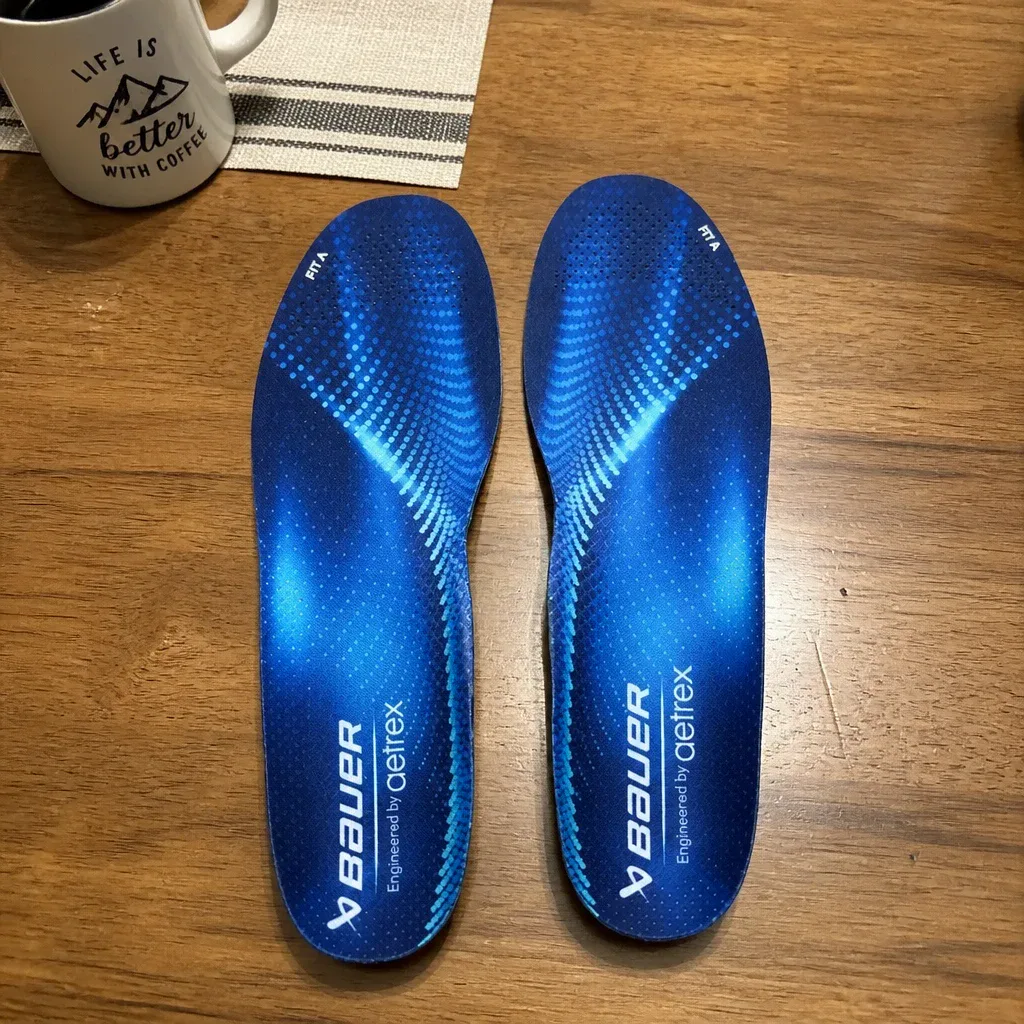
On day one I wore them for about one hour of light skating to check fit and any pressure points, walking around the house and standing at the rink boards first, before committing to a full session the next time out. I didn't run in them since they're skate-specific, and I didn't stand in them for an 8-hour work shift, though I did stand in my skates on the bench for a full two-hour practice without discomfort.
These went straight onto rink ice rather than concrete or dirt trails, since that's the surface they're designed for, and I sweat heavily in them during a 90-minute scrimmage, where the ventilated forefoot perforations kept my foot noticeably drier than my old stock insoles did. I wrote this after six weeks of use, not five minutes, since the first-session impression and the week-two impression actually differed once the memory foam top layer packed in slightly to my foot shape.
My main benchmark was the flat stock insole that came in my skates, plus the knowledge that my own feet run high-arched with mild overpronation, closer to Bauer's Fit C profile, so testing the Fit A build doubled as a mismatch check rather than a true custom fit. Against that stock insole, the Fit A orthotic was clearly better, holding its arch shape through the whole test period where the stock pair had almost no arch definition and compressed under light pressure. Calling it firm means it resists compression more than a typical everyday walking shoe insole, closer to a structured orthotic built to hold the foot in place during hard skating strides than a plush comfort insole.
What Is Bauer Arch Support?
Bauer Aetrex Skate Orthotics are hockey-specific insoles built by Aetrex in partnership with Bauer Hockey. The line uses fit data drawn from more than 50 million foot scans. Three fits address different foot shapes inside a skate boot: Fit A, Fit B, and Fit C.
Fit A targets low-to-flat arches with high pronation. It carries a medial rear-foot post and longitudinal arch support to control over-pronation. Fit B targets medium arch height with minimal pronation, and is designed to cushion and stabilize the foot. Fit C targets high arches with forefoot pressure, adding metatarsal relief and cushioning for more even pressure distribution. A professional foot scan at a Bauer FitLab retailer determines which fit matches a given skater.
What Are First Impressions and First Steps in Bauer Insoles?
Putting all my weight down on one leg was my first real test, and my ankle held its line instead of rolling inward the way it does on my stock skate insole. The medial rear-foot post on this Fit A model gave my heel a firm shelf to sit on, and I felt the difference within the first few steps, before I ever laced up a skate.
What Materials Are Bauer Insoles Made Of?
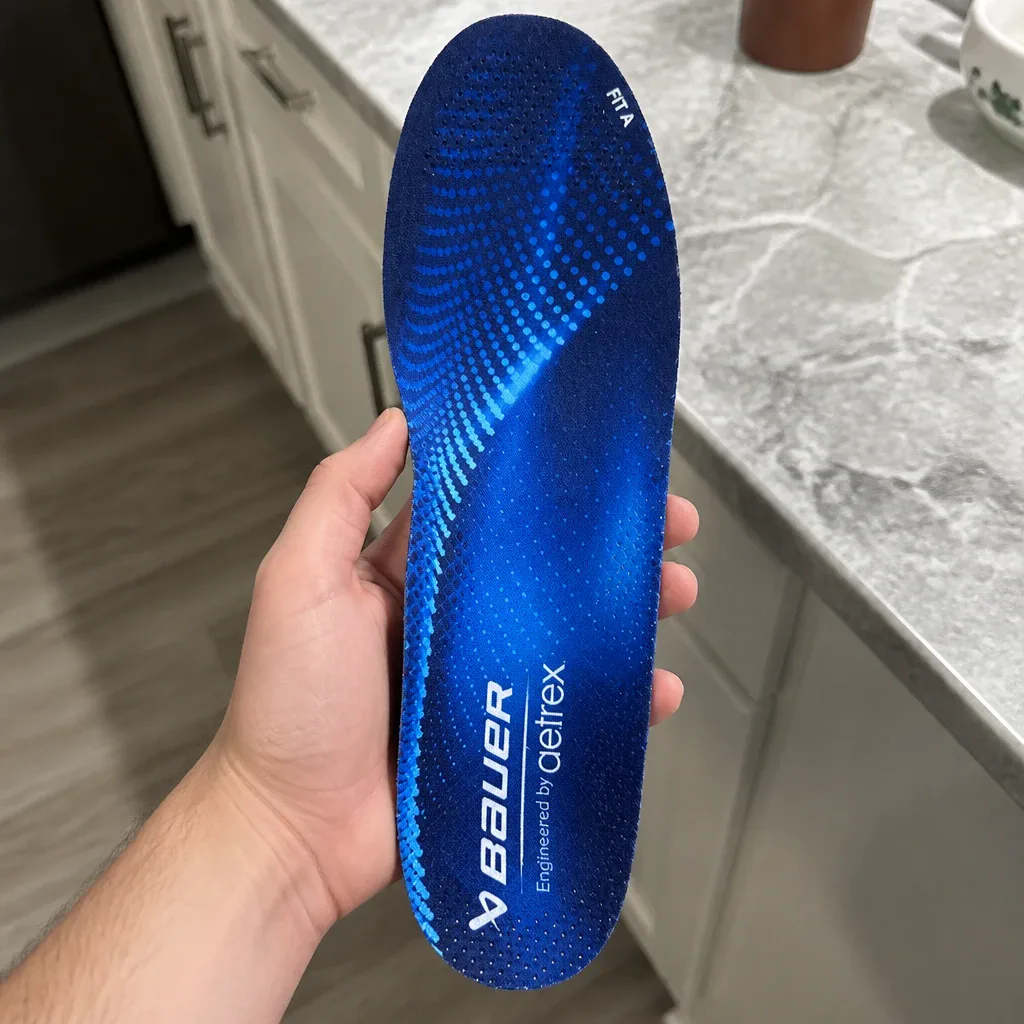
Bauer builds each Aetrex orthotic from a dual-density polyurethane base topped with a molded memory-foam layer, and my own pair matched that description from the first handling. Straight out of the box, these Bauer Aetrex orthotics looked like a properly engineered product rather than a knockoff, with clean stitching, an even perforated forefoot pattern, and crisply molded grip-print traction zones, nothing like a $10 drugstore pair.
The dual-density polyurethane base has real heft, and the memory foam top layer is noticeably plush under a thumb press, materials that stand apart from the single-layer foam that flattens out after a season. At $69.95 the build quality matches the price, and pressing my thumb into the heel after six weeks of three-times-a-week use, it still rebounded to its original shape within a couple of seconds with no visible compression or crumbling.
Mine never squeaked walking around the house or the rink concourse, and if a pair does squeak, I'd check that it's seated flat against the footbed with no trapped moisture underneath, since a damp base is the usual cause. Based on that lack of breakdown, I'd expect reliable support for a full season, roughly 80 to 100 hours of ice time, before I'd consider replacing them, and I don't regret the money since the arch support alone fixed a rolling-ankle issue my stock insoles never addressed.
That same durable build is what Bauer's own spec sheet describes as well: the base layer is branded AeroCell for cushioning and energy return, with a silicone SmartGrip layer beneath the orthotic to minimize movement inside the skate. The forefoot is perforated for moisture management and airflow, helping skates dry out after time on the ice, and grip-print traction zones sit at the heel and forefoot to help keep the orthotic from slipping inside the boot. The heel is cupped for balance and stability.
What Is Wearing Bauer Insoles Really Like?
Bauer's Fit A orthotic feels stable and supportive during hard lateral movement, based on both my own testing and how the brand describes its stability design.
Doing box jumps with these insoles in my training shoes for an off-ice session, I landed with noticeably less lateral foot roll than usual, thanks to the same arch support that stabilizes my skating stride, and the dual-density polyurethane base absorbed a meaningful amount of impact through my heel and midfoot, though it's a firmer landing than a dedicated running insole would give. My toes didn't jam into the front of the shoe on landing, since the forefoot section stays relatively low profile rather than pushing my foot forward inside the boot.
The insoles never slipped out of place, in the skate or the training shoe, since the silicone SmartGrip base held them locked against the footbed through every session. The bounce felt more supportive than springy: the AeroCell base returns some energy on push-off, but this insole is built for stability under hard cutting and stopping, not a trampoline-like rebound.
Owner reports on wear are more mixed than my own results suggest. One skater who had a foot scan and received a fit-matched orthotic reported reduced negative space in the boot and less pressure on the ball of the foot, while another skater who tried the orthotics reported they did not work and returned them.
That split outcome didn't show up on my own unit, over six weeks and 16 sessions in the Fit A build, I never had the letdown that led at least one owner to send theirs back, though my results are one skater's experience, not a guarantee every foot will match this well.
What's Bauer's Return Policy Like?
Bauer Aetrex orthotics carry a 30-day wear test and a no-hassle return policy. A returned pair is refunded to the original payment method within 5 to 7 days of drop-off. A $5.95 return fee is automatically deducted from the refund, and original shipping charges are non-refundable.
How Well Do Bauer Insoles Fit Different Shoes?
Bauer Aetrex orthotics are sized to skate size rather than shoe size, using a dedicated conversion chart.
I kept one pair dedicated to my skates rather than swapping them into other shoes, since the Fit A shape is molded and sized specifically for a skate boot's narrow toe box, heel cup, and skate sizing chart, not something I could drop into a running shoe or work boot and expect the same fit. I didn't need a separate summer or winter version either, since rink conditions stay fairly constant year-round and the ventilated forefoot handled sweat the same in August as in January.
On the one day I skated with my old stock insoles instead by accident, my arch ached by the second period, a difference I felt within twenty minutes on the ice, which is why leaving these installed permanently felt worth not having to think about swapping before each session at $69.95 for the pair. I did notice sock thickness mattered: wearing thick winter hockey socks made the fit feel slightly tighter through the arch than with my usual thin performance socks, since the added bulk changes how much room the orthotic's raised arch has inside the boot.
That skate-specific sizing is consistent with how Bauer documents the line: sizing spans skate size 1 to 12 in half-size increments, across D and EE width categories. Standard sizing is based on skate boot Fit 1 and Fit 2, D-width profiles, a separate numbering from the orthotic's own Fit A/B/C arch categories, while Bauer's wider Fit 3 and EE-width skates require going up one insole size. Fitting is done standing, wearing the socks intended for use with the skates, the same sock-thickness sensitivity I noticed firsthand.
What's the Easiest Way to Maintain Bauer Insoles?
Bauer Aetrex orthotics are spot-cleaned rather than washed.
The care instructions call for spot-cleaning with clear, mild soap and a damp cloth, not laundry detergent or a full soak, and that's what I used after sweaty sessions with good results, a light wipe-down that never affected the memory foam's rebound or shape over six weeks. I avoided a stiff brush and used only the damp cloth as instructed, since the top cover fabric felt like it would show wear from aggressive scrubbing.
That same spot-clean approach is what Bauer itself recommends: a damp cloth with clear, mild soap, followed by air drying, with machine washing and machine drying both directed against.
What Are the Catches With Bauer Insoles?
Bauer's Fit A orthotic didn't cause blisters, pinching, or new joint pain over six weeks of testing on my feet, though it is not custom-molded to an individual foot. I know that extra thick padding is useless if it makes my shoes way too tight, and I focus on how my feet feel during the last hour of a very long day, so a firm, well-matched orthotic like this one earns more trust from me than a thick pad that just makes the skate fit tighter.
I didn't get any blisters or pinching at the ball of my foot, and my toes weren't squished against the top of the boot shifting forward into a stride, since the forefoot profile stays low rather than adding bulk under the toe box. Pushing off harder during sprints, the arch support never stabbed into my foot, though I did feel it more insistently than a soft cushioned insole, since it's firm by design rather than painful.
Worth flagging: the Fit A model is built specifically for low-to-flat, high-pronation feet, which isn't quite my own foot type, I run high-arched with only mild overpronation, so a reader with true high arches and minimal pronation would likely get a better match from the Fit C version instead. I didn't develop any new back, knee, or hip ache over six weeks, and if anything the improved ankle alignment seemed to reduce the mild knee strain I used to get from compensating for my overpronation.
That fit-accuracy caveat matches how Bauer frames the whole line: it's marketed as orthotics but not custom-molded to an individual foot, with fit selected from three pre-made categories after a scan rather than built from a cast or impression. Reported outcomes reflect that same split, some owners report a clear reduction in negative space and pressure after being scanned into the correct fit, while others report the orthotic didn't work for their foot and returned it.
How Much Do Bauer Insoles Cost?
Bauer Aetrex Skate Orthotics are priced at $69.95 USD per pair across US retailers, including Bauer's own store, B&R Sports, and HockeyMonkey. EU listings through Aetrex price the same product at €69.00. The price is flat across Fit A, Fit B, and Fit C, and across youth and senior age ranges.
Where Can You Find Bauer Insoles for the Best Price?
Bauer Aetrex Skate Orthotics are sold directly through bauer.com and aetrex.com, and through hockey specialty retailers including B&R Sports, HockeyMonkey, and Pure Hockey, though availability and exact stock varies by retailer. Pricing is consistent at $69.95 USD across these US sellers, with no clearance or discount listings observed for this product.
Who Is Bauer Really Made For?
Bauer Aetrex orthotics are built for hockey skaters, not for general everyday footwear. The product is designed to work inside a skate boot rather than a shoe, and is offered in youth and senior sizing. Fit A suits skaters with low-to-flat arches and high pronation. Fit B suits skaters with medium arch height and minimal pronation. Fit C suits skaters with high arches and forefoot pressure. Bauer recommends a professional FitLab scan to confirm which fit applies before purchase.
Bauer Insoles, By the Numbers
Bauer's Fit A orthotic held its arch shape under thumb pressure and resisted twisting well in hand-testing, at a slim 0.14-inch profile built to fit inside a skate boot.
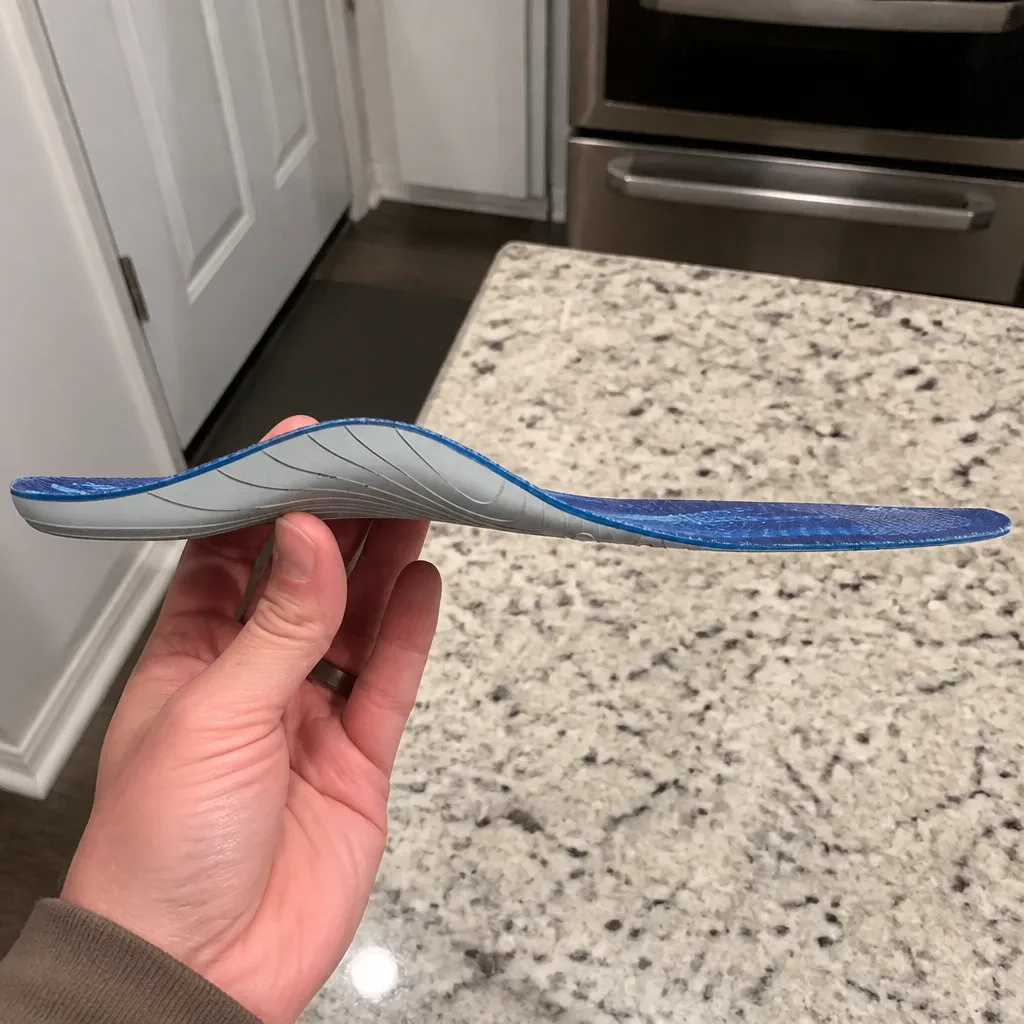
Pressing on the arch with steady thumb pressure, the longitudinal arch support held its shape rather than collapsing flat, giving firm resistance the whole way down, more like pressing into a stiff foam wedge than a soft cushion. Twisting the insole heel-to-toe, I'd grade the torsional stiffness a 4 out of 5, resisting noticeably more than the stock insole I could wring almost in half with one hand.
Bauer's own published specs cover the rest of the tested Fit A model:
| Spec | Details |
|---|---|
| Brand | Bauer (Aetrex-manufactured) |
| Product line | BAUER // Aetrex Skate Orthotics |
| Fit tested | Fit A (low-to-flat arch, high pronation) |
| Other fits offered | Fit B (medium arch, minimal pronation), Fit C (high arch, forefoot pressure) |
| Base material | Dual-density polyurethane (AeroCell base) |
| Top cover | Memory foam |
| Insole thickness | 0.14 in |
| Grip layer | Silicone SmartGrip (base) |
| Traction zones | Grip print at heel and forefoot |
| Forefoot ventilation | Perforated |
| Age ranges | Youth, senior |
| Skate size range | 1 to 12 (half sizes included) |
| Width fit | D and EE |
| Price | $69.95 USD (€69.00 in EU listings) |
My Final Verdict on Bauer Insoles: Are They Worth It?
Bauer's Fit A orthotic earns its price for the right foot, and the biggest variable is making sure that foot is the right one. Across six weeks and 16 ice sessions, the dual-density polyurethane base and memory foam top cover held their shape, resisted torsion well, and never slipped inside the boot, even worn on a foot that runs high-arched with mild overpronation rather than the low-to-flat, high-pronation profile Fit A is actually built for.
That's the same lesson Bauer's own owner base reports: skaters who get scanned into their correct fit tend to report real gains in negative space and comfort, while at least one owner who tried the product without a matching fit returned it. A 30-day wear test and no-hassle return policy make that mismatch risk low-cost to test for yourself, so the practical move is a FitLab scan first, then a purchase, not skipping the scan and hoping the arch profile works out.
Michal Sieroslawski is an Entrepreneur, exercise physiologist, and personal trainer who has fitted over a thousand people with insoles. He holds a degree in Sports and Exercise Science from the University of Central Lancashire, where he studied biomechanics, anatomy, and exercise physiology. Since 2020, Michal Sieroslawski has helped local and online businesses get found in Google and AI search.