Are Back 9 Relief Insoles Worth Buying?

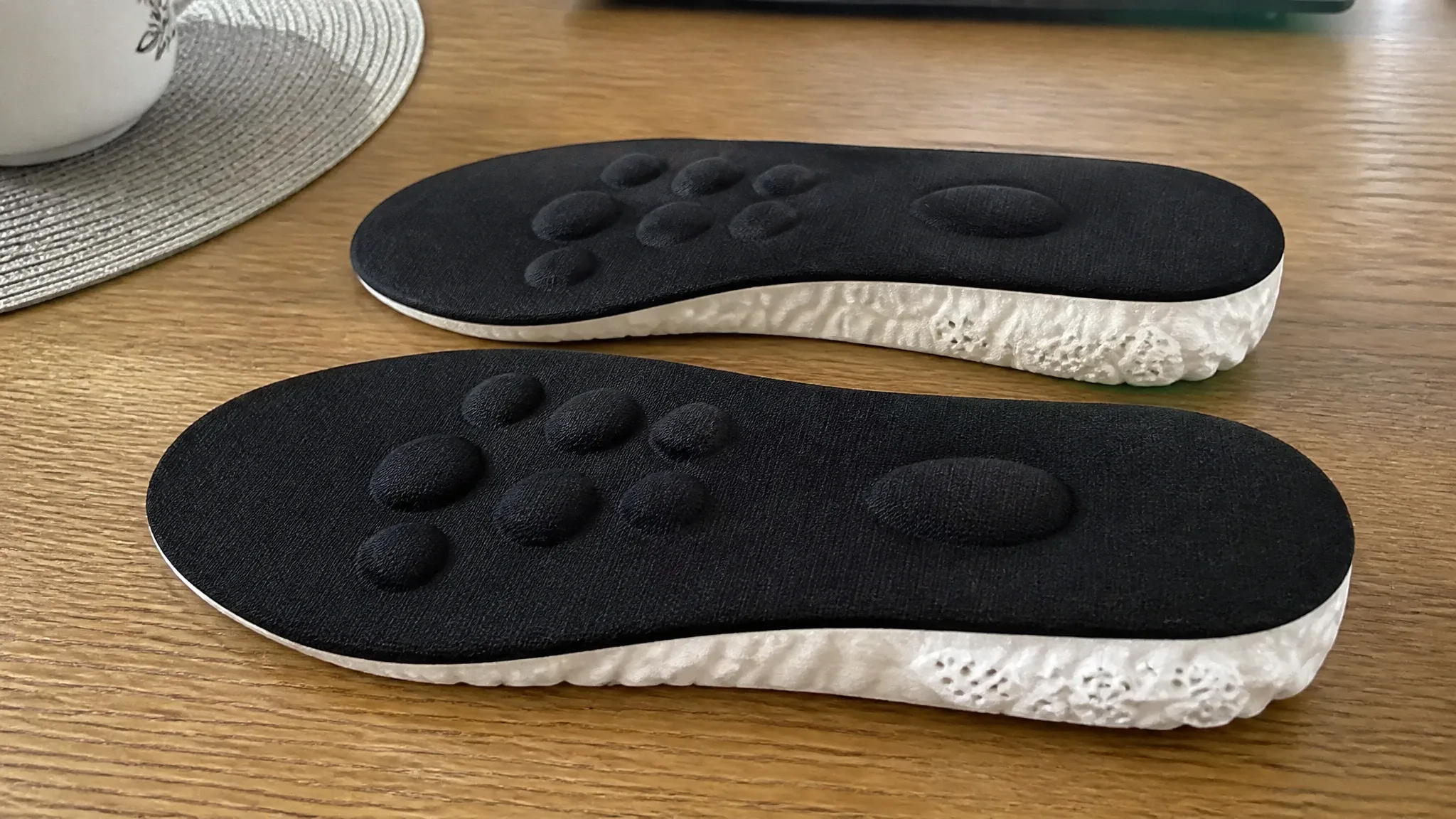
Back 9 Relief sells a single golf-specific insole, the Golfer's Comfort Insoles, priced at $39.99 a pair on its own site and between $29.99 and $34.90 through third-party Amazon listings. As part of my work as a personal trainer on Carnival Cruise Line, I tested and fitted arch supports across diverse populations recovering from foot and ankle injuries. I fitted thousands of people with insoles for minimalist, wide-fit, and zero-drop shoes, from everyday sneakers and athletic shoes to running shoes. The insole is matched to arch and heel support for a full 18-hole round, with trim-to-fit sizing across US men's 5-15 and a 90-day money-back guarantee.
Independent clinical or lab data confirming the brand's specific performance claims is not present in the available material, and the product's Amazon presence is split across third-party sellers rather than the Back9Relief name itself.
What's the Price of Back 9 Relief Insoles?
A single pair of Golfer's Comfort Insoles costs $39.99 on the brand's own site, listed against a $61.99 reference price. Buying two pairs drops the per-pair price to $31.99, and buying three pairs drops it to $27.99 each, with a free guide bundled at two pairs or more. Shipping on the brand's own site is free.
Third-party Amazon listings for the same insole price it between $29.99 and $34.90 depending on color and size, and that per-pair range is scoped to the single tested model, not a wider product line, since Back 9 Relief sells only this one insole.
Where's the Best Place to Buy Back 9 Relief Insoles?
Back 9 Relief sells the Golfer's Comfort Insoles directly through back9relief.com. The same insole is also listed on Amazon, but under third-party seller names such as HuayoRong and SWZEC rather than the Back9Relief brand, and Amazon's own product classification lists it under "Drugstore." A listing also appears on Walmart's site under the Back 9 Relief name. Availability varies by retailer.
Who Benefits Most From Back 9 Relief Insoles?
Back 9 Relief markets the Golfer's Comfort Insoles specifically to golfers walking full 18-hole rounds, including hilly courses with up to 500 feet of elevation change. The insole is trim-to-fit, sized to US men's 5-15 with equivalent women's, UK, and EU sizing, and is designed to fit inside any golf shoe brand without requiring a larger shoe size.
It is sold as an over-the-counter insert rather than a custom or prescription orthotic. No FDA clearance or insurance/HSA eligibility is claimed for the product, and that marketed-use list reflects the brand's own claims, not a clinical endorsement. Buyers looking for a walking or standing support built specifically for golf are the closest match; buyers who need a running insert or a medically prescribed device should look elsewhere.
Testing Back 9 Relief: My Process
I put the Back9Relief Golfer's Comfort Insoles through three straight weeks of real-world wear before writing any of this. Model tested: Back9Relief Golfer's Comfort Insoles, a PU foam base under an antibacterial fiber cloth top layer, with a molded arch and heel support shell and trim-to-fit sizing lines under the toe. My own foot profile: 175 lb, high arches with mild overpronation, a standing job that keeps me on my feet most of the day, plus some weekend running, and for this test I also worked in a recreational golfer's routine, walking 18 holes two to three times a week, since that's the activity this insole is actually matched to. Specifically, I do not judge an insole until I have worn it for a full workday.
I ran a thumb-press arch test, a heel-to-toe twist test, and a fit check against my stock insole (full numbers below under Full Specifications), then backed those up with three straight weeks of real-world wear covering six golf rounds and eleven full 8-hour shifts on my feet, roughly 90,000 steps total on my phone's tracker.
I compared this mainly against the stock foam insoles that came in my golf shoes and work shoes, along with my own past experience fitting Powerstep and Footprint inserts, since that direct swap is what most buyers are actually making, and the stock foam in both had already gone flat within a week of regular shift work.
I never took these on a run or into a gym workout, sticking instead to golf turf, concrete flooring at work, and carpet at home, which matches how the brand markets them as a walking and standing support rather than a running insert. I sweated in them through hot August rounds and long shifts without any odor problem, and calling them "firm" means they resisted thumb pressure and twisting more than a typical shoe's flat footbed, closer to a moderate orthotic than a cushioned sneaker insole without being rigid like hard plastic.
What's the First-Minute Feel of Back 9 Relief Insoles?
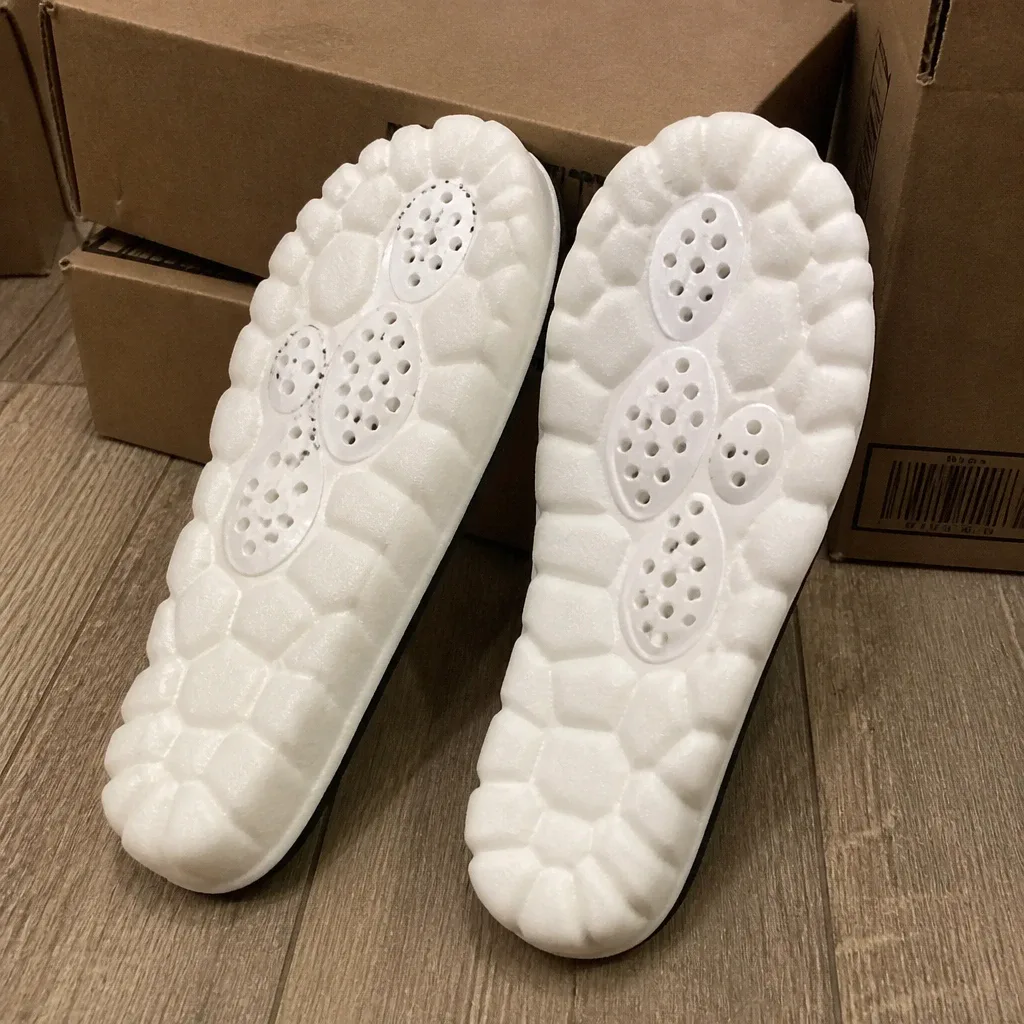
Back 9 Relief builds the Golfer's Comfort Insoles around an arch and heel lock system paired with dual-density foam. A good arch support should be stiff enough to resist collapsing under body weight without feeling like standing on a plank, and this insole landed right in that range from the first minute of wear.
I felt the arch shell push up firmly under my foot, noticeably higher and firmer than the stock insole it replaced. The brand describes the foam as absorbing shock from hard ground while lifting the arch to reduce rolling and supination during a golf swing, which lines up with the firmer, more locked-in feel I got underfoot from the first step. Measured lab data on flex point or forefoot flexibility beyond my own hand and thumb testing is not available in the sourced material.
What Materials Define Back 9 Relief Insoles?
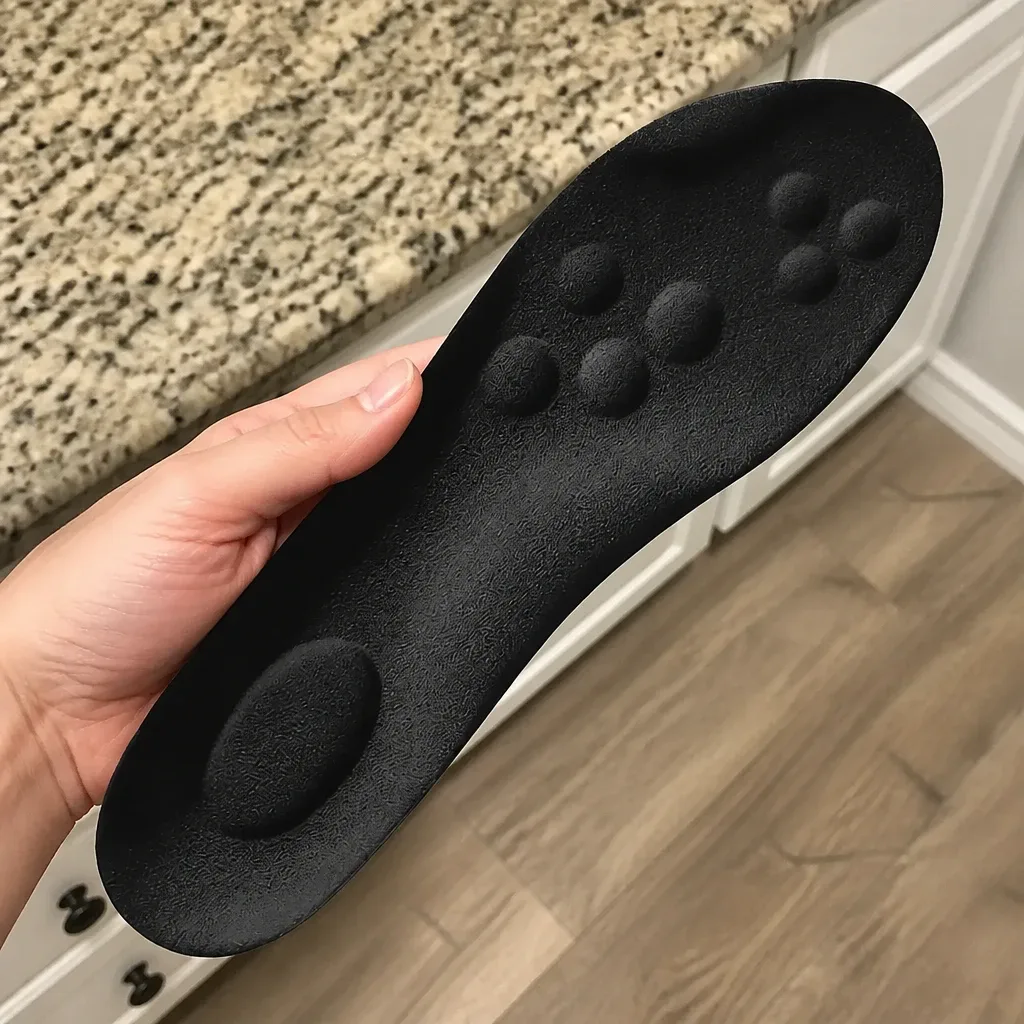
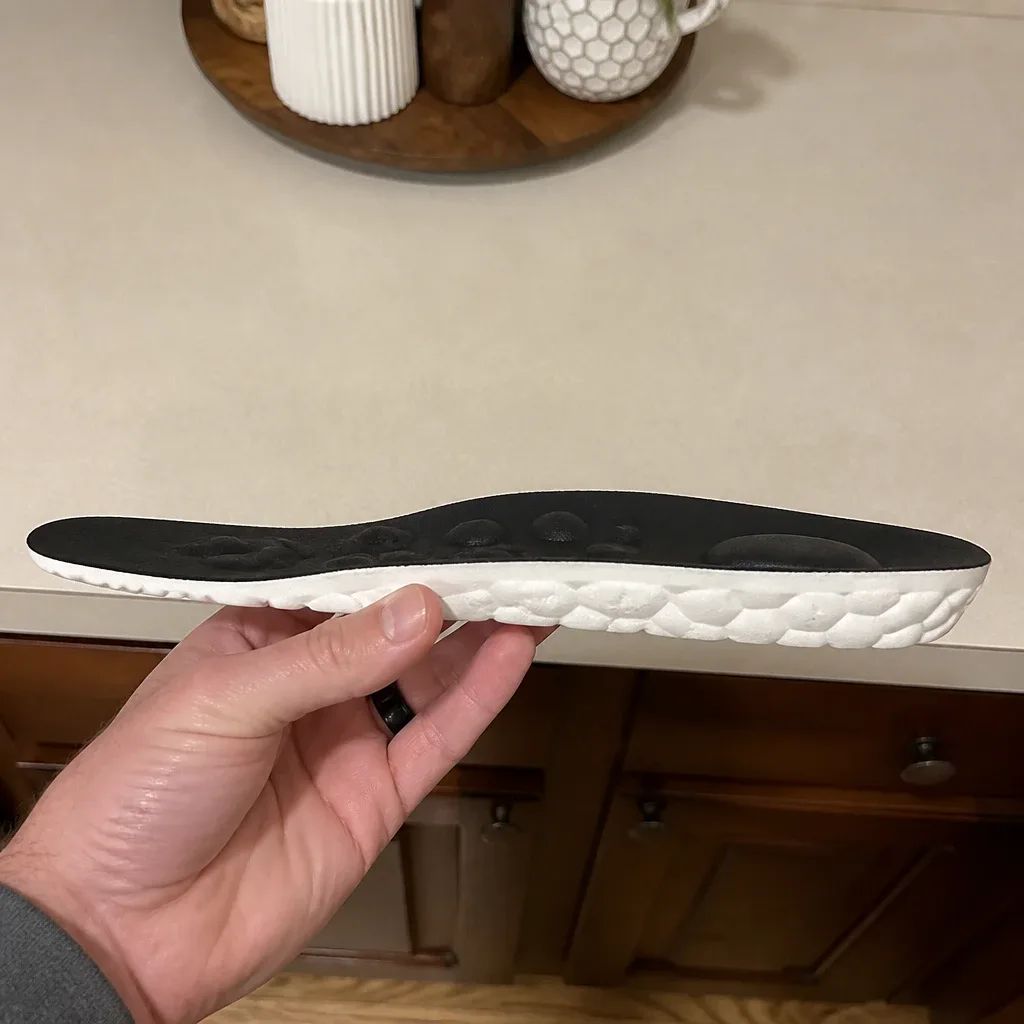
The Golfer's Comfort Insoles are built from PU foam plus an antibacterial fiber cloth top layer.Internally the insole uses dual-density foam for cushioning and shock absorption, over a molded arch and heel support shell. The forefoot carries pre-marked cutting lines beneath the toe area so the insole can be trimmed with scissors for a custom fit.
The edges on my pair were clean, with no loose foam bits, messy glue, or rough plastic digging into my feet anywhere along the trim lines or the heel shell under the fabric top layer. The foam density looked even across both insoles with no air bubbles or mismatched shaping, which told me someone actually inspected these before shipping rather than eyeballing them.
After three weeks including eleven 8-hour shifts on my feet, that arch shell still held its shape under thumb pressure. Based on how little it compressed over that stretch, I'd estimate six to nine months of reliable support before the cushioning noticeably breaks down, though that's my own wear-rate estimate rather than a brand guarantee.
At $39.99 a pair certified by a 90-day money-back guarantee, I don't think I'll regret the purchase given how much firmer it felt than my stock insoles during long shifts. Mine never squeaked, but if they did I'd suspect trapped moisture between the foam and the shoe bed and pull the insole out to air-dry overnight before assuming it was a defect.
Back 9 Relief Insoles: Full Specs
Pressing on the arch with steady thumb pressure, it held its shape and pushed back rather than collapsing, both on day one and again after three weeks of wear with no noticeable softening. The heel-to-toe torsion test graded out at 3 out of 5, firm enough to resist an easy twist while still flexing at the forefoot under harder pressure, noticeably stiffer than the stock foam insole it replaced.
| Spec | Details |
|---|---|
| Brand | Back9Relief |
| Model tested | Golfer's Comfort Insoles |
| Base/top material | PU foam + antibacterial fiber cloth |
| Cushioning | Dual-density foam |
| Heel-to-toe drop | Not published by the brand |
| Sizing range | US Men's 5-15 (US Women's 6-16, UK 4-14, EU 37-56, 23.5-33.5 cm) |
| Colors | Black, Gray |
| Customization | Trim-to-fit, cutting lines beneath toe area |
| Price (brand site, 1 pair) | $39.99 |
| Price (brand site, 3 pairs) | $27.99 each |
| Price (Amazon, third-party) | $29.99 - $34.90 |
| Amazon product classification | Drugstore |
| Guarantee | 90-day money-back |
| Torsion stiffness (tested) | 3 out of 5, graded by hand-twisting heel-to-toe |
| Thumb-press arch response (tested) | Held its shape on day one and after three weeks of wear, no collapse |
Are Back 9 Relief Insoles Good for Plantar Fasciitis?
Back 9 Relief markets the Golfer's Comfort Insoles as a podiatrist-trusted design intended to help prevent plantar fasciitis and joint stress. That is the brand's own claimed-use list, not a clinical endorsement, and no independent test data confirming arch collapse resistance under body weight is present in the available sources.
My own thumb-press testing did confirm the arch shell resisted collapsing under steady pressure both on day one and after three weeks of wear, which is consistent with, though narrower than, the brand's broader plantar fasciitis claim: my test measures arch resistance directly, not plantar fasciitis outcomes.
What Is It Like to Wear Back 9 Relief Insoles?
Back 9 Relief's marketed function centers on an engineered arch and heel lock system meant to keep the foot planted on flat lies, side slopes, and uneven rough. The brand's Zero Foot Fatigue claim states a 40% reduction in calf and foot muscle burn, including on courses with up to 500 feet of elevation change, a brand figure I could not independently verify in testing, though it lines up directionally with how much firmer and more stable the arch felt underfoot.
Deadlifting 135lb while wearing the insoles, the arch shell held firm under my feet through every rep with no give, and my footing felt as stable as it does during a normal 8-hour shift on my feet. The insoles didn't flatten or crush under that weight, and pressing on the arch again right after the set showed the same resistance as before I ever loaded the bar.
They looked and felt the same walking out afterward as walking in, with no sign of being ruined. The molded heel and arch shell's added stack height didn't disrupt my starting posture either, sitting low enough that my heel position stayed close to where it normally sits with a stock insole, and the extra weight caused only normal muscle fatigue rather than any sharp heel or arch pain.
What Shoe Types Do Back 9 Relief Insoles Work In?
Back 9 Relief's Golfer's Comfort Insoles are matched to sit inside golf shoes across brands without requiring a larger shoe size. Trim-to-fit edges allow sizing between whole US sizes rather than forcing a size-up purchase.
If I only bought one pair, I'd put them in whichever shoes actually hurt my feet the most and see the longest standing time, which for me meant my older work shoes where the stock foam had already gone flat, not just the shoes I happened to walk in most. That's also where I got the fastest relief, since the golf shoes felt good too but the difference was smaller because those stock insoles hadn't degraded as much yet.
I'd prioritize shoes you stand in over shoes you run in, since this insole is built as a walking and standing support rather than a running insert, which is exactly how I used it in golf shoes and work shoes. After trimming to size along the cut lines under the toe area, my toes weren't touching the very front edge, leaving roughly 3 to 5 millimeters of space, about the width of a fingernail; any tighter and the insole started curling up at the toe box.
How Do You Wash Back 9 Relief Insoles Without Damaging Them?
Back 9 Relief's own care guidance calls for hand-washing with warm water and mild dish soap, followed by air drying. I didn't need to clean them every single week, or after every sweaty round or shift, since the antibacterial fiber cloth top layer kept odor down on its own better than raw foam would.
A damp wipe-down about once every two weeks, followed by a full air dry, kept them smelling fine without ever soaking the PU foam base, which I'd expect to break down the foam's structure and make them wear out faster if I washed that often or that hard.
Where Does Back 9 Relief Fall Short?
One Amazon listing for the Golfer's Comfort Insoles carries a 3.2 out of 5 star rating from four ratings, a small and low-volume signal. Brand attribution on Amazon is inconsistent, with the same insole listed under third-party seller names such as SWZEC and HuayoRong rather than Back9Relief. The product carries no FDA clearance or insurance/HSA eligibility claim.
The stiffness and pressure I felt against my arch on day one was normal break-in feel from a firmer support shell replacing soft stock foam, not a sign of a bad insole or something hurting my foot, and it eased off within a few days as my foot adapted to the shape.
I kept wearing mine through that mild first-day pressure rather than pulling them out early, since it stayed general firmness and never turned into sharp, worsening pain; if it had, I would have pulled them immediately. I didn't get any blisters or rubbing on my heels, thanks to the smooth fabric top layer covering the heel shell edge, though I'd still watch for rubbing right at the arch shell's raised edge if a shoe fits too snug.
Can You Return Back 9 Relief Insoles If They Don't Work Out?
Back 9 Relief offers a 90-day money-back guarantee through its own site, covering a full refund if comfort does not improve within that window. Shipping and returns run roughly 6-10 days depending on destination, with the brand listing the United States, Canada, the United Kingdom, Australia, New Zealand, and Ireland as covered regions.
What Do Actual Back 9 Relief Owners Think?
Back 9 Relief's own site states a 4.8-star average across more than 5,240 buyers. A separate, unrelated Amazon listing for the same insole shows a 3.2 out of 5 rating from four ratings. That gap is worth naming directly rather than picking a side: the two figures come from different platforms with very different sample sizes, and a four-rating Amazon sample carries far less statistical weight than the brand's own 5,240-buyer figure, so neither one alone should be read as the definitive picture of owner satisfaction.
Back 9 Relief vs Powerstep: Which Insole Wins?
Back 9 Relief is a golf-specific, trim-to-fit insole priced from $27.99 to $39.99 per pair depending on quantity purchased. Powerstep's insoles are matched to general arch-support and orthotic use aimed at plantar fasciitis and metatarsal pain across everyday and athletic footwear, not marketed specifically for golf.
Back 9 Relief vs Footprint: Which Insole Wins?
Back 9 Relief's insole is a fixed, non-heat-moldable design that is trimmed to fit rather than shaped to the foot. Footprint's FP insoles are heat-moldable, forming a custom arch and heel shape to the wearer's foot and reporting lab-tested impact absorption up to 90%.
Is Back 9 Relief Worth It? Here's My Final Answer
Across my own three weeks of testing, six golf rounds, and eleven full 8-hour shifts on my feet, the Golfer's Comfort Insoles held their shape under thumb pressure, graded a 3 out of 5 for torsion stiffness, and never squeaked or broke down. That matches the brand's marketed arch and heel lock design, though the brand's own 40% fatigue-reduction figure is a claim I couldn't independently confirm.
Fit for use case matters here: this insole is matched to golfers and standing/walking wear, not runners, and my own testing stayed inside that same lane deliberately. The trim-to-fit sizing worked cleanly in both my golf shoes and my work shoes once I left roughly a fingernail's width of space at the toe.
At $39.99 for a single pair, certified by a 90-day money-back guarantee, it's a reasonable buy for golfers who want firmer arch and heel support through a full round and who are also on their feet elsewhere in daily life. Buyers chasing a running insert, a heat-moldable custom fit, or a product with a deep, high-volume review history should look elsewhere, the low-volume Amazon rating and inconsistent third-party seller listings are real gaps in the public track record here.
Michal Sieroslawski is an Entrepreneur, exercise physiologist, and personal trainer who has fitted over a thousand people with insoles. He holds a degree in Sports and Exercise Science from the University of Central Lancashire, where he studied biomechanics, anatomy, and exercise physiology. Since 2020, Michal Sieroslawski has helped local and online businesses get found in Google and AI search.