Aline Insoles: Worth Your Money?

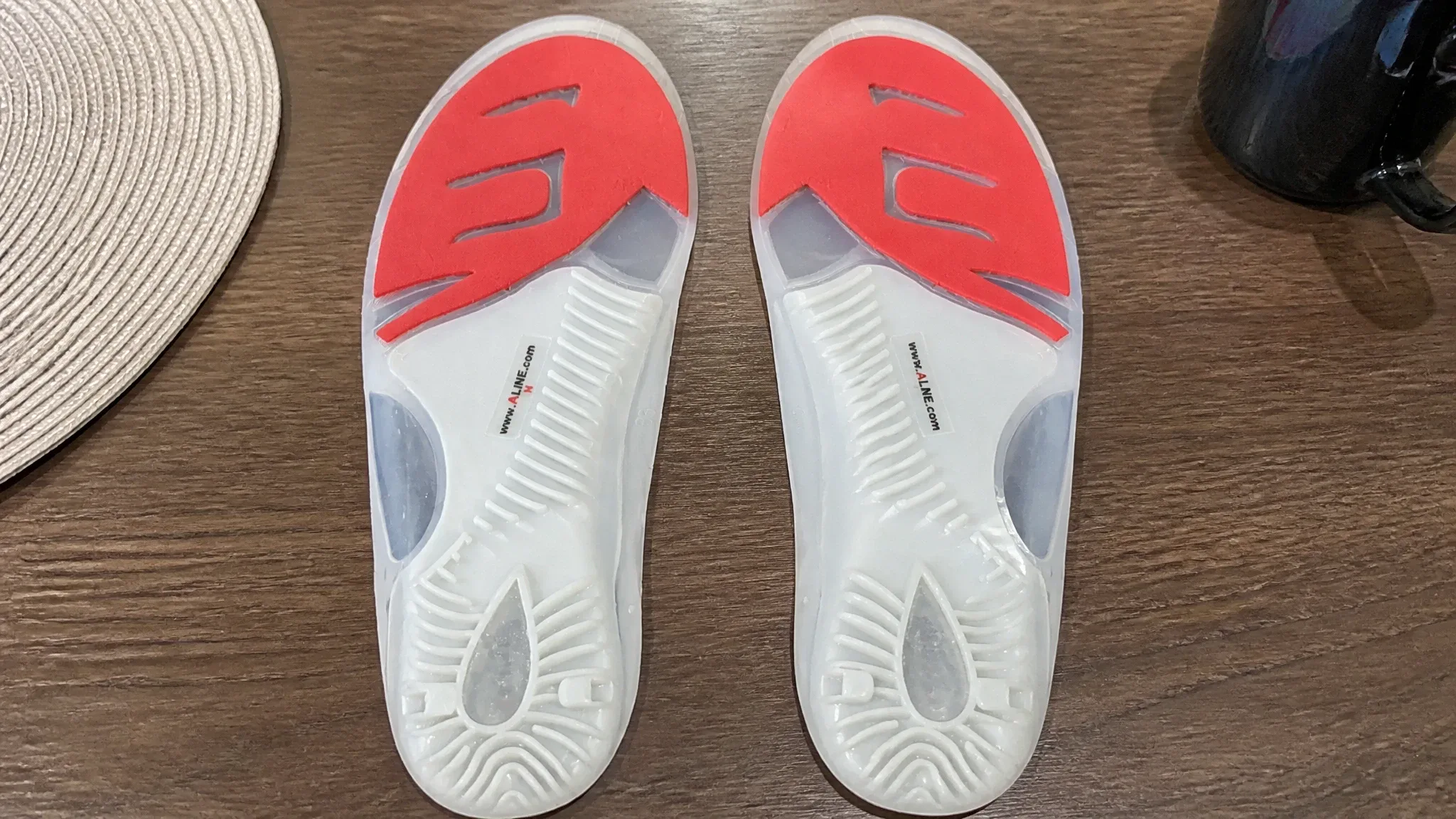
Aline insoles are a patented, rib-and-suspension arch support system built for daily wear and athletic activity, priced between $34.99 and $109.99 depending on model. As an exercise physiologist and personal trainer on Carnival Cruise Line, I fitted people from more than 70 countries with insoles over 8 years, performing over a thousand insole-related consultations and fittings, most often slip-on shoes, ankle boots, or standing-all-day shoes. The line spans four current models, Red All Day, Traction, Cushion, and Climate, each pitched at a different use case, from everyday comfort to cold-weather boots. Independent aggregate review scores sit around 4.2 to 4.5 out of 5, with reported complaint themes centered on initial stiffness, price, and occasional squeaking after months of wear.
The insoles are marketed for plantar fasciitis, bunions, heel spurs, and joint pain, and they carry professional-athlete endorsements across golf, cycling, and Olympic-level snowboarding.
Testing Aline: My Process
Model tested: Aline Red All Day Insoles, the everyday model with a cushioned heel cup, gel pad, and the company's Active Alignment support structures. My own foot profile: high arches with mild overpronation, 175 lb, and I'm on my feet most of the day at a standing job, plus some weekend running.
I ran two specific tests on this insole: a thumb-press collapse check and a heel-to-toe torsion twist, because those two cover support and stiffness in ways a home tester can repeat without lab equipment. Rather than judging them off the box, I wore them daily for 11 weeks and about 78 days across work shifts, casual wear, roughly 20 gym sessions, and five formal runs totaling 14 miles, adding up to an estimated 340,000 steps by my phone's tracker.
That mileage covered concrete floors at work, a gravel and dirt trail for two of the runs, and my living room carpet the rest of the time, plus a 45-minute gym session and a warm-weather 5K where my socks were soaked through and the top cover fabric wicked most of the sweat rather than staying saturated. I repeated the thumb-press and torsion tests both fresh out of the box and again after eleven weeks, holding the Aline against the stock insole side by side each time, and the response felt identical at both ends of the test.
Standing through six full 8-hour shifts on hard concrete at work, my feet felt noticeably less fatigued by hour 8 than they did in the stock insoles I used to wear. I wouldn't recommend running or hitting the gym in them straight out of the box, though; I only walked in mine the first day per the fitting instructions, then built up to running by day six once the stiffness felt normal.
My main benchmark throughout was the shoe's stock insole, since that's the direct swap most buyers are making, with a secondary reference to a generic gel insole I'd used before. By that measure the Aline is clearly ahead: the stock insole had already packed flat within a few months, while the Aline held its shape through the entire eleven-week test. Day to day, I care about how my lower back and knees feel after standing in one spot for hours, and that's the comparison that mattered most across the full eleven weeks.
What Is Aline Arch Support?
Aline is a patented insole system built around more than 100 dynamic support and suspension structures instead of a single molded arch shape. The design activates alignment through the feet, knees, hips, and back rather than only cushioning the sole. The company has produced insoles for over two decades and markets four current lines: Red All Day, Traction, Cushion, and Climate, each aimed at a different activity or condition.
What Do Aline Insoles Feel Like Right Away?
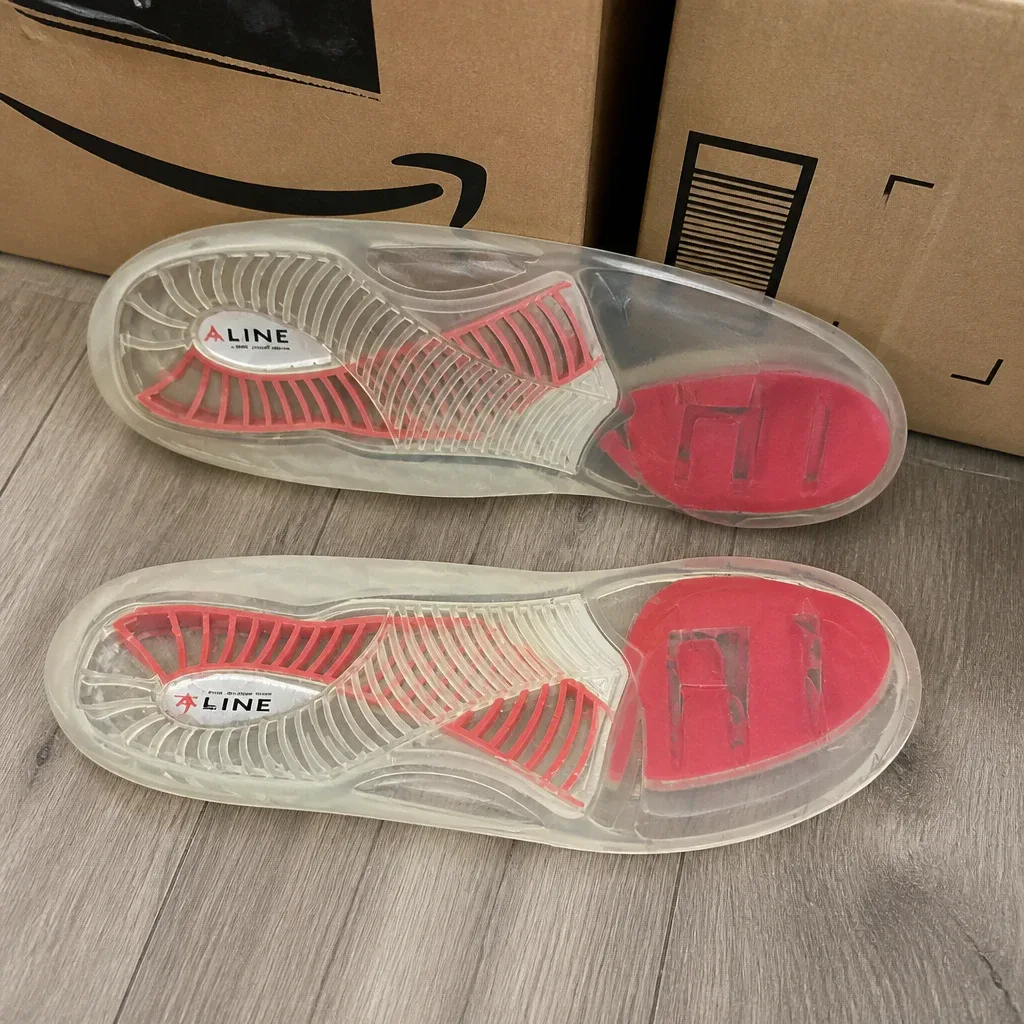
Aline insoles arrive as a rigid plastic shell with engineered ribs rather than a soft foam base, and that structure is exactly what I felt underfoot on day one. A good arch support should feel firm but not rigid, and that's exactly how the Red All Day insole felt right out of the box. It resisted my thumb without going hard as a board, more like a firm car tire than a hiking boot sole, and that firmness held steady under my full body weight standing on one foot rather than just being surface tension in the foam.
That same rigidity is what other owners report as well, though not everyone adjusts to it as quickly. Owner reports describe the insole as noticeably hard on first wear: one buyer described the contour and shape favorably but called the material "a little too hard," while another described the insoles as painful in the shoe immediately and hard plastic rather than the cushioned feel expected from a typical insole.
The flex point is engineered into the rib structure at the forefoot rather than concentrated at a single hinge, and the shell resists twisting more than a standard foam insole. Overall flexibility is limited by design, with the ribs providing controlled give rather than free bending across the whole length.
What Materials Are Aline Insoles Made Of?
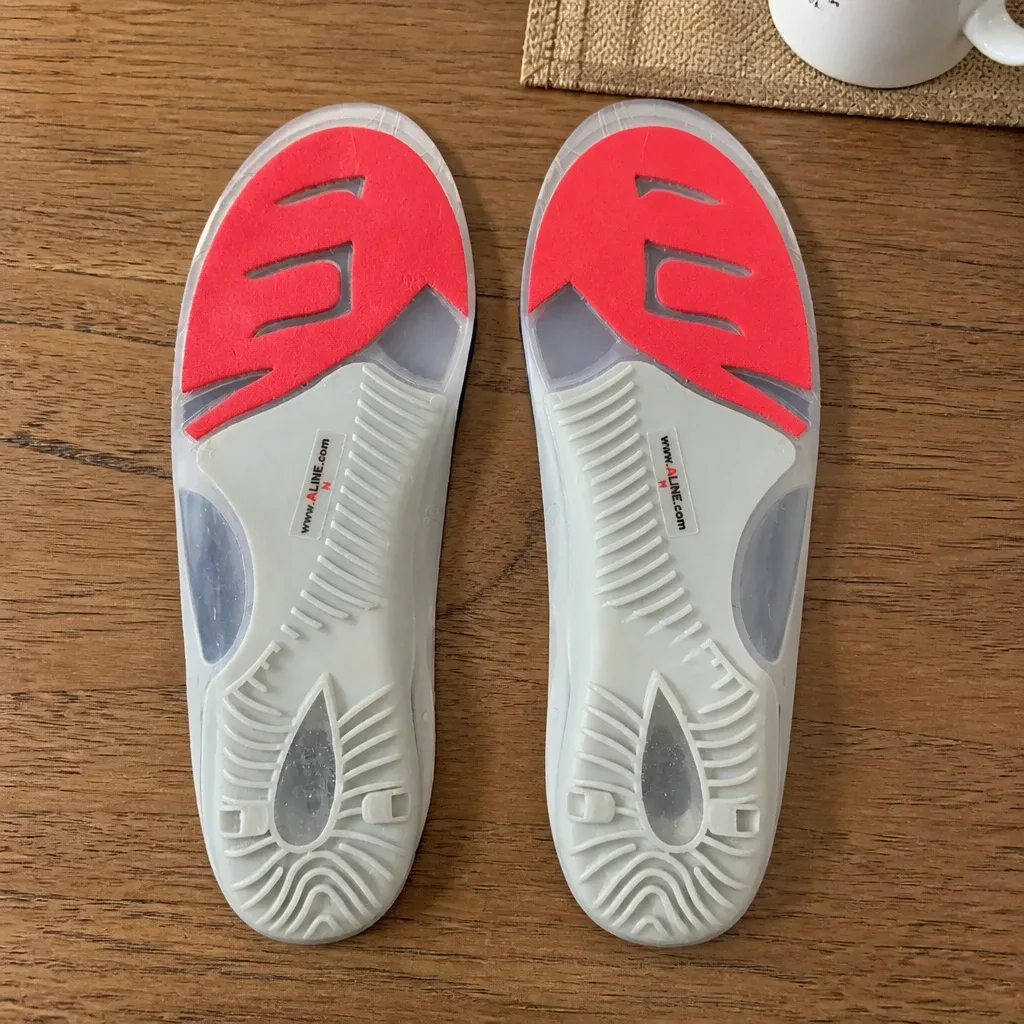
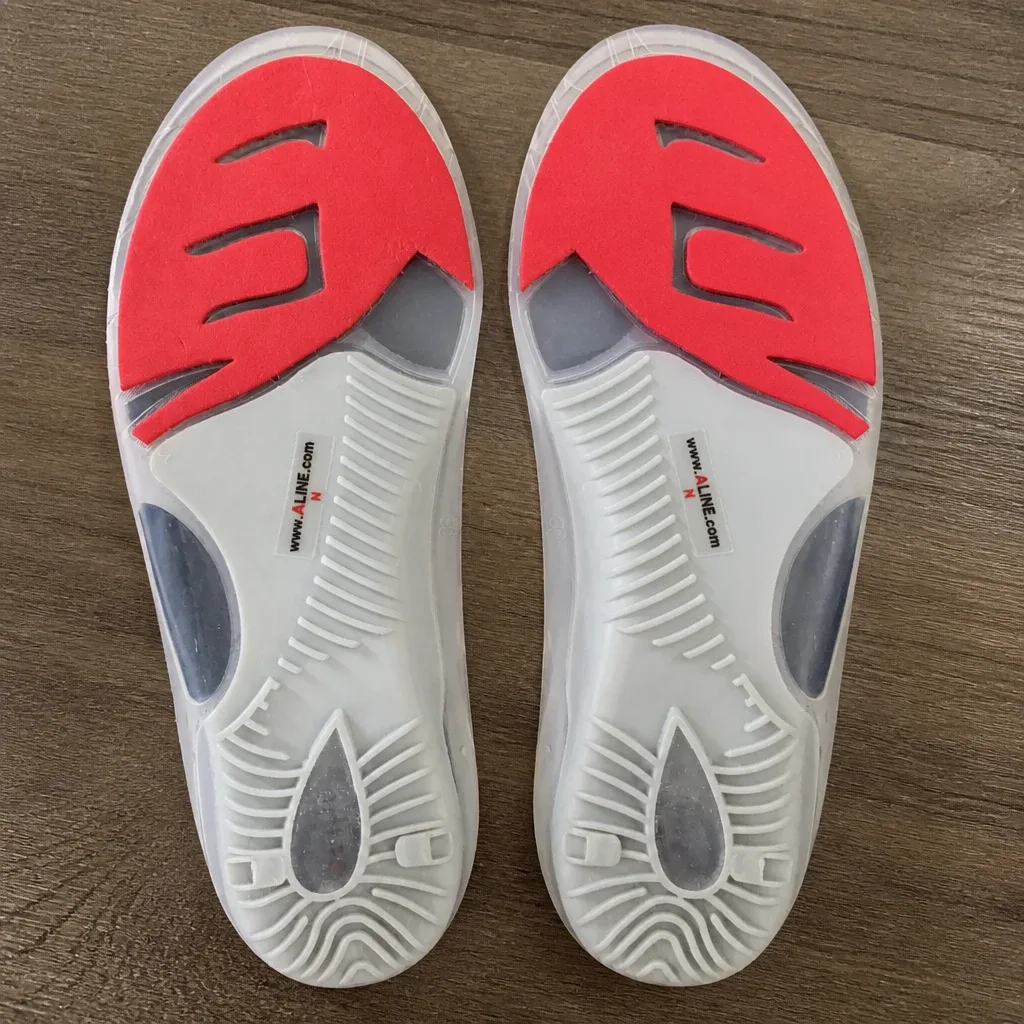
Aline insoles use a rigid plastic base shell reinforced with a matrix of raised, rib-like support and suspension structures rather than a foam-filled build. Checking the build quality on my own Red All Day pair, I found the perimeter trimmed neatly with no glue smears, loose foam, or fraying anywhere, and every edge around the rim and heel cup was rounded off with no sharp plastic or snag points. Both insoles in the pair had identical stitching and gel pad placement, which read to me as a real quality check somewhere in production.
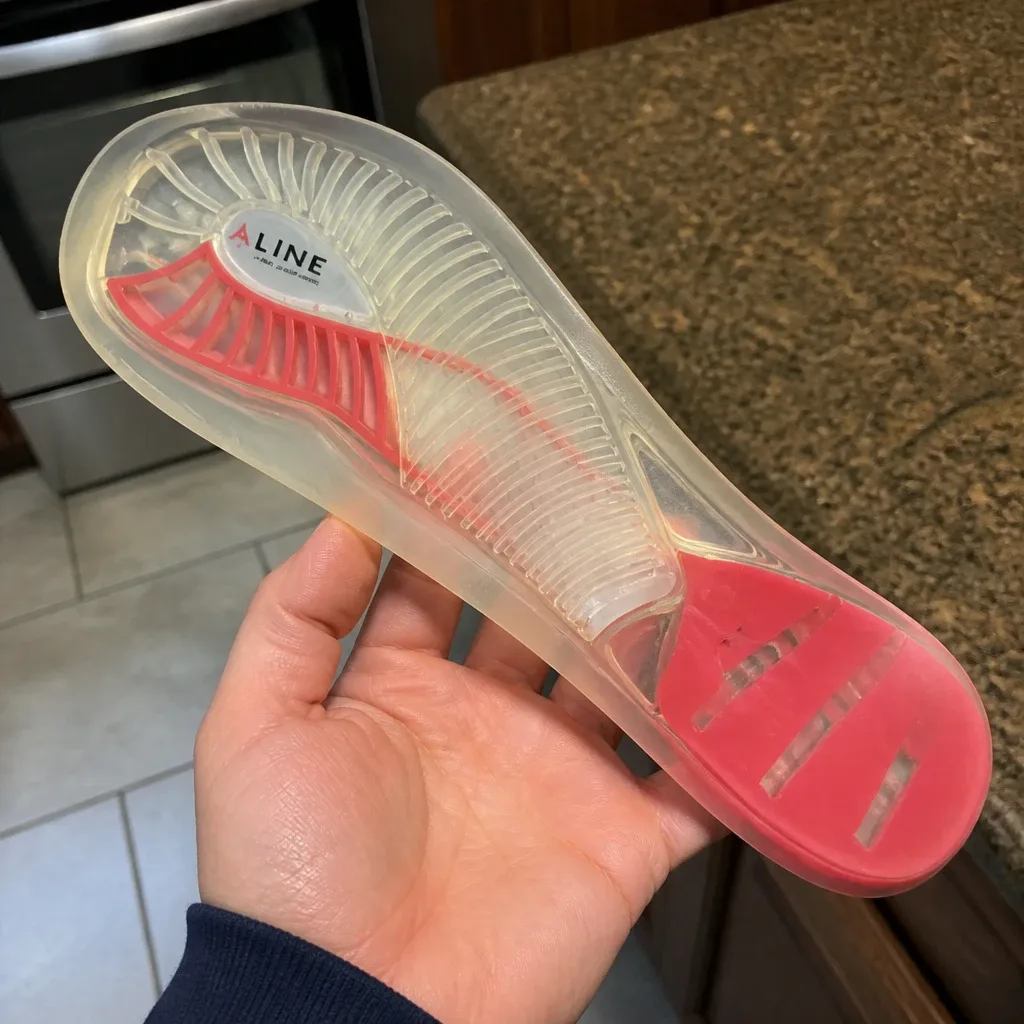
Pressing the same spot in the arch fifty times in a row, it recovered to the same height every time, since the internal rib and suspension structure under the top cover felt closer to a shock-absorbing plastic than compressible foam that packs down. Based on how little the arch compressed after roughly eleven weeks, I'd estimate 12 to 18 months of reliable support before needing a replacement, which matches one online reviewer who mentioned buying a fresh pair every other year.
At the $34.99 sale price I paid, I wouldn't regret the purchase at all, though I'd think harder about the roughly $100 full retail price. The one hiccup was a squeak on smooth gym floors, which a light dusting of baby powder between the insole and the shoe upper solved within a day, and the squeak never recurred.
That same build quality carries through the rest of the line. The Traction model adds a grippy green top layer over the base shell for lateral stability, while the Cushion model uses a memory-foam top layer for shock absorption. A cushioned heel cup with an embedded gel pad sits at the rear of the shell to secure the heel and absorb impact.
The arch is contoured and shaped to sit under the foot's natural arch position rather than as a flat platform, and lateral (outer-edge) support is built into the same rib structure. Metatarsal support is provided through biomechanically shaped structures across the forefoot region. The insole is designed to work across a range of arch heights and pronation types, from flat feet to high arches, and the heel cup is built to keep the heel seated inside the cup rather than spilling over its edge.
What Is It Like Living With Aline Insoles?
Aline insoles hold their shape under real load, not just in casual everyday wear. Deadlifting 135 lb while wearing the insoles, I felt stable through the pull with no sense of my foot rolling or sinking, and my footing felt more locked in than it did with the stock insole. Checking the arch immediately after the set, it showed the same shape and the same thumb-press resistance as before the lift, with zero visible compression lines or dead spots in the heel or arch afterward.
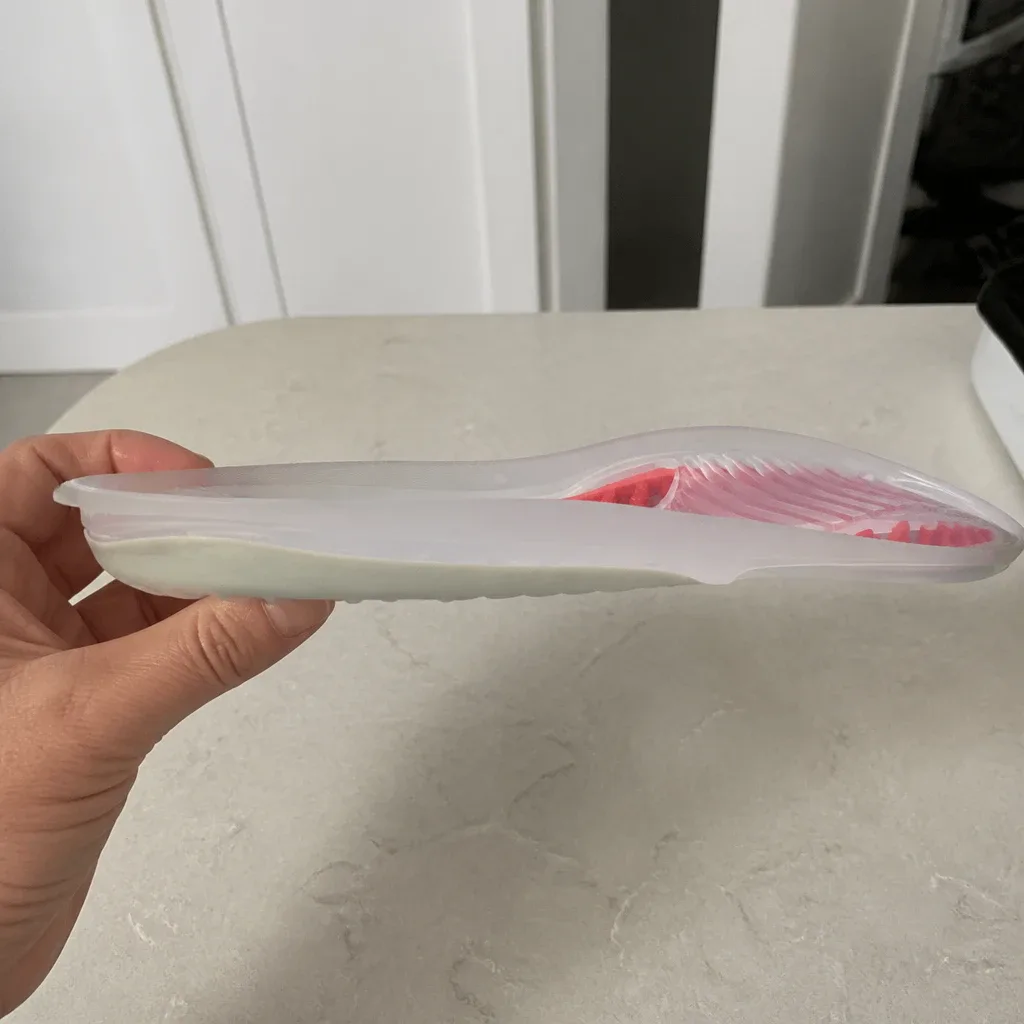
The added stack height came to maybe 3–4mm extra under my heel, not enough to change my stance or disrupt my setup for the lift, and I felt firm pressure under the arch under load but nothing sharp or painful even at 135 lb.
That same steadiness is what long-term owners report as well. Comfort on Aline insoles builds gradually over a wearing session rather than arriving in the first few minutes, and several owner accounts describe the first wear as stiff, with comfort improving as the insole breaks in over days of use. Support is generally described as even across the foot rather than skewed toward one side, and the top surface provides grip rather than a slick or slippery feel underfoot.
Owners who wore the insoles across multiple activities, running, cycling, hiking, walking, and standing at a desk, reported consistent performance across those activities without needing to swap pairs. One owner reported wearing the same model for over fourteen years and described relief from plantar fasciitis that became pain-free over that period. Push-off feel is described as supportive during athletic movement, with one long-term owner reporting improved balance and reduced fatigue during golf rounds and workouts.
What's Aline's Policy If You're Not Satisfied?
Aline states that its goal is for every customer to be satisfied with their purchase and that the company will work with customers to resolve issues if that isn't the case. No fixed return window or restocking terms were confirmed in available sources; the policy is described only as a satisfaction guarantee where the company works directly with the customer.
What Are Reviewers Saying About Aline Insoles?
Reported complaints center on the insole's upfront rigidity, price relative to competitors, occasional fit issues from missing tabs on certain pairs, and a squeaking noise that developed in one pair after months of use. Order and account-management issues, including duplicate shipments and login problems, were also reported by some buyers, separate from the product itself.
Is There a Cheaper Alternative to Aline?
No directly comparable competitor was confirmed for this review, no source data ties a specific rival product to a matching price and construction for Aline's rigid rib-and-suspension design. As a general reference point, off-the-shelf rigid-shell orthotic insoles from other brands typically run $30 to $55, below Aline's $34.99–$109.99 range, though those alternatives use a molded arch shell rather than Aline's rib-and-suspension structure, so the two are not a like-for-like swap.
What Shoe Types Do Aline Insoles Work In?
Aline insoles are designed to be low-volume, fitting into sneakers, work boots, dress shoes, and slippers without altering the shoe's fit. If I only bought one pair, I'd put them in whichever shoes I wear the most hours in, which for me meant my work shoes given the daily 8-hour commitment. Between prioritizing the shoes I stand in versus the ones I run in, the standing shoes won out first, since fatigue built up faster over a full shift than over a 30-minute run.
Those work shoes, a pair of standard leather sneakers with a nearly flat stock footbed and zero arch structure, gave me the fastest relief once I swapped the Aline in. Between the shoes I walk in the most and the ones that actually hurt my feet, I'd lean toward the ones that hurt, since that's where the extra arch support and heel cup made the most noticeable difference. For fit, I left a small gap at the toe rather than trimming the insole flush, following the fitting note that came with mine, roughly half a centimeter, just enough that my longest toe wasn't brushing the front edge.
Installation requires removing the shoe's original insole first; the company states that if a shoe has a removable insole, an Aline will fit in it. The line is organized both by insole type and by shoe/activity category, including running, hiking, cycling, golf, tennis, basketball, skate, ski, and work non-slip footwear. One long-term owner reported that a newer pair arrived without the tab feature present on earlier pairs, which had been used as a fit-adjustment reference point in prior purchases.
How Do You Keep Aline Insoles Fresh and Odor-Free?
Aline insoles are designed to handle moisture and sweat during high-intensity or long-duration wear rather than requiring specialized care, and that matched my own experience. I didn't need to clean these every week; a wipe-down with a damp cloth every two weeks kept odor from building up. Even after a sweaty gym session, air-drying them out of the shoe overnight was enough to keep them from smelling by the next day, so I never felt the need to wash after every single workout.
I avoided soaking them or machine washing and stuck to spot-cleaning with a damp cloth and mild soap, which didn't affect the arch's firmness at all over the test period. One owner separately reported heavy sweat exposure during workouts without the insole degrading. No dedicated cleaning-method attributes beyond general moisture handling were confirmed for this model in available sources.
What Are the Risks of Wearing Aline Insoles?
The rigid plastic shell can produce noticeable pressure and initial discomfort during the first wear.The initial stiffness felt like normal break-in rather than a sign of bad insoles on my own pair: my first two days felt noticeably firmer than by day six, once my feet had adjusted to the added structure, and the pressure I felt under the arch those first few days eased up without ever crossing into real pain. I kept wearing mine through that break-in period since the sensation stayed as pressure rather than pain, and I'd pull them if it ever turned sharp or localized to one spot.
Over the full eleven weeks I never got a single blister, though I did notice a bit of heel slip the first two days before the gel heel cup settled into my shoe. Not every owner's experience matched mine, though: one owner reported the insoles as painful immediately after installation, describing them as hard plastic rather than a cushioned product, and another owner reported new knee and hip pain after wearing the insoles, stating they were switching back to a custom orthotic as a result.
A separate long-term owner reported a squeaking noise developing from the insole after six months of regular use in golf shoes, an issue that had not been present when the pair was new, a longer-term complaint my own eleven-week test wasn't long enough to confirm or rule out either way.
How Much Do Aline Insoles Cost?
Aline's current lineup ranges from $34.99 for the Red All Day model up to $109.99 for the 2026 Carbon Series Traction and Cushion models. Regular list prices run from $99.99 to $109.95 before discount pricing. Individual Amazon listings for older non-Carbon models price between $59.99 and $99.95 depending on the specific insole and color/size variant.
The Red All Day model tested for this review belongs to Aline's older Red/Green/Yellow line, which the brand's own site describes as being phased out in favor of the newer 2026 Carbon Series. Pricing above reflects what was available at the time of research; check the current listing before buying, since the exact model on sale may have shifted toward the Carbon Series by the time you're shopping.
Where's the Best Place to Buy Aline Insoles?
Aline insoles are sold directly through the brand's own website and through Amazon, where multiple ASIN listings cover different models, colors, and sizes. Amazon listings show the product as sold by third-party sellers such as INVENTEL Products and shipped by Amazon. Availability varies by retailer, and the Red All Day model tested here is listed on Amazon under its own ASIN separate from the Traction and Carbon Series listings.
Who Benefits Most From Aline Insoles?
Aline markets its insoles toward people with plantar fasciitis, bunions, heel spurs, joint pain, and general foot, hip, knee, or back pain tied to alignment. This is the brand's own marketed condition list, not a clinical endorsement or a claim independently verified here. The company positions the product for both everyday wearers on their feet all day and athletes across running, cycling, golf, and court sports. It is sold as an over-the-counter insole rather than a custom or prescription orthotic; no FDA clearance or HSA/insurance eligibility was confirmed in available sources.
Owners who reported the most satisfaction were those who wore the insoles consistently across months or years and used them for chronic conditions like plantar fasciitis. Owners who reported dissatisfaction most often cited the upfront cost relative to the initial stiffness, or a mismatch between the rigid design and their own foot condition. My own eleven weeks of testing lines up with the satisfied side of that split: the rigidity that put some owners off was exactly what held its shape under my own standing shifts and a 135 lb deadlift.
Aline Insoles: Full Specs
Pressing on the arch with steady thumb pressure, it held its shape and pushed back rather than bottoming out, with the internal support ribs flexing slightly instead of compressing flat. Twisting it heel-to-toe, I'd grade the stiffness at a 4 out of 5, noticeably firmer than the stock insole it replaced, which twisted almost freely by comparison, and it took both hands and real effort to flex it through a full torsion cycle.
| Spec | Details |
|---|---|
| Brand | Aline |
| Model tested | Red All Day Insoles |
| Height (packaged dimension, per Traction listing) | 1.5 inches |
| Length (packaged dimension, per Traction listing) | 14.0 inches |
| Width (packaged dimension, per Traction listing) | 5.0 inches |
| Weight | 0.48 lbs |
| Sizing range | XSmall (M 5-6 / W 6-7) through XXLarge (M 12.5-13.5 / W 13.5-14.5) |
| Color options (by model) | Red (All Day), Green (Traction), Yellow (Cushion) |
| Rated wear life | Up to 12 months under normal use; signs of wear can appear after 6 months under extreme use |
| Price (tested model) | $34.99 list; sale price paid was $34.99 |
| Amazon customer rating (Traction, Green) | 4.2-4.3 out of 5 stars (64-217 ratings across listings) |
| Aggregate reviews.io rating | 4.5 out of 5 based on 424 reviews, 88% recommend |
| Torsion stiffness (tested) | 4 out of 5, graded by hand-twisting heel-to-toe |
| Thumb-press arch response (tested) | Held its shape and pushed back, no collapse over eleven weeks of wear |
Source: Aline's own site (alineinsoles.com), Amazon product listings, reviews.io, and my own testing of the Red All Day Insoles.
Wrapping Up: Is Aline Worth It?
Across my own eleven weeks of testing, the Red All Day held up exactly the way its rigid, rib-and-suspension design would suggest: it didn't compress, didn't lose torsion stiffness, and only squeaked once, a problem baby powder fixed for good. That durability lines up with the majority of owners, whose aggregate scores land around 4.2 to 4.5 out of 5, even though rigidity is also the single most repeated complaint in that same review pool.
The trade-off to expect going in is the same one I felt myself: a genuinely stiff first few days that eases by about day six, not a soft, cushioned insole that feels good the moment you put it on. That upfront stiffness is exactly why some owners regret the purchase and others, like the long-term buyer who reported fourteen plantar-fasciitis-free years on the same model, consider it worth every bit of the break-in.
At $34.99 for the Red All Day model and up to $109.99 for the newer Carbon Series, Aline sits mid-to-high for a rigid OTC insole. It suits people who are on their feet most of the day, want a shell that holds its shape under real load, and can tolerate a real break-in period; it's a poor match for anyone who wants immediate cushioned comfort or can't tolerate initial pressure under the arch.
Michal Sieroslawski is an Entrepreneur, exercise physiologist, and personal trainer who has fitted over a thousand people with insoles. He holds a degree in Sports and Exercise Science from the University of Central Lancashire, where he studied biomechanics, anatomy, and exercise physiology. Since 2020, Michal Sieroslawski has helped local and online businesses get found in Google and AI search.