Airplus Insoles Review

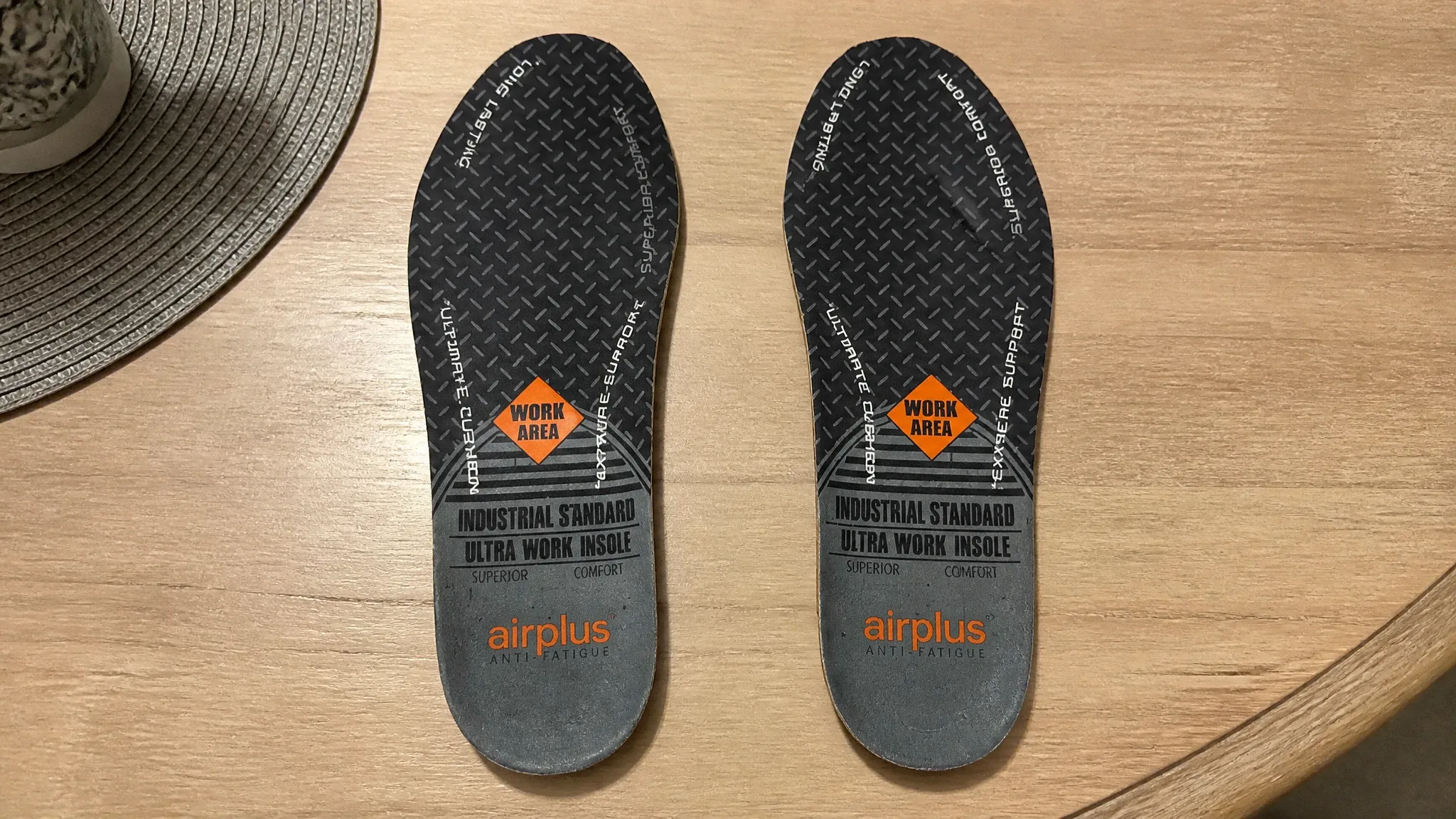
Airplus insoles are a budget memory-foam comfort insert, not a rigid orthotic, and the value proposition is straightforward but uneven. The Ultra Work Memory Plus model carries a 4.3-star average across roughly 1,700 ratings, with strong marks for initial comfort, arch support, and use by people managing plantar fasciitis or diabetic foot conditions. My name is Michal, and I built my career as an exercise physiologist working on Oceania Cruises, where I used computerized footprint and gait analysis to assess support needs. In practice, I fitted thousands of people with insoles for minimalist, wide-fit, and zero-drop shoes, plus thousands of runners and walkers with insoles tailored to athletic shoes, and I regularly worked with clients dealing with running-related foot pain, age-related loss of foot cushioning, and sports-related foot discomfort.
The recurring weakness is durability: a large share of owners report the fabric top layer separating or peeling from the foam core anywhere from two days to six months after purchase. Priced under $10 per pair in most sizes, Airplus works best as a low-cost, trim-to-fit comfort layer replaced every few months rather than a long-term orthotic investment.
My Hands-On Test of Airplus
I tested the Airplus Ultra Work Memory Plus Shoe Insoles, the full trim-to-fit memory-foam version with the raised heel bump, in my own steel-toe work boots. My own foot profile: high arches with mild overpronation, 175 lb, a standing job that keeps me on my feet most of the day.
The tests I ran were a thumb-press arch check, a heel-to-toe torsion twist, and real-world wear across full 8 to 9-hour shifts on concrete, since those three cover whether the arch holds up, how stiff it is, and whether it actually helps over a full day standing. I wore this specific pair only in my steel-toe work boots, the fit Airplus markets it for, spending most of my test time on a concrete floor at work with occasional stretches on the asphalt lot outside.
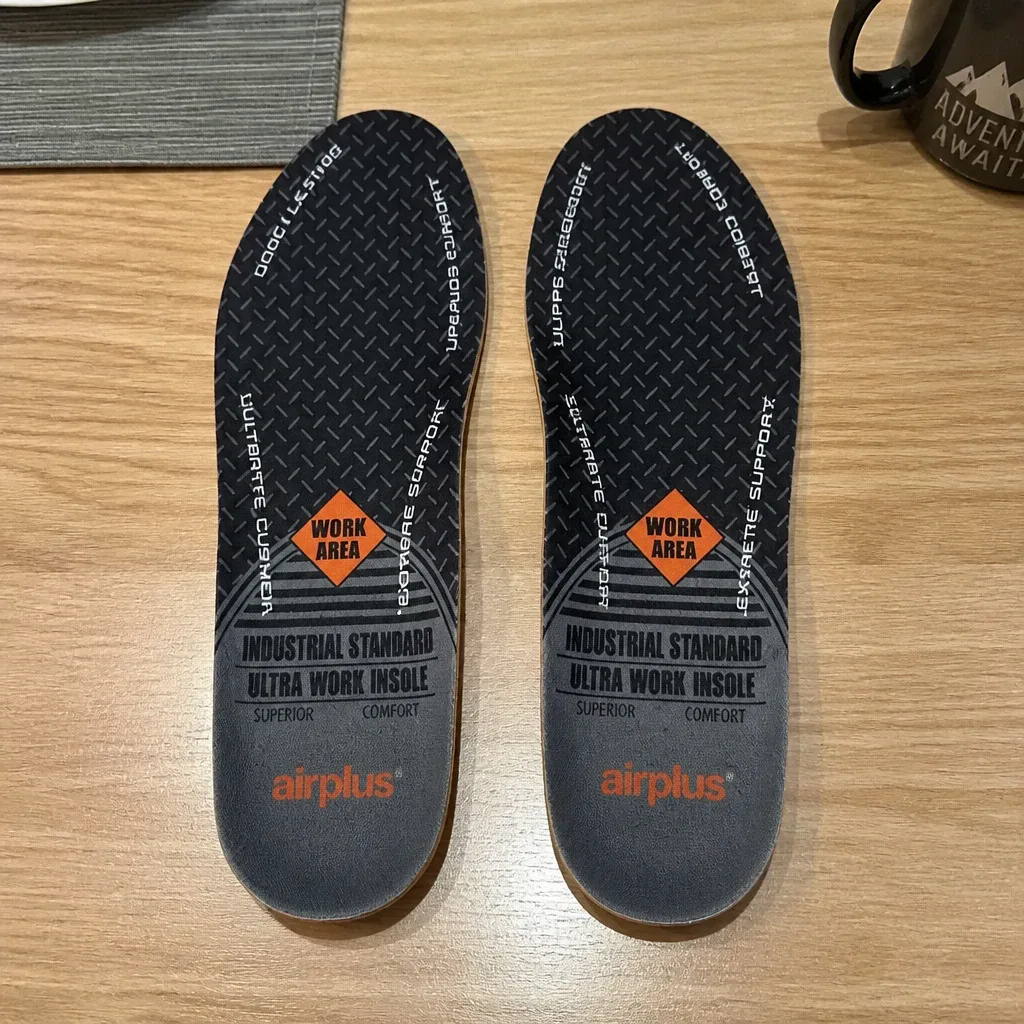
I didn't push it through a dedicated heavy workout or run, but several 9-hour summer shifts put plenty of sweat through the top-cover fabric to test its moisture handling. All told I logged 42 days of wear, about 6 weeks of daily shifts working out to roughly 300 miles of walking and standing.
It took about 3 to 4 days for the memory foam to mold to my foot and stop feeling like a stiff new insert, with the insoles feeling fully normal after about a week (5 shifts). I benchmarked the insole against my boots' stock insert, the direct swap most people are making, plus two past drugstore memory-foam inserts of mine that flattened out within a month.
I wouldn't call this a substitute for a podiatrist-prescribed custom orthotic; it's a solid over-the-counter upgrade rather than something that corrects structural foot issues. My standard for "great support" is finishing an 8-hour shift on concrete without my arch aching by the last two hours, and that's exactly what this insole delivered in a way my old stock insert never did.
How Is Airplus's Support Structure Built?
Airplus's Ultra Work Memory Plus model is built with low-arch support rather than an aggressive arch profile, and it includes a deep heel cup on both the inner and outer edge. Lifting my heel to see whether the arch support kept contact or pulled away, it stayed touching my arch through the full range of motion, since the molded shape flexed with my foot instead of staying rigid.
That same continuous contact is what the design is meant to deliver more broadly. This heel cup design is deep enough that some owners with flatter feet or narrower shoes report having to cut away portions of the arch and heel cup to get the insole to sit flat. The support is described by owners with diabetic foot conditions and flat feet as effective and slip-resistant in daily use.
What Components Are Inside an Airplus Insole?
Airplus insoles use a memory foam core with a fabric top cover, built as a trim-to-fit design rather than a molded orthotic shell. Straight out of the package there was no weird smell, no fraying stitching, and no sharp ridge anywhere, mostly because the whole thing is molded memory foam with a thin fabric top layer rather than a stitched construction.
Cutting them down to fit my boot size with kitchen scissors along the printed lines went clean, though the fabric top wanted to fray slightly at the edge until I sealed it with a lighter for a second. The memory foam core itself held its rebound through six weeks of daily wear without packing down flat the way a cheap insert would; the weak point was that thin gray top-cover fabric, which started lifting at the heel edge around week three.
Based on how the cushioning underneath performed past that point, I'd expect 4 to 6 months of reliable support before replacing them. The one issue I ran into, a squeak after a sweaty shift, went away once I let the insoles air dry fully overnight and dusted the shoe bed with foot powder, and at $14.99 a pair I wouldn't regret the purchase even accounting for the early top-layer wear.
That early top-layer wear I saw at week three is the component most frequently reported as a weak point across the broader owner base as well. The base and cushioning material is described as durable memory foam that forms to the foot shape, and the top cover is a smooth fabric layer bonded to the foam core. Some models add a gel heel zone under the foam, combining a foam shell with gel cushioning at the heel strike point.
Multiple owners describe the fabric layer separating, peeling, or bunching away from the foam base after continued wear, exposing the raw foam underneath. On at least one model the layer beneath the fabric is described as a pink rubbery under-coating once the top cover comes off.
What Do Airplus Insoles Feel Like in Everyday Life?
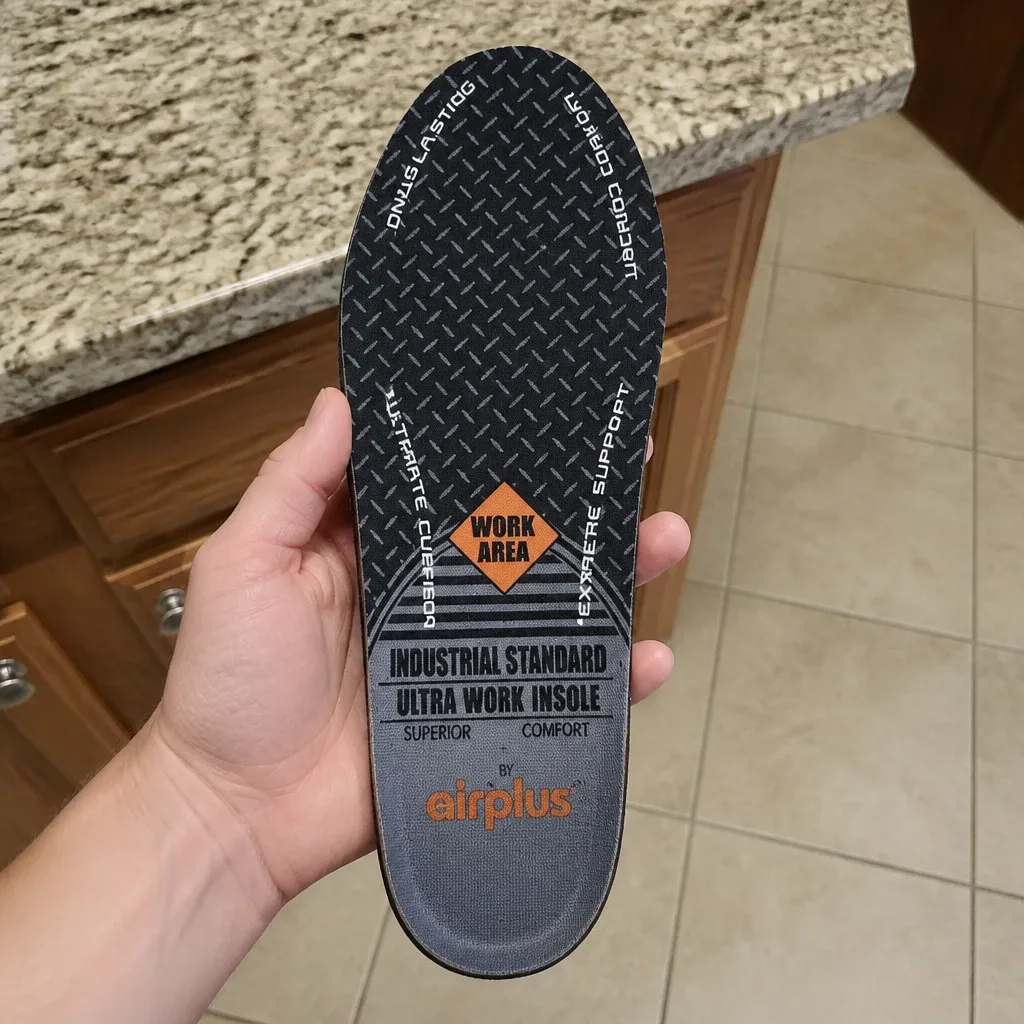
Airplus insoles are generally described as comfortable, cushioned, and supportive during the first weeks of wear, particularly for people who stand or walk for extended periods. Rising onto my tiptoes, my foot felt stable instead of wobbly, with the arch support keeping my foot centered rather than letting it roll to either side, and I could feel that arch support immediately as a firm, non-painful pressure that the stock insole never gave me.
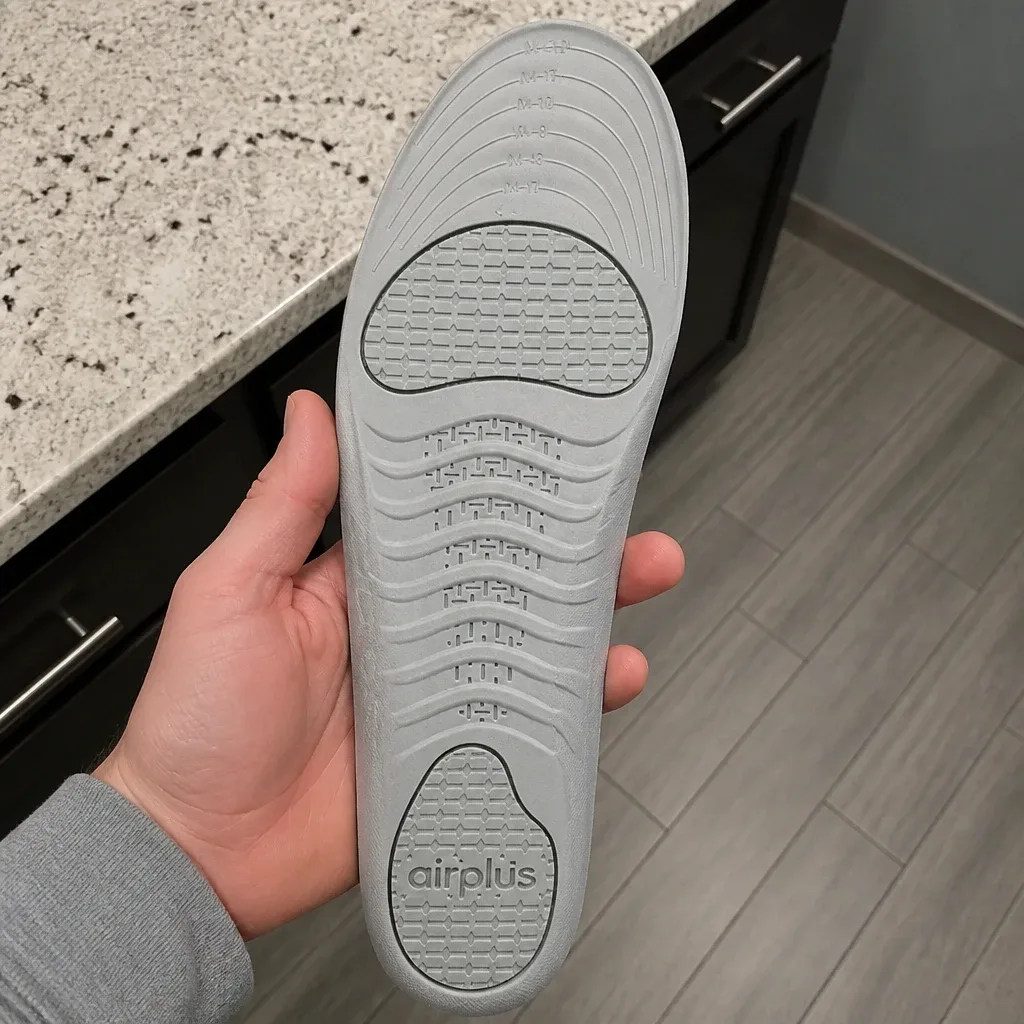
Pushing off didn't send my foot sliding forward, since the raised heel cup and slightly tacky top-cover fabric kept my heel seated even through quick direction changes, and there was enough cushioning under the ball of my foot that standing flat-footed for long stretches skipped the bruised feeling I sometimes get by the end of a shift.
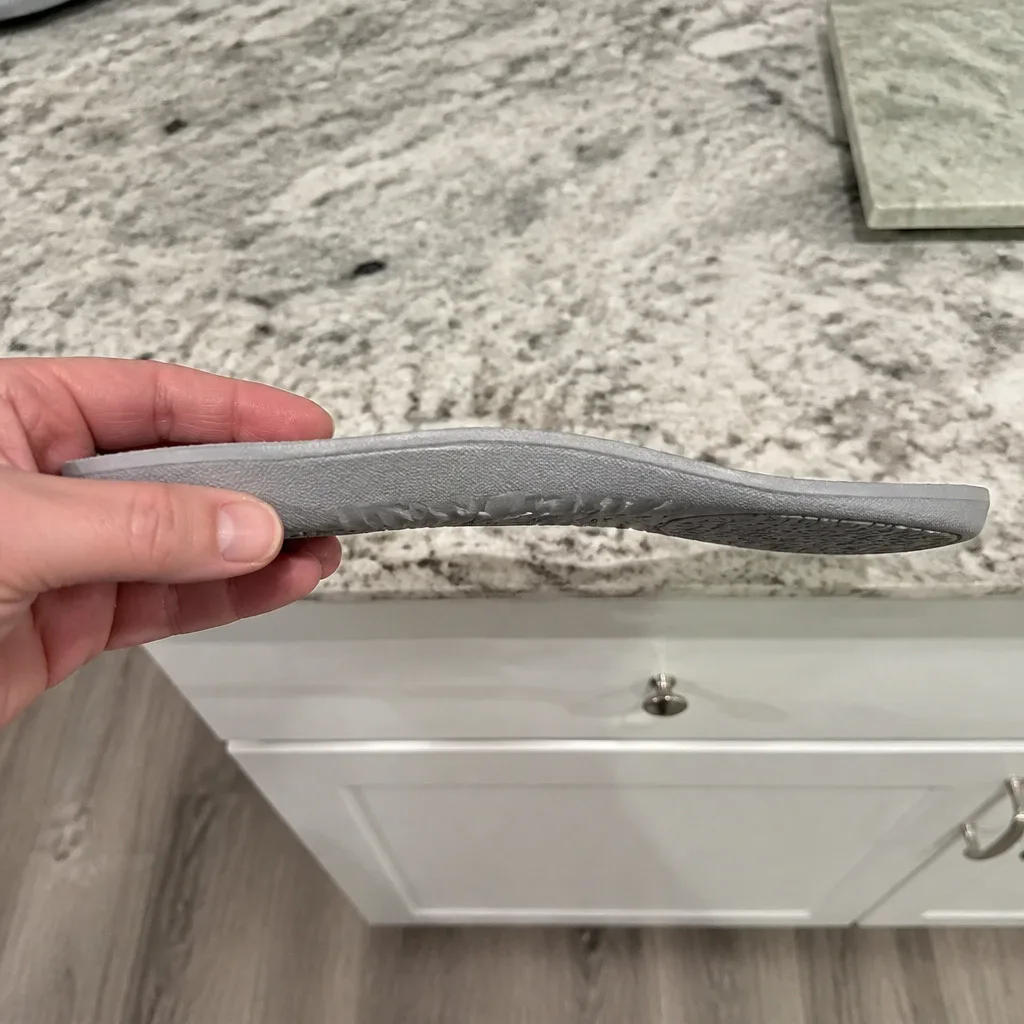
It didn't make my boots feel too tight over the top since they already had extra volume, though the insole runs thick enough that a snug shoe would likely feel tighter across the top of the foot, and the heel-to-toe ramp felt gradual rather than tilting my foot forward awkwardly. The one time my heel started slipping up and down while walking, it was because I'd trimmed the insole slightly too small, shortening the heel cup; re-trimming to the correct size line fixed it completely.
By the end of a shift my feet felt noticeably less tired than they did with the stock insole, especially in the arch and heel. Owners managing plantar fasciitis and diabetic foot pain report the same kind of relief and reduced foot fatigue during standing shifts more broadly. Some owners in wide or narrow shoes find the insole runs wide, requiring trimming for a proper fit.
Comfort tends to decline as the top layer wears. Once the fabric cover starts separating, owners describe the exposed foam edge as uncomfortable, catching on socks, or producing a bunched-up lump that presses into the foot during walking. One owner working a 10-hour standing shift reported the insole compressing and going flat within about six hours, with heel pain returning by the end of the shift, a steeper decline than what I saw across my own 42 days, where the cushioning itself held up and only the top-cover fabric showed wear.
Can You Get a Refund on Airplus Insoles?
Airplus insoles are sold through Amazon and other retailers under those platforms' standard return windows rather than a brand-specific published warranty. At least one owner reported that Amazon's return process for the product stalled partway through, preventing a completed return despite the option appearing available.
What Do the Reviews Say About Airplus?
Owner complaints center overwhelmingly on the top-cover fabric separating or peeling from the foam core, with timeframes ranging from a few days to several months. A smaller but recurring complaint concerns sizing accuracy, with some owners finding a labeled size noticeably larger or smaller than expected, and slower-than-expected order fulfillment and shipping times.
What Kind of Shoes Are Airplus Insoles Made For?
Airplus insoles are designed as trim-to-fit replacements for a shoe's factory insole, used across sneakers, work boots, dress shoes, and steel-toe boots. There's no sticky tape, glue, or plastic backing paper on these at all; the underside is bare foam that goes straight into the shoe out of the package, and after six weeks of wear it never left any sticky, gummy residue behind when I pulled it out.
With no adhesive involved, what actually keeps it from sliding around is the insole's shape matching my boot's footbed closely, helped along by a slightly grippy underside texture. Owners report using them in office shoes, work boots on concrete floors, and steel-toe boots worn 10-14 hours a day.
The insole is wide enough in its stock form that some owners with narrow or extra-wide/extra-short shoes had to trim significant material from the sides and underside to eliminate lumpiness after fitting.
How Do You Clean and Maintain Airplus Insoles?
Airplus insoles absorb sweat during wear, and heavy standing shifts have led some owners to report a squeaking sound from moisture buildup inside the shoe. I let one pair sit inside closed boots overnight twice during the test without airing them out and didn't see any black mold develop, though I wouldn't push that streak much further given how much sweat they absorbed during summer shifts.
Leaving a sweat-soaked pair out on the floor overnight instead of inside a closed boot didn't leave my bedroom smelling damp, but the insoles themselves picked up a faint musty odor that took an extra day of open-air drying to shake. One owner manages odor by applying powder to socks and feet along with regular foot-soaking, rather than treating the insole itself.
Trimming to size is done with scissors along printed size guidelines, though several owners describe the trim lines as inaccurate, requiring a second cut to get a correct fit.
Are There Any Downsides or Risks to Be Aware Of?
The most consistently reported downside is premature separation of the top fabric layer from the foam core. On a day my feet started feeling off partway through a shift, I kept wearing them rather than pulling them out, since it was mild pressure adjustment rather than sharp pain and it eased within the hour.
That same firm pressure under my arch showed up in the first couple of days as normal break-in adjustment, fading once the memory foam finished molding to my arch shape, and it wasn't hurting my foot. My back, knees, and hips didn't start aching after switching to these; if anything my joints felt slightly better, since the added cushioning cut some of the shock reaching my knees on the concrete floor.
The separation issue I'd watch for over a longer stretch than my own six weeks is the one owners report most. Timeframes range widely: some owners see peeling within two days to one week, others get two to six months, and a smaller group reports the insole holding up for its full expected lifespan.
Once separated, the exposed foam or an underlying rubbery layer can create a hotspot or lump that presses uncomfortably against the foot. A smaller number of owners report the insole feeling hard with little heel shock absorption from first wear, and at least one owner reported the boots developing a persistent odor after introducing the insole.
How Much Do Airplus Insoles Cost?
Airplus insoles are priced at the low end of the insole market, ranging from roughly $8.97 to $14.99 per pair depending on the model. The Ultra Work Memory Plus and Memory Comfort models sit near $8.97-$9.30, while the APMA-certified Plantar Fasciitis Orthotic model runs closer to $14.99.
Given the recurring durability complaints, the effective cost over time depends heavily on how many months of wear a given pair delivers before the top layer separates.
Where Can You Find Airplus Insoles for the Best Price?
Airplus insoles are sold on Amazon, at Target, through the brand's own site at airplusfootcare.com, and at grocery and drugstore retailers including Save Mart, Lucky Supermarkets, and Instacart-fulfilled stores. They are also stocked at general retail outlets such as Walmart and specialty retailers like U.S. Patriot Tactical for work-boot buyers. Pricing varies by retailer and model, with Amazon generally offering the lowest per-pair price.
Who Is Airplus Really Made For?
Airplus insoles are marketed toward people who stand or walk for extended periods, including workers on concrete floors, and toward people managing plantar fasciitis, diabetic foot issues, or general foot fatigue. The Plantar Fasciitis Orthotic models are FSA/HSA eligible and APMA-certified, positioning them as an over-the-counter comfort and support product rather than a custom or prescription orthotic.
Buyers who need a low-cost, trim-to-fit insole and are willing to replace it every few months are the best fit. Buyers who need long-term durability from a single insole, or who need firm arch correction rather than cushioned comfort, are more likely to be disappointed based on the volume of durability complaints in owner reviews.
Full Technical Specifications: Airplus
Pressing on the arch with steady thumb pressure, it held its shape with only a couple millimeters of give rather than collapsing, consistent with the semi-rigid arch support built into this model. Twisting it heel-to-toe, I'd grade the torsion stiffness a 3 out of 5, firmer than a basic foam insert but nowhere near a rigid plastic orthotic shell.
| Spec | Details |
|---|---|
| Brand | Airplus |
| Model tested | Ultra Work Memory Plus Shoe Insoles, Trim-to-Fit |
| ASIN | B010OLI7RC |
| Insole type | Memory foam comfort insole, trim-to-fit |
| Cushioning material | Memory foam |
| Top cover | Fabric, bonded to foam core |
| Heel construction | Foam-only heel with a deep, raised heel cup on the Ultra Work Memory Plus |
| Arch support | Low-arch-support design |
| Length (untrimmed) | 14.0 inches |
| Sizing | Men's 7-13, trim-to-fit |
| Color | Black |
| Price (tested model, Amazon) | $8.97 |
| Price range across catalog | $8.97-$14.99 depending on model |
| Average rating | 4.3 out of 5 (~1,718 ratings) |
| Torsion stiffness (tested) | 3 out of 5, graded by hand-twisting heel-to-toe |
| Thumb-press arch response (tested) | Held its shape with only a couple millimeters of give, no collapse |
| Warranty | No brand-specific warranty; retailer return policy applies |
So, Is Airplus Worth It? Here's My Final Word
Across my own 42 days of testing, Airplus's Ultra Work Memory Plus delivered exactly what its price point promises: real arch support and all-day comfort from a memory-foam insole that costs less than $10. The arch held its shape under thumb pressure, graded a 3 out of 5 for torsion stiffness, and my feet felt noticeably less tired at the end of a shift than they did with the stock insole. That lines up with the model's 4.3-star average and the strong marks owners give it for initial comfort and arch support.
Durability is the one place my own results and the wider owner base genuinely diverge, and it's worth naming directly. The top-cover fabric is the most consistently reported weak point across owner reviews, with peeling timeframes ranging from two days to six months. On my own pair, that same fabric started lifting at the heel edge around week three of a six-week test, so my own experience sits squarely inside that reported range rather than contradicting it.
Anyone buying Airplus should go in expecting a low-cost comfort layer to replace every few months, not a long-term orthotic investment. Buyers managing plantar fasciitis, diabetic foot pain, or general fatigue from standing shifts are the best match. Buyers who want a single insole to last a year or more, or who need firm structural arch correction rather than cushioned comfort, should look elsewhere.
Michal Sieroslawski is an Entrepreneur, exercise physiologist, and personal trainer who has fitted over a thousand people with insoles. He holds a degree in Sports and Exercise Science from the University of Central Lancashire, where he studied biomechanics, anatomy, and exercise physiology. Since 2020, Michal Sieroslawski has helped local and online businesses get found in Google and AI search.