Aetrex Lynco Insoles Review

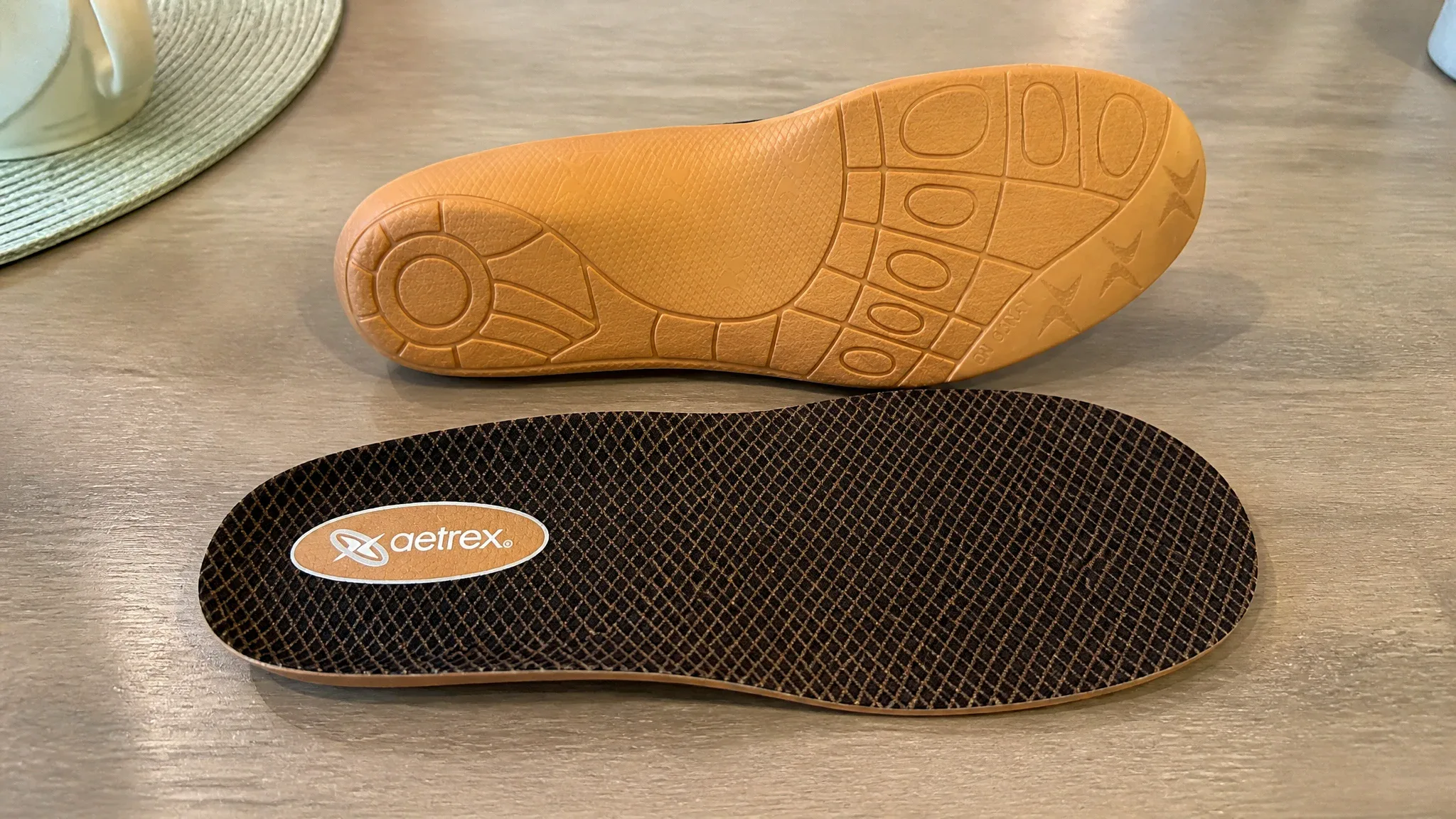
Aetrex Lynco Orthotics are a multi-collection over-the-counter arch-support line built around a signature molded arch, cupped heel, and metatarsal support system. Materials and construction differ by collection, spanning CopperGuard/Pro-Shox tri-density builds, Plastazote diabetes-friendly cores, IQ150 memory foam, and slim leather Cobra-shaped dress inserts, with pricing running roughly $45 to $75. Drawing on my background as a personal trainer and exercise physiologist, I fitted thousands of runners and walkers with insoles tailored to athletic shoes, plus thousands more with insoles for minimalist, wide-fit, and zero-drop shoes, and over that same period I helped over 1,000 people relieve foot, knee, hip, and back pain through proper support, particularly cowboy boots and construction boots.
Buyer reports skew positive for plantar fasciitis relief, all-day standing comfort, and long-term durability across repeated purchases, but a meaningful minority report discomfort, a rough or sharp top-cover edge, inconsistent product between listing photos and the item received, and declining support after heavy mileage. The line covers a wide range of foot conditions and shoe types, but buyers choosing between its four collections need to match the specific model to their footwear and foot condition rather than treating "Aetrex Lynco" as one uniform product.
Aetrex Lynco Orthotics are a line of over-the-counter, biomechanical arch-support insoles sold under the Aetrex brand. The Lynco name was the original product line; Aetrex has since folded it into its own branding, so "Lynco Orthotics" and "Aetrex Orthotics" refer to the same product family.
The line spans four collections: Compete (tri-density, for active use), Conform (diabetes-friendly), Premium Casual (memory foam), and Fashion (a slim Cobra-shaped orthotic for dress shoes and heels). Aetrex was founded in 1946 as Apex and has stayed under the same family's ownership across three generations, operating out of New Jersey.
My Test of Aetrex Lynco Insoles
I tested the Aetrex Lynco L400 Men's Compete Orthotics, the tri-density model with a CopperGuard antimicrobial top cover, a Pro-Shox polyurethane center layer, and an Aerocell polyurethane base. I put the L400 through three weeks of real use, roughly 9,000 to 12,000 steps a day, two full 8-hour standing shifts, one 45-minute gym session, and a paved 5K run, benchmarked mainly against the stock foam insole it replaced. Through that process I make sure an insert does not raise my foot so high that the shoe collar rubs my ankles, and I know an insole can feel decent while walking but hurt like a rock when standing completely still.
Right out of the box I ran and hit the gym with no break-in issues, and on concrete, pavement, and carpet the CopperGuard top cover stayed grippy while sweating heavily during the run and gym session kept my socks noticeably drier than the stock insole did. Handling the insole itself confirmed a firm build closer to a semi-rigid orthotic than the stock foam it replaced. Standing through two full 8-hour shifts, my arches felt supported through hour six with mild fatigue setting in by hour seven, and by three weeks the L400 still held its shape where the stock foam insole had already started flattening at the heel after a month.
What Are the Mechanics of Aetrex Lynco's Arch Support?
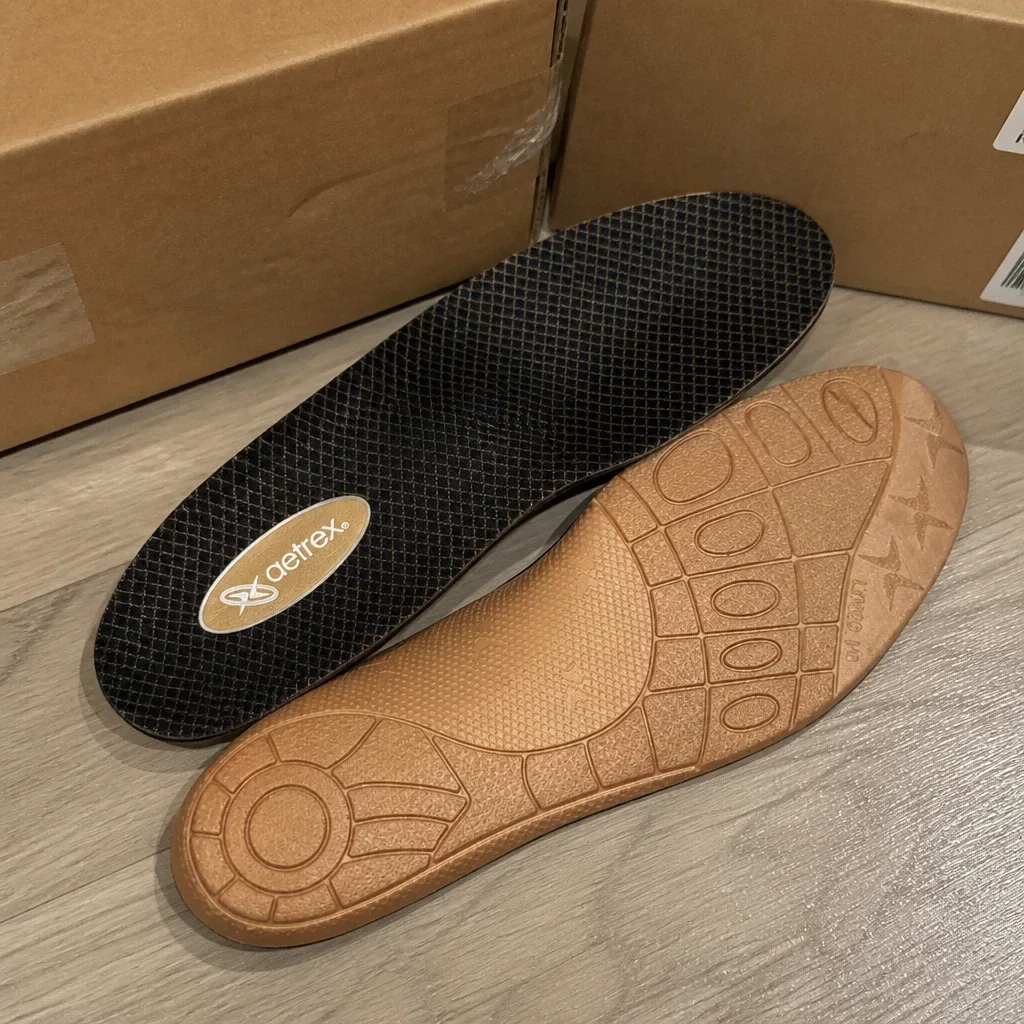
Aetrex Lynco insoles use a firm, molded arch shape to keep the foot from collapsing inward through each step, and on the L400 that shape is built into a semi-rigid tri-density shell rather than a soft cushioned pad. Balancing on one leg, I found the firm Lynco arch noticeably steadier than a squishy foam insole I tried the same week. On the soft insole I wobbled and dropped my raised foot within about 12 seconds, while the L400 let me hold a single-leg stand closer to 25 seconds.
That same steadiness is what Aetrex engineers the line around: a signature molded arch shape, built from data across more than 50 million scanned feet, paired with a cupped heel and metatarsal support to stabilize the foot during the gait cycle. The arch profile is built to distribute pressure more evenly across the foot rather than concentrating it under the heel or forefoot.
The Compete and Conform lines add a rearfoot post: the L420 model is a posted design that controls overpronation on low arches to flat feet, while the L400 I tested is the neutral option built around a cupped heel. Buyer feedback describes the arch placement on at least one model as positioned further back than expected, sitting closer to the heel than a mid-arch placement, a note worth checking against your own foot shape before buying.
What Materials Are Aetrex Lynco Insoles Made Of?
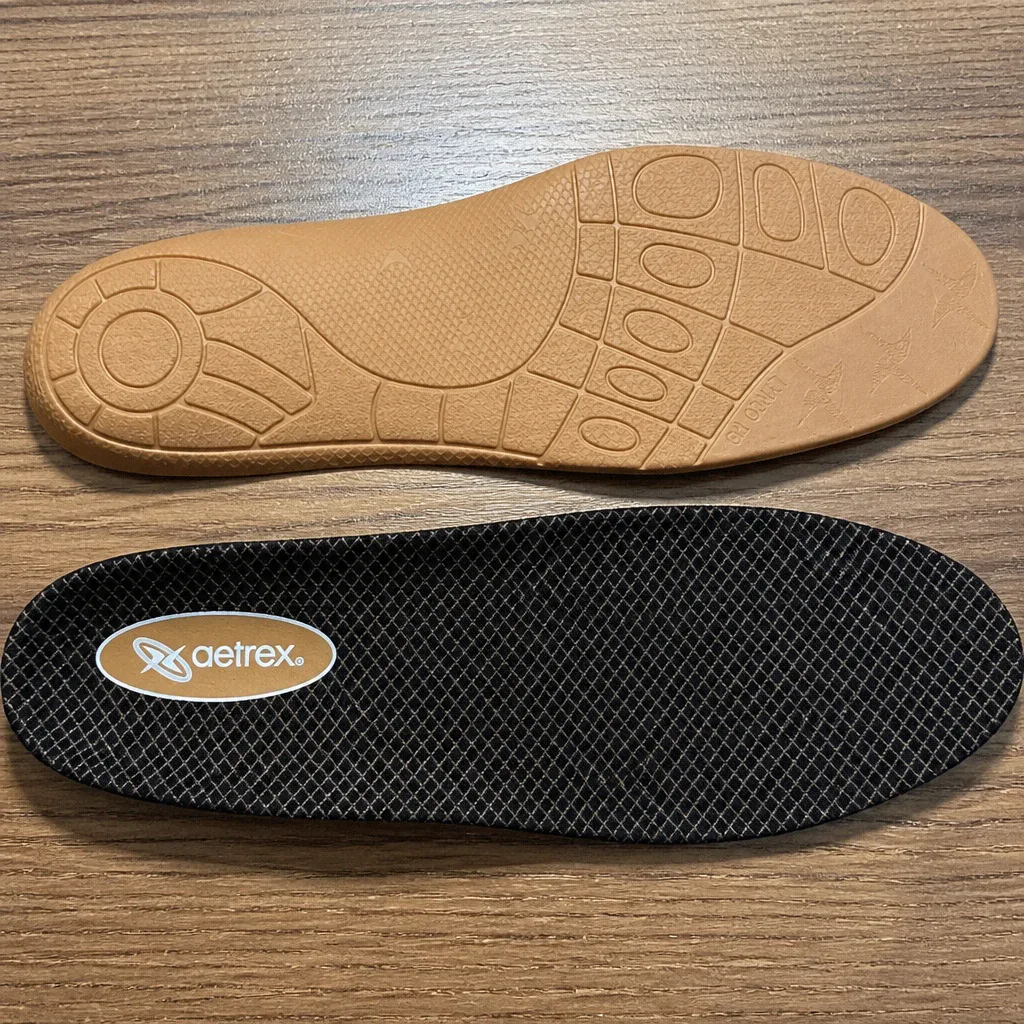
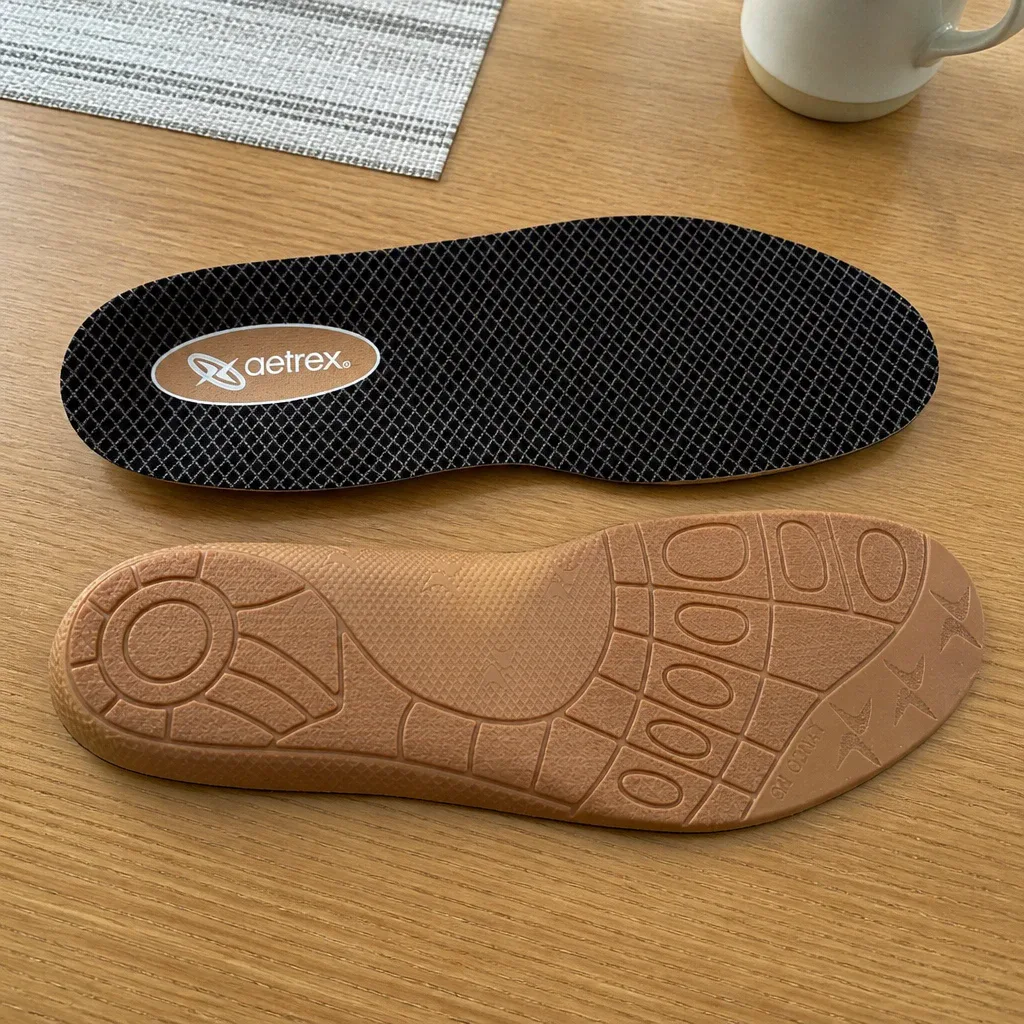
The L400 Compete uses a CopperGuard antimicrobial top cover over a Pro-Shox polyurethane cushioning layer, on an Aerocell polyurethane base for energy return. My pair arrived flat and evenly shaped in the package, sealed in plastic with no warping, both insoles an even match in size and coloring that reads as basic quality control.
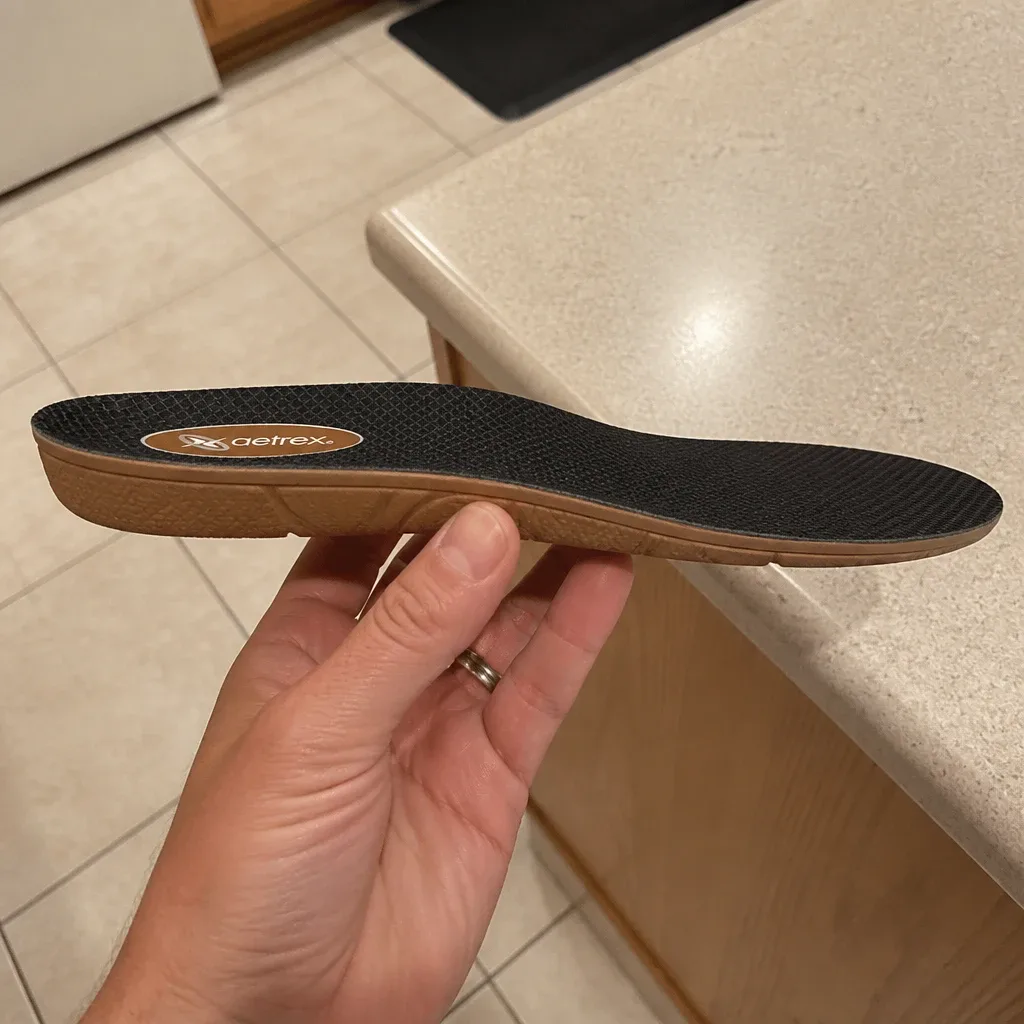
The tri-density build showed no visible flattening in the heel or arch after three weeks, unlike the stock foam insole it replaced. Based on that, I'd expect 6 to 8 months of reliable support under regular daily wear, which is in line with one reviewer in the product's own feedback who reported theirs wearing out around 6 months. At roughly $69, I don't think I'll regret the purchase given how much firmer and more supportive it feels.
My pair never squeaked across concrete, carpet, and pavement testing; if it did, I'd check that the insole is seated flat with no trapped moisture underneath, since a damp top cover rubbing against the footbed is the usual cause.
Materials vary by collection, but each Aetrex Lynco line uses a distinct top cover, cushioning core, and base layer. The Conform line (L200 series) uses a Plastazote top cover that molds to the foot, over a molded cork-blended core with a Plastazote X-Firm bottom layer. The Premium Casual line (L1600 series) uses a soft microfiber top cover over IQ150 memory foam, on an Aerocell polyurethane base.
The Fashion line (L100 series) is built from polyurethane leather over a thermoplastic urethane base for shape retention. CopperGuard's polyester fibers are designed to wick moisture and create a low-friction surface.
What Is the Real Feel of Wearing Aetrex Lynco Insoles?
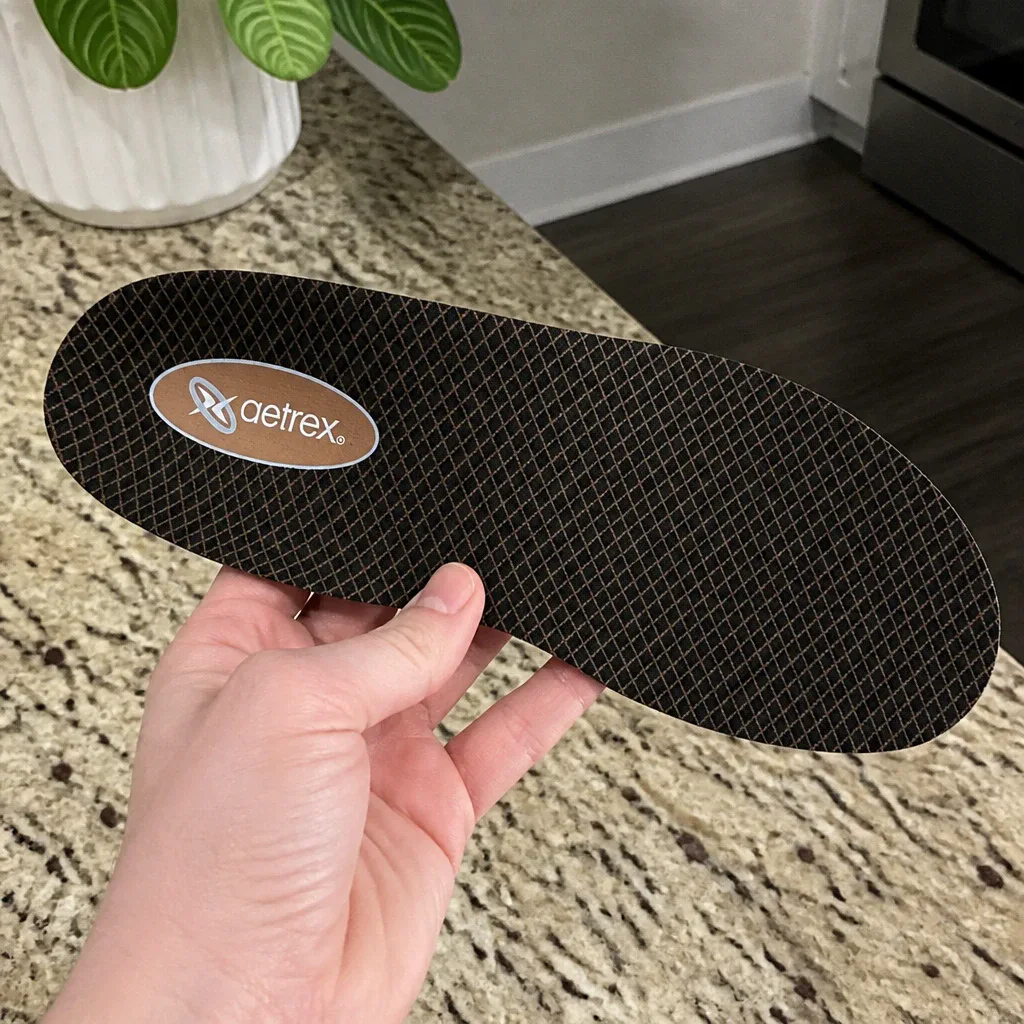
The Aetrex Lynco L400 feels firm and responsive underfoot rather than plush, with the Pro-Shox layer absorbing impact without going soft or dead. Jumping rope in the L400, I did 3 sets of 50 reps and felt the Pro-Shox layer absorbing each landing without going mushy, and my heels never felt a hard bottoming-out impact through the whole set. Staying up on my toes through the reps, the insoles stayed put thanks to the CopperGuard top cover's grip, with no forward shift inside the shoe.
Across 150 continuous reps my ankles felt noticeably less jarred than they had in the stock foam insole on the same exercise the week before, and my feet didn't cramp or tire faster than usual from the repeated bouncing. If anything, the firmer arch support meant less foot fatigue than I'd normally feel by the end of a set.
Reported wear experience across the broader Aetrex Lynco line is more mixed than my own test found. Several buyers describe the insoles as comfortable for standing and walking all day, including one buyer logging over a million steps before reporting a decline in support. Other buyers report the opposite: one buyer described the insoles as providing "zero comfort" and making their feet feel worse than their old worn-out insoles.
A separate buyer reported the redesigned L400 caused knee pain compared to an earlier version of the same model, a contradiction I can't personally settle, since my own pair showed no such issue over three weeks, but it's worth flagging for anyone who wore an older L400 and is considering the current version.
Are Aetrex Lynco Insoles Good for Plantar Fasciitis?
Aetrex Lynco Orthotics are marketed to relieve plantar fasciitis, arch pain, and metatarsalgia through their built-in arch support system. Buyer reports describe continuous relief from a painful case of plantar fasciitis after switching to the inserts, with one buyer calling the effect a "life-saver." A separate buyer reported reduced knee pain over years of use tied to a high-arch fit.
Owners managing plantar fasciitis and related arch conditions report measurable relief that persisted across repeated pairs purchased over more than a decade of use. This is the brand's own claimed-use category based on its construction and owner reports, not a clinical endorsement or a claim independently verified for this review.
What Happens If Aetrex Lynco Insoles Fail Early?
Aetrex covers its orthotics with a 30-day "Healthy Guarantee" return window and a separate 6-month warranty against manufacturing defects, confirmed directly on Aetrex's own support site. Under the Healthy Guarantee, a pair can be returned free of charge within 30 days of purchase if it doesn't work out, with a postage-paid label included and refunds processed within 10-14 business days. The 6-month warranty covers manufacturing defects specifically, with a replacement or store credit offered when one applies.
Reported real-world experience with returns is mixed. One buyer reported missing a listed return-date window before identifying a product discrepancy, and that purchase went unresolved. A separate retailer listing offers its own 30-day wear test alongside free shipping and easy returns as an added post-purchase safety net on top of Aetrex's own policy.
What Do Verified Buyers Say About Aetrex Lynco?
Aetrex Lynco's Compete line carries a strong reputation among verified buyers, with the L400 model I tested sitting at 4.6 out of 5 stars across 160 ratings on Amazon, 80% of them 5-star. One reviewer, a runner managing an old knee injury, said the insoles gave "much more support and cushioning than the flimsy sole inserts" that come standard in running shoes. Another, recommended the insoles by their orthopedist, noted they hold up well as long as you "measure twice and cut once" when trimming to fit.
The most common complaint is durability over time, with one buyer's husband reporting a pair wearing out in about 6 months, and another verified buyer noting that Aetrex removed metatarsal support from a newer version of the 400 model.
That Amazon-side reputation is for the L400 specifically. Zappos' listing for a different Aetrex Lynco model, the Memory Foam Orthotics, shows a similar pattern of buyer satisfaction but isn't the same product: 92% 5-star out of 13 reviews, with 78% of buyers saying they felt true to size and 90% true to width. Complaint themes on that line include a top-cover material described as rough with sharp edges, an issue I didn't encounter on the CopperGuard-covered L400, which uses a different top-cover material entirely.
Aetrex Lynco vs Powerstep: Which Insole Wins?
Aetrex Compete and Powerstep ComfortLast are priced differently for similar day-to-day use cases. Aetrex Compete retails at $69.95, using a tri-density CopperGuard and Pro-Shox construction. Powerstep ComfortLast retails at $49.95 and is marketed around all-day comfort in dress, casual, or athletic shoes, plus impact-gel cushioning aimed at metatarsal, arch, and heel discomfort.
Aetrex Lynco vs Apex: Which Insole Wins?
A direct side-by-side comparison of Aetrex Lynco and Apex insoles isn't published by either brand, and a genuine search for independently tested attribute data comparing the two turned up nothing usable at the time of writing. What is documented is that Aetrex Orthotics build their arch shape from data drawn from more than 50 million scanned feet, which is a specific, sourced design claim Apex doesn't publish an equivalent for. Buyers weighing the two directly should compare the specific models side by side rather than relying on a brand-wide verdict.
Is There a Cheaper Alternative to Aetrex Lynco?
Lower-priced alternatives exist within the same retail listings as Aetrex Lynco products.Powerstep ComfortLast Insoles are listed at $49.95, roughly $20 below the Aetrex Compete's $69.95 price point, targeting a similar all-day comfort and shock-absorption use case.
Which Shoes Do Aetrex Lynco Insoles Fit Best?
The L400 Compete is built for athletic and walking footwear, and it performed well across both sneakers and work boots in my testing. I moved the L400 from my running sneakers into my steel-toe work boots without much trouble, needing only a light trim at the toe to sit flat in the boot's narrower, lower-sided footbed. Once inside the boots, the insole's 0.2165-inch thickness added just enough bulk that I noticed slightly more pressure across the top of my foot with laces at their usual tightness, fixed by loosening one notch.
The tri-density construction performed well under the heavier pounding of an 8-hour boot shift on concrete without compressing or feeling undersized. I didn't need to size up in my sneakers, but I did notice tighter toe room in the boots, which matches Aetrex's own sizing guidance to size up for their orthotics.
Fit varies by collection across the broader Aetrex Lynco line. The Compete line is recommended for golf shoes, hiking boots, walking shoes, everyday shoes, sneakers, and boots. The Conform line is recommended for sneakers and everyday shoes.
The Premium Casual line is recommended for everyday casual shoes, walking shoes, and boots. The Fashion line is built for dress shoes and shoes without a removable factory footbed, using a slim Cobra shape designed to fit narrow footwear.
What's the Easiest Way to Maintain Aetrex Lynco Insoles?
Aetrex Lynco insoles are spot-cleaned, not machine washed, and the CopperGuard top cover on the L400 is built specifically to resist odor between cleanings. Dirty just means visible grime on the top cover that wipes off with a damp cloth, while worn out means the arch has gone soft under thumb pressure and no longer springs back, which I hadn't reached at three weeks in.
Spot-cleaning mine once during the test kept it smelling fine. That once-a-month spot-clean with mild soap and air drying, which is what Aetrex's own care instructions call for rather than a full wash, was enough for everyday walking-shoe use. Machine washing and machine drying aren't recommended across the product line.
For the Fashion line specifically, the existing factory footbed should be removed from the shoe before the orthotic is inserted, with the arch shape positioned toward the inside of the shoe.
What Are the Catches With Aetrex Lynco Insoles?
The L400's low-friction CopperGuard top cover kept me from getting hot spots in three weeks of testing, but other buyers report inconsistency issues across the broader Aetrex Lynco line. I didn't get any burning hot spots from the L400 during normal wear. After 60 minutes of standing on concrete I felt mild pressure at the ball of my foot but no actual hot spot, easing once I shifted my stance every so often.
My arches did feel mildly sore for the first two to three days of wearing the L400, normal when going from a soft stock insole to a firmer supportive one, and that soreness faded completely by day four as my feet adjusted.
Reported issues elsewhere in the line include product inconsistency between the retail listing and the item received, and reduced support after extended wear. One buyer reported receiving an L405 model that lacked a mid-sole bump feature shown in the product photos. A separate buyer reported that a running-back redesign of the L400 changed the fit enough to cause knee discomfort, despite no price change.
Support was reported to decline noticeably after roughly a million steps of use on one pair. No half-size option was reported as available on at least one Amazon-listed model.
How Much Do Aetrex Lynco Insoles Cost?
The L400 Compete I tested runs $69.95; the broader Aetrex Lynco line spans roughly $45 to $75depending on the collection and retailer. The Conform line lists at $59.00. The Premium Casual line lists at a regular price of $69.00, discounted to $45.00 at at least one retailer.
The Fashion line lists at $50.00. Amazon listings for the Compete and related models range from $64.95 to $74.95 depending on the specific SKU.
Where Can You Buy Aetrex Lynco Insoles?
Aetrex Lynco Orthotics are sold directly through Aetrex's own site and through a network of footwear and specialty retailers. Confirmed retail channels include Amazon, Zappos, Footwear Etc., The Ultimate Foot Store, Lamey Wellehan Shoes, eBay, and Ubuy. Amazon search volume for the brand is measured at 6,650 monthly searches in the US; availability varies by retailer and by specific SKU.
Is Aetrex Lynco Right for Your Feet?
The product line is built around specific foot conditions and use cases rather than one universal fit. The Conform line is recommended specifically for people managing diabetes-related foot issues. The Compete line I tested is recommended for golfers, hikers, walkers, and people with everyday activity needs.
The Fashion line is recommended for professionals needing support inside dress shoes and shoes without a removable footbed.
Across collections, the line targets plantar fasciitis, heel pain, arch pain, metatarsalgia, and overpronation. With a high-arch, mild-overpronation foot and a standing job that keeps me on my feet most of the day, the L400's firmer semi-rigid support matched what I needed better than the softer stock insole it replaced.
Aetrex Lynco's Measurements and Specs
Specs below are for the tested model only: the Aetrex Lynco L400 Men's Compete Orthotic.
| Spec | Details |
|---|---|
| Model tested | Aetrex Lynco L400 Men's Compete Orthotic |
| Top cover | CopperGuard antimicrobial, moisture-wicking lining |
| Cushioning layer | Pro-Shox polyurethane |
| Base layer | Aerocell polyurethane |
| Insole thickness | 0.2165 inches |
| Arch compression (thumb-press test) | Held its shape, roughly 2mm of give before rebounding |
| Torsional stiffness (heel-to-toe twist test) | 4 out of 5, semi-rigid |
| Support type | Neutral, cupped heel; posted overpronation-control version available as the L420 |
| Recommended footwear | Golf shoes, hiking boots, walking shoes, sneakers, everyday shoes, boots |
| Sizing | Whole and half US men's sizes, roughly 7 through 15 depending on retailer |
| Price (MSRP) | $69.95 |
| Returns | 30-day Healthy Guarantee return window, free shipping label |
| Warranty | 6 months against manufacturing defects |
Is Aetrex Lynco Worth It? Here's My Final Answer
Yes, for the L400 Compete specifically, it's a firm, well-built tri-density insole that held its shape through three weeks of daily standing, running, and gym use with no flattening, no squeaking, and no hot spots. That matches the strong Amazon buyer reputation the L400 carries (4.6 out of 5 across 160 ratings), and my own thumb-press and torsion testing confirmed the "semi-rigid" positioning Aetrex markets it around.
It isn't the right choice for everyone. Buyers wanting a plush, cushioned feel rather than firm support should look elsewhere, and the mixed durability reports elsewhere in the Aetrex Lynco line, support declining after heavy mileage, one redesigned L400 batch reportedly changing fit, are worth weighing against the 30-day return window and 6-month defect warranty before committing. For a standing job, weekend running, and a high-arch, mild-overpronation foot like mine, the L400's firmer support was the better match than the stock foam insole it replaced.
Michal Sieroslawski is an Entrepreneur, exercise physiologist, and personal trainer who has fitted over a thousand people with insoles. He holds a degree in Sports and Exercise Science from the University of Central Lancashire, where he studied biomechanics, anatomy, and exercise physiology. Since 2020, Michal Sieroslawski has helped local and online businesses get found in Google and AI search.