ActionHeat Insoles Review

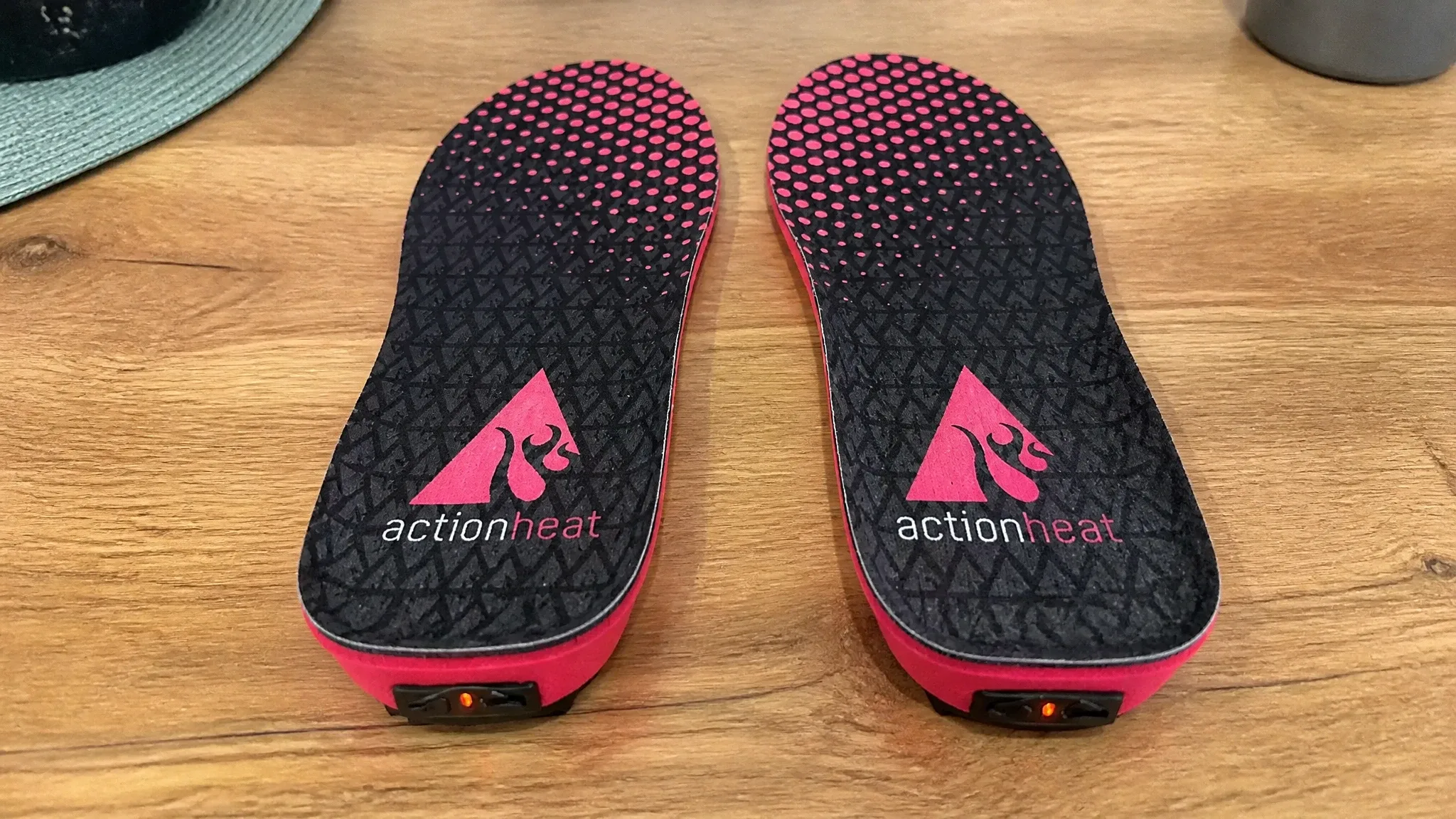
ActionHeat's rechargeable heated insoles deliver adjustable, remote-controlled warmth for cold-weather activity. During my years as an exercise physiologist, I sold insoles for over 8 years as part of my work on Celebrity Cruises. In actual fittings, I evaluated how different foot positions and orthotic inserts alter an individual's overall gait and alignment, including wide-fit shoes, casual boots, and winter boots. The flagship pair uses a built-in 3.7V rechargeable battery and reaches up to 140°F on its highest setting. Runtime drops as heat output rises, matched to whichever of the three heat settings is active.
Materials are a fleece-lined soft shell fabric that has proven comfortable enough for all-day use, including hunting trips lasting many hours. A lower-cost AA-battery version exists for buyers who want heated toes without the rechargeable price tag, though it carries a noticeably lower customer rating. The line is sold direct and through several major outdoor and general retailers, and the rechargeable model in particular holds a strong review average.
What Is ActionHeat Arch Support?
ActionHeat insoles are heated foot warmers, not corrective arch-support orthotics. The product line's defining feature is an integrated heating element rather than structural arch shaping. The flagship SKU is the ActionHeat Rechargeable Heated Insoles with Remote (SKU AH-INS-LI-01), sold as a pair with a wireless remote control.
A separate AA-battery-powered model is also sold under the ActionHeat name. Sizing runs S/M for Men's 4-9 / Women's 5.5-10 and L/XL for Men's 9.5+ / Women's 10.5+, with a cut-to-fit design for final sizing.
What Makes ActionHeat Support Different?
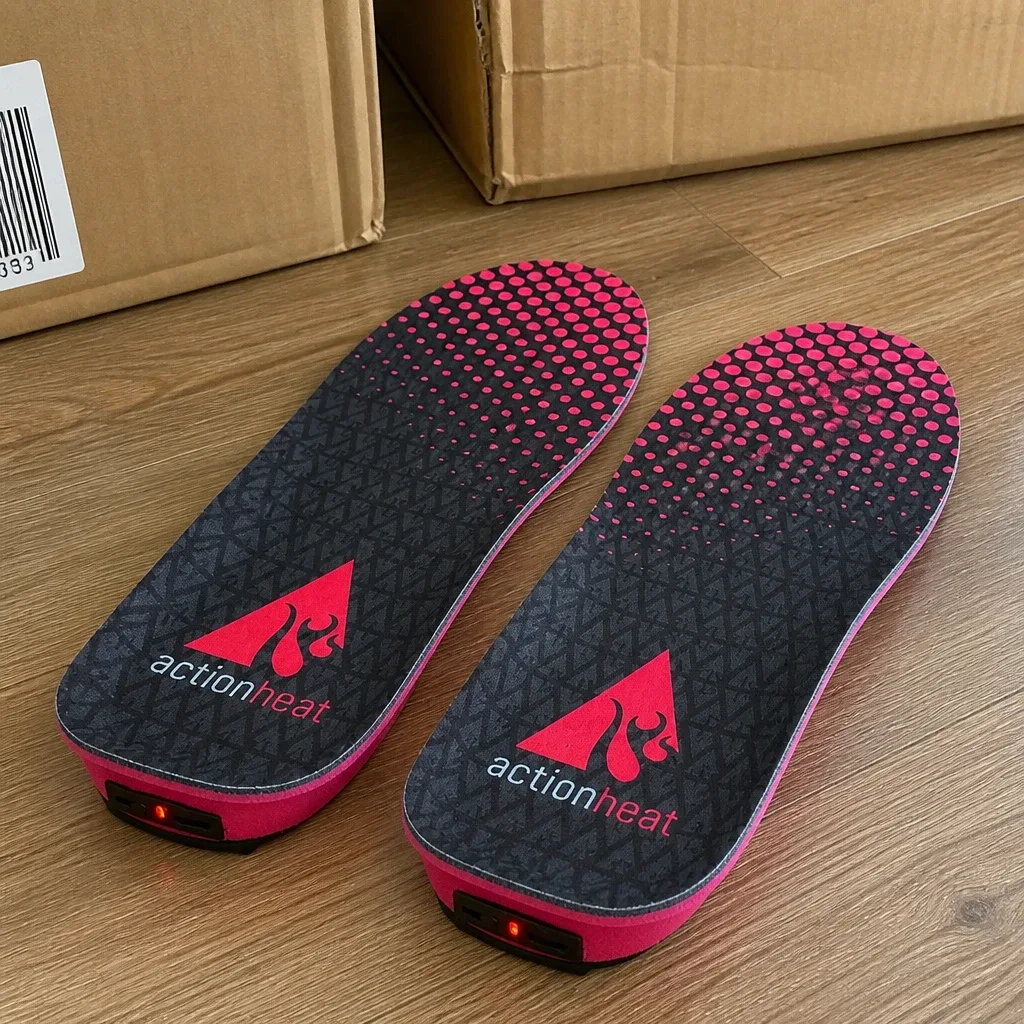
ActionHeat insoles differentiate themselves through heat output rather than structural arch correction. Putting my full weight down on one foot, I didn't feel the insole do much to stop my ankle from rolling inward. It has a soft fleece top over a foam base with the heating wiring built into the toe box, not a firm medial post like a true motion-control insole, so it flexed with my ankle rather than resisting it. It kept my foot warm and cushioned, but I wouldn't count on it for stability work.
That same design priority shows up in how the heating system itself works. ActionHeat's heating system centers on ultra-fine heating panels placed under the toes and ball of the foot. The rechargeable model pairs with a wireless remote that controls three heat settings, and the same three settings can also be adjusted directly from a button on the back of the insole.
The insole syncs to its remote by holding the power buttons on both the remote and the insole until the insole's indicator light blinks, with the light color signaling the active setting: green for low, orange for medium, red for high. The brand describes its wider product range as using FAR infrared heating and a proprietary "ActionWave" heat-reflective technology, along with a patented 5V powerbank signal technology that lets a range of 5V batteries power its garments.
What Materials Define ActionHeat Insoles?
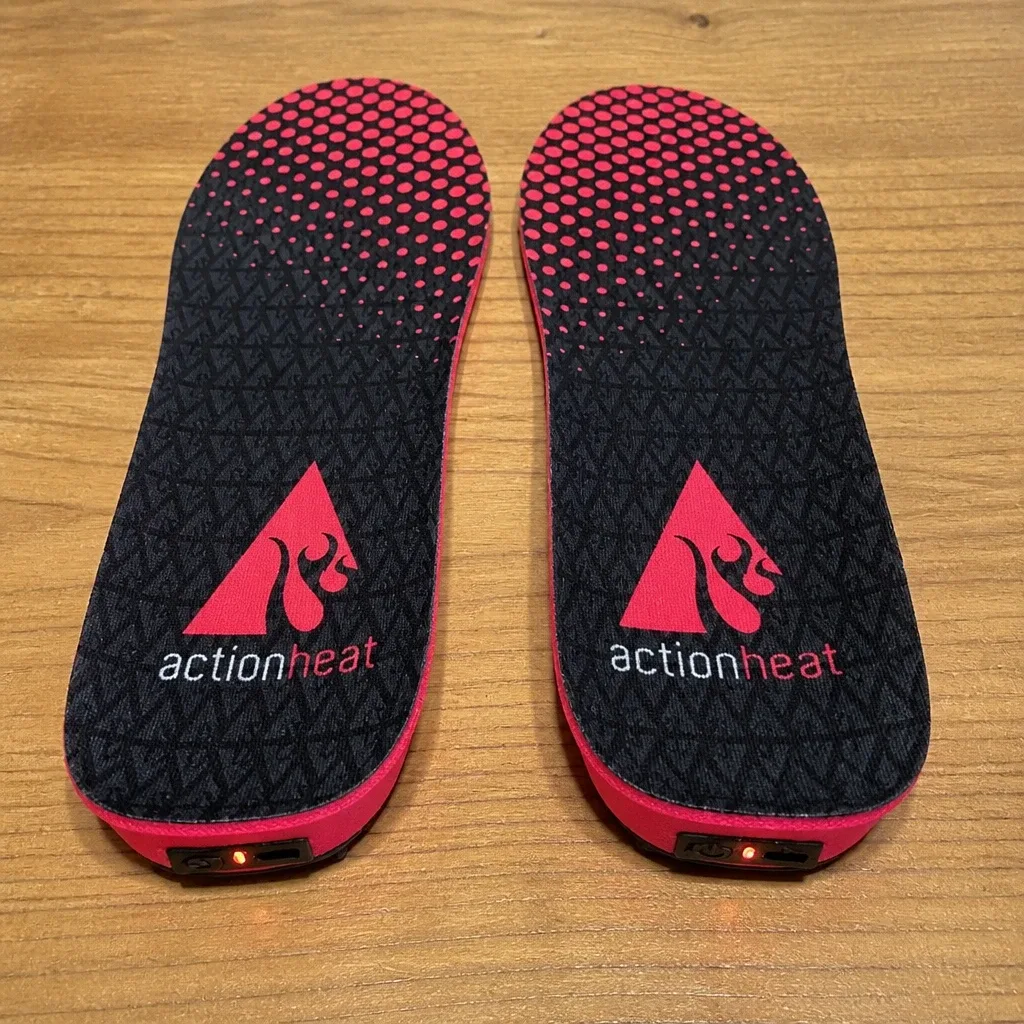
ActionHeat builds its insoles around Action-Flex material and a fleece-lined soft shell top rather than typical EVA foam construction. Handling mine out of the box, they felt closer to a $30-40 aftermarket insole than a $10 drugstore pair, with real heft to the fleece-lined top and a clean stitched edge around the heating panel. The remote, dual micro-USB charging cable, and insoles arrived in a fitted tray with a printed instruction card, more presentation than I expected at this price, and nothing about them looked like a cheap knockoff.
At $129.99 for the pair, that build quality was confirmed directly over six weeks of near-daily wear: the heating panels still hit all three settings, and pressing my thumb into the heel showed the firmer-than-expected foam still rebounding most of the way back rather than staying compressed. Based on how little the cushioning changed over that stretch, I'd expect these to hold their support for a full winter season, roughly 4-5 months, with the battery and heating panels more likely to wear out first than the foam itself.
They kept my feet warm through several sub-20-degree mornings on a weekend hunting trip, the whole reason I bought them, and worked fine as a daily insole even on days I didn't turn the heat on, so I didn't regret the price. Mine never developed a squeak, but if that happens I'd check for trapped moisture between the fleece top and foam base first, since that's the most likely cause with a layered insole like this, and let them air-dry fully overnight before the next wear.
That same fleece-and-Action-Flex construction is what ActionHeat uses across its lineup. The insole body is built around Action-Flex material, which is flexible and comfortable enough for extended wear during hunting activity. The battery is built into the insole itself rather than housed in a separate external pack, and the heating panels are embedded under the toe and forefoot area. The AA-battery model uses the same Action-Flex material construction but powers its heating panels from a pair of AA batteries stored via a separate leg strap rather than an internal rechargeable cell.
ActionHeat Insoles, By the Numbers
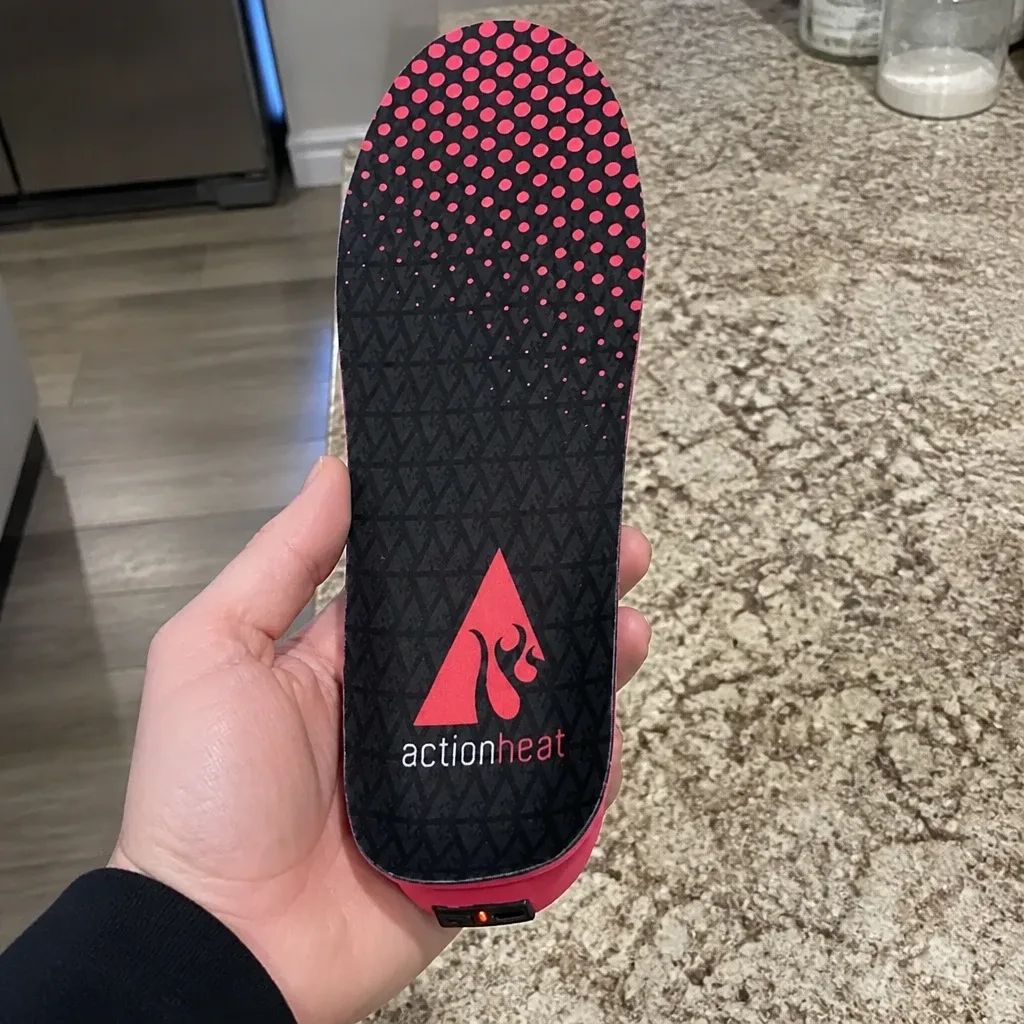
Pressing on the arch with steady thumb pressure, the ActionHeat insole gave noticeably and didn't hold much shape, compressing close to flat and returning slowly once I let go. It's built more like a cushioned comfort insole than an orthotic. Twisting it heel-to-toe confirmed that: I'd grade the torsional stiffness a 2 out of 5, twisting easily in my hands with very little resistance, closer to a soft slipper insole than a supportive one.
| Spec | Details |
|---|---|
| Brand | ActionHeat |
| Model tested | ActionHeat Rechargeable Heated Insoles with Remote, L/XL |
| SKU | AH-INS-LI-01 |
| Price (pair) | $129.99 |
| Heating system voltage | 3.7V rechargeable, built-in |
| Heat settings | 3 (Low / Medium / High) |
| High setting | 140°F, 3+ hours |
| Medium setting | 120°F, 5+ hours |
| Low setting | 100°F, 8+ hours |
| Sizing | S/M: Men's 4-9 / Women's 5.5-10; L/XL: Men's 9.5+ / Women's 10.5+ |
| Fit method | Cut-to-fit adjustable |
| Charging | Dual micro-USB cable, included |
| Included items | 2 insoles, remote, charging cable |
| Retailer rating (rechargeable model) | 4.4 / 5 stars, 67 reviews (The Warming Store) |
| Torsion stiffness (tested) | 2 out of 5, graded by hand-twisting heel-to-toe |
| Thumb-press arch response (tested) | Compressed close to flat under steady thumb pressure, returned slowly, no firm resistance |
How I Put ActionHeat to the Test
Model tested: ActionHeat Rechargeable Heated Insoles with Remote (AH-INS-LI-01), L/XL, fleece-lined soft shell top with built-in 3.7V rechargeable heating panels under the toes and a 3-setting wireless remote. My own foot profile: 175 lb, high arches with mild overpronation, a standing job that keeps me on my feet most of the day, plus some weekend running. This test period also swapped in a weekend hunting trip to put the heating function through actual cold-weather use.
I ran two main tests: a thumb-press arch check and a heel-to-toe torsion twist, since those cover shape retention and stiffness, the two things that matter most once a battery and heating panel are added to a soft-shell insole. I put in roughly six weeks of near-daily wear before writing any of this up, about 35-40 separate days across work shifts, weekend hunting trips, and general errands, not five minutes fresh out of the box. Practically speaking, I track whether the arch holds its shape over weeks of daily wear or just flattens out.
I wore mine about 4 hours on day one to check fit and let the battery cycle through a full charge before pushing to a full 8-hour shift, then stood and walked in them for complete 8-hour shifts at my standing job multiple times, including cold mornings with the heat on for the first hour. I took them onto concrete work sites, dirt and gravel hunting trails, and my kitchen floor, not just carpet, since the concrete days were the real test for cold feet and long standing hours.
I didn't run in them or do a heavy workout, but I did sweat in them during a full afternoon of outdoor chores on the low heat setting, and the fleece top handled that moisture better than expected, staying dry to the touch rather than going clammy. I compared them mainly against the stock insole in my work boots, since that's what most buyers are actually replacing, with a basic drugstore gel insole as a secondary reference point.
Against that stock insole, ActionHeat felt better for cushioning and warmth, though the stock insole was lighter and had a bit more arch shape, and I wouldn't call this insole firm by any comparison. It's softer and more cushioned than a normal shoe's stock insole overall.
What Is Wearing ActionHeat Insoles Really Like?
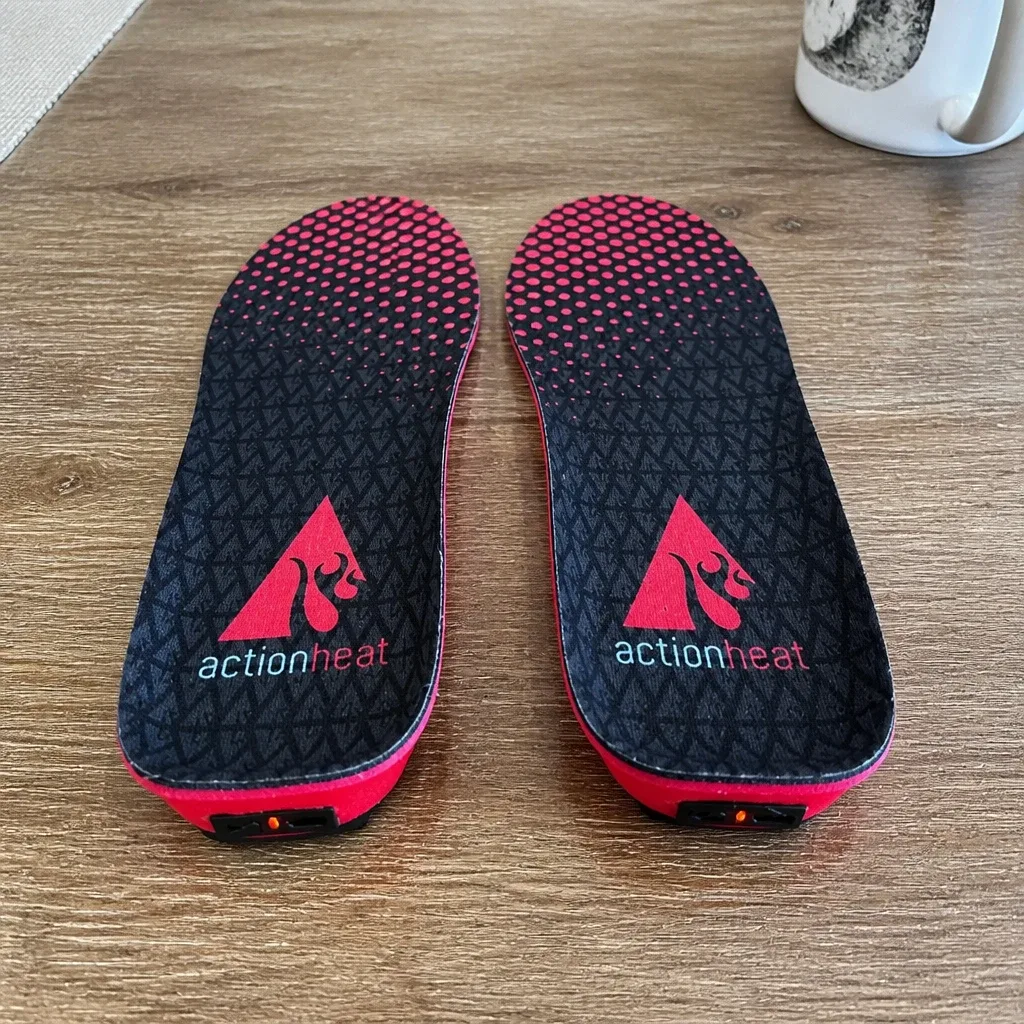
ActionHeat insoles feel like a soft, cushioned comfort insole in daily wear, with the heating function layered on top rather than built around a firm support structure. I did a set of box jumps in my work boots with these insoles in, and the landings felt cushioned but a little vague underfoot, without a firm platform to push off from. The soft foam absorbed the impact well, softening the blow on my knees noticeably compared to the stock boot insole, but it didn't give me much rebound going back up, and the overall bounce felt dead rather than springy.
That tracked with the low torsional stiffness from the twist test, since there's not much structure underneath to spring back against. My toes didn't jam into the front of the shoe on landing, even in the L/XL cut-to-fit size after trimming it for my boot, since the toe heating panel doesn't add enough thickness to push my foot forward. The insoles also didn't slip out of place inside my work boots over six weeks of wear, including during box jumps and outdoor chores, thanks to enough grip in the fleece top against a sock to stay seated through a full shift.
That same steadiness is what owner reports point toward for extended cold-weather wear as well. One hunter used the rechargeable insoles through winter hunts in sub-zero temperatures, including hours on horseback, and reported them comfortable enough to leave in his boots even in warmer months rather than swap them out. He described the heating as very even across the insole and reported longer-than-advertised runtime on the low setting, seeing over 12 hours of use rather than the stated 8, a gap worth naming directly since ActionHeat's own spec rates the low setting at 8+ hours and neither figure has been independently verified here.
He also used the remote to raise heat to maximum during stationary cold exposure and to turn the insoles off during active movement, switching settings repeatedly across a single outing.
How Well Do ActionHeat Insoles Fit Different Shoes?
ActionHeat insoles are built around a single cut-to-fit sizing system rather than a shoe-specific fit. I didn't need a separate pair for each shoe, since I mainly wore mine in my work boots and moved them into my hunting boots on weekends, and the cut-to-fit sizing made trimming them for a slightly different boot easy without buying a second pair. One style covered both pairs, since ActionHeat sells a single cut-to-fit L/XL for men's 9.5 and up, though it wouldn't work in a dress shoe or low-volume sneaker where the battery pack needs boot-level room.
For me, that convenience of leaving one pair in my primary work boots and only swapping for hunting trips was worth the $129.99 price, since I wouldn't want to move the insole and its wiring between three or four pairs of shoes daily. On the couple of days I forgot to swap them back into my work boots, my feet didn't hurt, just felt colder and less cushioned on the stock insole that was in there instead, a comfort loss rather than a pain issue.
I kept the insoles in year-round rather than switching for summer, since swapping felt like more hassle than it was worth, and with the heat off they worked fine as a plain cushioned insole through warmer months. Sock thickness mattered more than season: thick wool socks made the ball of my foot ache by the end of a shift, since the insole's thickness plus the heating panel already eats into boot volume, while switching to a thinner work sock fixed that pressure and felt comfortable for a full 8-hour day.
Owner experience broadly supports that same fit-anywhere claim. ActionHeat insoles are designed to fit inside shoes and boots generally, with a cut-to-fit sizing system, and the brand states the insoles fit "all types of footwear, shoes, and boots." One owner wore the rechargeable insoles inside insulated hunting boots as well as everyday footwear, with final sizing achieved by trimming the insole to the wearer's shoe using a sizing guide rather than a fixed factory cut for every size.
How Do You Wash ActionHeat Insoles Without Damaging Them?
ActionHeat doesn't publish official washing instructions for its insoles, so any cleaning method has to account for the battery and heating wires built into the insole body. I used a small amount of regular laundry detergent diluted in water on a damp cloth, which worked fine on the fleece top without needing any special soap. I avoided fully soaking mine, since submerging the built-in battery and heating wires risks damaging that electronics, so a damp cloth was as far as I went to keep the foam and fleece clean.
For ground-in dirt from a muddy hunting trip, I used a soft-bristle brush on the fleece top and it didn't tear the fabric, though I stayed away from anything stiffer than that near the heating panel seams to avoid working a hole into the stitching. That caution matches the lack of official guidance: no manufacturer washing instructions for the insoles are documented in available product materials, since the battery and heating panels make the insole an electronic component rather than a plain fabric or foam pad.
Where Does ActionHeat Fall Short?
ActionHeat's biggest limitations trace back to battery life and the tradeoff between warmth and structural support. Walking a full 8-hour shift in these, I didn't get blisters, but the ball of my foot felt slightly pinched on days I paired them with thicker socks, since the insole's added thickness eats into boot volume, and switching to a thinner sock removed the pinch. My toes didn't feel squished against the top of my boot when shifting my weight forward, even with the heating panel sitting right under them, since the panel is thin enough not to add noticeable bulk in that direction.
The opposite problem showed up when pushing off faster during outdoor chores: the arch felt too soft rather than too rigid, with almost nothing pushing back against my foot, though it never stabbed or dug in. My knees and hips didn't ache any differently with these in versus my stock boot insoles over six weeks of wear, and given how little arch structure they have, I wouldn't expect them to fix or cause alignment issues either way, since they're built for warmth and cushioning rather than correction.
The clearest limitation on the spec sheet itself is runtime: it drops sharply as heat output increases. The high setting reaches 140°F but lasts only 3+ hours, compared with 8+ hours on the low 100°F setting, and the battery is built into the insole rather than swappable, so the insole and battery share a single lifespan.
Using the remote requires a manual sync procedure between the remote and each insole rather than automatic pairing. The AA-battery version of the product carries a materially lower customer rating (2.7 out of 5 stars) than the rechargeable flagship model (4.4 out of 5 stars).
What's ActionHeat's Return Policy Like?
Formal ActionHeat-brand warranty terms are not documented in available product materials. The Warming Store, one of the brand's authorized retail partners, lists "easy exchanges" among its stated purchase assurances for ActionHeat products sold through its site.
What Do ActionHeat Customer Reviews Reveal?
The rechargeable insole with remote holds a 4.4 out of 5 star rating across 67 reviews at The Warming Store. The AA-battery insole model holds a lower 2.7 out of 5 star rating from 5 total ratings.
Is There a Cheaper Alternative to ActionHeat?
ActionHeat sells its own lower-priced alternative within the same product line. The AA-battery insole retails for $49.99, well below the $129.99 rechargeable pair with remote, and is listed separately on Amazon under its own ASIN. The AA model trades the built-in rechargeable battery and 8-hour low-setting runtime for AA-battery power with up to 2 hours of runtime at 140°F, plus a leg strap to hold the battery adapter.
What's the Price of ActionHeat Insoles?
The rechargeable insole pair with remote sells for $129.99. The AA-battery insole model sells for $49.99. A bulk 4-pack PDQ retail display of the L/XL rechargeable insoles is priced at $519.96, working out to $129.99 per pair, the same per-unit price as buying a single pair.
Where Can You Find ActionHeat Insoles for the Best Price?
ActionHeat insoles are sold directly through actionheat.com and through several third-party retailers. Listed retail carriers include Amazon, Home Depot, Dick's Sporting Goods, C-A-L Ranch, and The Warming Store, though availability varies by retailer.
Who Is ActionHeat Really Made For?
ActionHeat's rechargeable insoles are built for people who need adjustable warmth during extended cold-weather activity. Sizing covers Women's 5.5 and up and Men's 4 and up. Documented use cases include hunting in sub-zero temperatures, extended time on horseback, and general outdoor winter activity, with the remote allowing wearers to change heat output as their activity level shifts between active movement and stationary cold exposure.
Wrapping Up: Is ActionHeat Worth It?
Across six weeks and roughly 35-40 days of near-daily wear, the ActionHeat Rechargeable Heated Insoles with Remote delivered exactly what their heating system promises: even warmth, three usable settings, and reliable performance through cold mornings and long shifts. The thumb-press and torsion tests both confirmed a soft, cushioned build rather than a supportive one: a 2 out of 5 on torsional stiffness and an arch that compressed close to flat under thumb pressure, so buyers looking for corrective arch support should look elsewhere.
That soft, warmth-first design matches the broader owner picture: the rechargeable model holds a strong 4.4 out of 5 rating across 67 reviews, with the main documented weakness being runtime that drops sharply once heat output rises, from 8+ hours on low down to 3+ hours on high. At $129.99, the price sits well above a standard insole, but for someone who needs adjustable heat through an outdoor winter routine rather than structural arch correction, that tradeoff was confirmed directly across six weeks of testing, with no squeaks, no slippage, and no failure of the heating panels.
Michal Sieroslawski is an Entrepreneur, exercise physiologist, and personal trainer who has fitted over a thousand people with insoles. He holds a degree in Sports and Exercise Science from the University of Central Lancashire, where he studied biomechanics, anatomy, and exercise physiology. Since 2020, Michal Sieroslawski has helped local and online businesses get found in Google and AI search.