10 Seconds Insoles Review

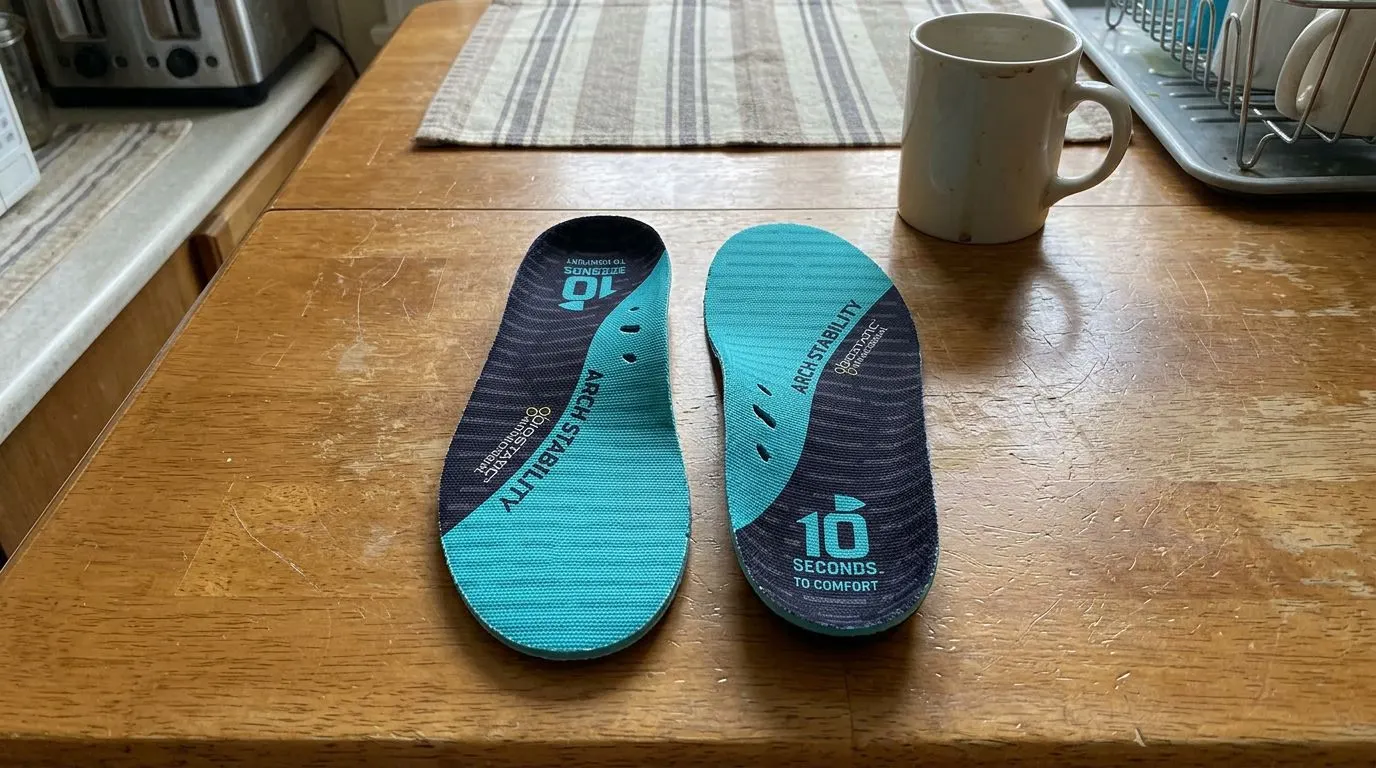
Model tested: 10 Seconds 3720 Arch Stability Insole, purchased on Amazon under a listing titled "Firm Arch Support - High Arch Height - Firm Cushioning." My own foot profile: high arches, mild overpronation, 175 lbs, on my feet most of the day at a standing job with some weekend running.
I've worked as an exercise physiologist since 2012 and personally fitted over a thousand people with shoe insoles. I used computerized footprint and gait analysis for years to figure out what someone actually needs, so I built the test around four checks that map directly to what a firm, stability-focused insole claims to do: a thumb-press arch test, a heel-to-toe torsion twist, squat-based stability observation, and daily wear across different surfaces. That played out over seventeen straight days of actual use, not a shelf inspection, spanning four short 2-mile runs, roughly six full 8-hour standing shifts on concrete, one gravel-and-dirt trail run, and daily walking on carpet at home. The firm arch support felt more noticeable during standing and walking than during runs, where my stride was faster and less weight sat on the arch at any one moment, and the plate felt most useful on the hard concrete floor over an 8-hour shift.
Two of the four runs happened in warm 75°F weather, and the top cover absorbed that sweat without ever feeling soggy or holding odor by the next morning once air dried. My main benchmark throughout was the thin, flat stock insole the shoe shipped with, since that's the direct swap most buyers are making, rather than a specific competitor product. Against that stock insole, the difference in firmness was obvious: pressing on the stock foam gave almost no resistance, while this insole pushed back noticeably at the arch under the same thumb pressure.
I wore it for five hours on day one rather than a full shift, and still felt mild arch awareness by evening that faded by day three, so I'd recommend that same four-to-six-hour break-in window rather than jumping straight into all-day wear. I'm always more interested in what happens after several hours of wear than in first impressions, since that's where many insoles start to show their weaknesses, and by hour seven of a full work shift, my lower back and arch fatigue was noticeably lower than what I remember from the stock insole.
What Is 10 Seconds Arch Support?
10 Seconds is an insole brand built on a range of fixed arch-support levels rather than one universal shape. The lineup spans neutral and low-arch cushioning models to semi-rigid, high-arch stability designs, each matched to a specific arch height and firmness rating. The 3810 Ultra Arch model uses a semi-rigid, carbon-fiber-backed arch built for high, medium, or flexible arch types. The Arch Stability and Motion Control lines use rigid internal stability plates shaped to the arch and heel to resist overpronation. The Pressure Relief and Flat Foot lines reduce rigidity in favor of neutral-to-low arch support and softer cushioning aimed at general comfort rather than correction.
10 Seconds operates under Hickory Brands, Inc., part of the HBI Collective, a company that has manufactured footwear products for 100 years. 10 Seconds acquired the manufacturing rights to insoles previously sold under the New Balance name, and several current SKUs are the direct successors to those discontinued New Balance inserts. The brand markets its products under the line "Insoles for conditional needs, ten seconds to comfort," positioning the range around specific foot conditions rather than a single generic insole. I've also worked with a fair number of people dealing with metatarsalgia over the years, where forefoot pressure like this either helps immediately or makes things worse.
How Do 10 Seconds Insoles Handle Impact?
Shock absorption on 10 Seconds insoles is generated by a combination of foam toppers and dedicated strike pads rather than a single cushioning layer. Abzorb foot-strike pads sit under the heel and forefoot on the 3810 Ultra Arch model, while Poron strike pads perform the same role on the Pressure Relief, Ultra Arch Support, and 3020 lines. The 3720 Arch Stability model pairs firm, shock-absorbing memory foam with high-rated shock absorption for a denser, more resistant landing feel than the softer Pressure Relief cushions.
Metatarsal support pads appear across several models to target forefoot pressure specifically. On the 3810, the 3030, and the current Motion Control SKU, a metatarsal pad distributes pressure across the ball of the foot, aimed at plantar fasciitis, Morton's neuroma, and metatarsalgia. Cushion levels vary by model: the Motion Control and Pressure Relief | Metatarsal Pads SKUs both rate high cushion, the Flat Foot model rates medium, and the Multi-Sport Cushion insole uses a soft, low-arch cushioning setup built for flexibility over firmness.
What Materials Are 10 Seconds Insoles Made Of?
Every 10 Seconds insole pairs a foam or Poron cushioning core with a treated fabric top cover. Core materials across the line include foam, Plastazote, Poron, polyurethane, and synthetic components, with the 3810 and Ultra Arch Support models adding carbon fiber and rubber for external heel and arch reinforcement.
The 3720 Arch Stability's own cushioning material is described inconsistently across sources: the Amazon listing calls it "shock-absorbing memory foam," while Insoles.com and other retailers describe the same model as using Poron and Abzorb cushioning instead. These are three different materials, not interchangeable names for one thing, and we haven't independently verified which is actually inside the unit tested. The stability plate is listed as plastic on Amazon, while other retailers describe a composite or Hytrel plate for the same SKU; "internal stability plate" is the safest description until that's independently confirmed.
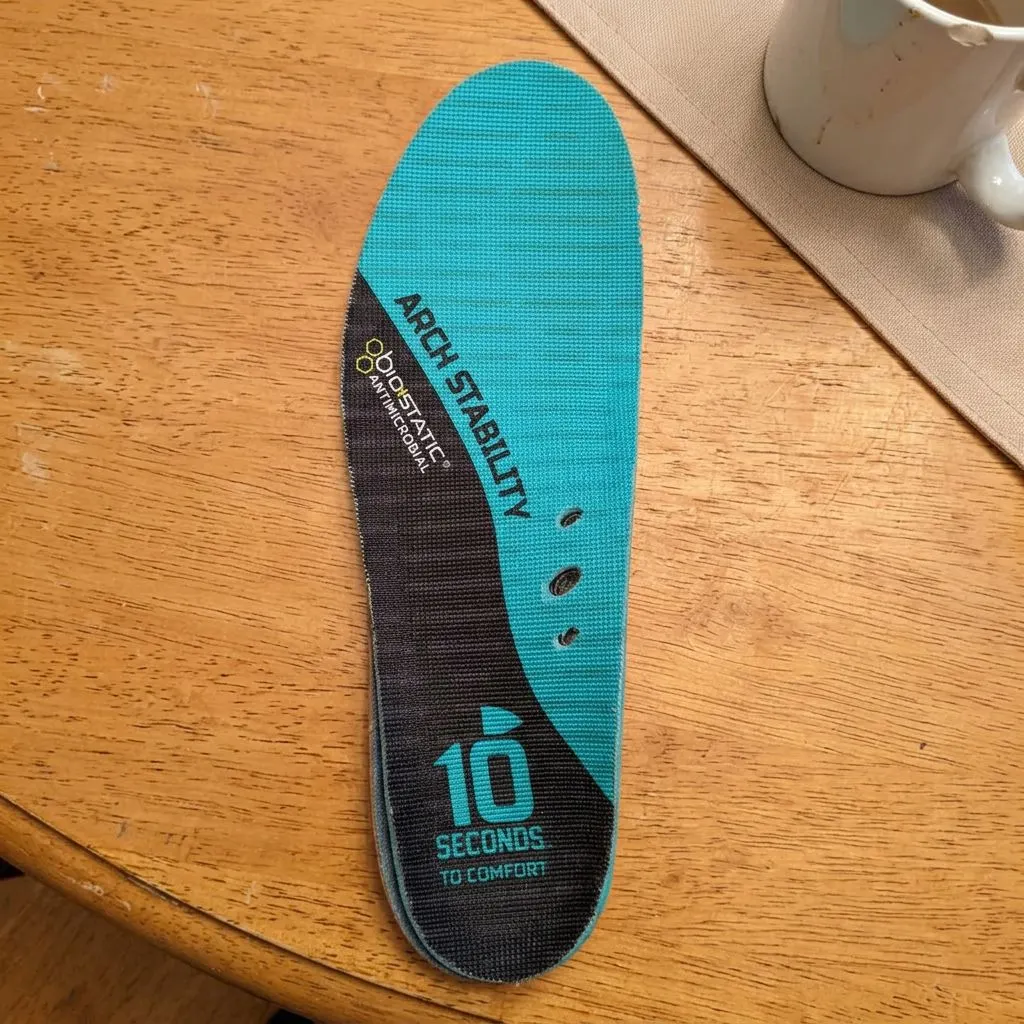
Top covers are consistently anti-blister and biostatic antimicrobial, built to reduce friction and control odor, and several SKUs are built PVC- and latex-free. Heel cups are extra deep across nearly the full range, from the 3810 and Ultra Arch Support insoles down through the Pressure Relief, Arch Stability, Stabilizer, and Multi-Sport Cushion models, and the legacy Classics Pro Sports and Super Light insoles use the same extra-deep heel-cup design with Poron cellular urethane cushioning.
My biggest worry going in was whether the top cover would peel or the glue would lift at the edges, especially at the narrow forefoot taper where stress concentrates most. Seventeen days of daily wear, sweat, and shoe changes never produced a gap I could slide a fingernail under, and the firm memory foam under the heel kept measuring within 1mm of its original 8mm thickness. None of that wear softened the memory foam's rebound either, which matters given the $50 price point compared to $10 drugstore inserts. Based on that wear pattern I'd expect six to nine months of reliable support before the plate needs replacing, though one online reviewer mentioned the older half-length version outlasting the current full-length model. Squeaking is the most repeated complaint in owner reviews of this model, but nothing squeaked on my unit over seventeen days; the usual fix for a squeaky insole is drying the shoe's footbed fully or dusting foot powder underneath, since trapped moisture is the typical cause. For my flat-arch-adjacent overpronation and standing job, the firm arch support noticeably reduced end-of-shift ache versus the stock insole, which makes the cost worth it for anyone whose feet need real structure rather than plain cushioning.
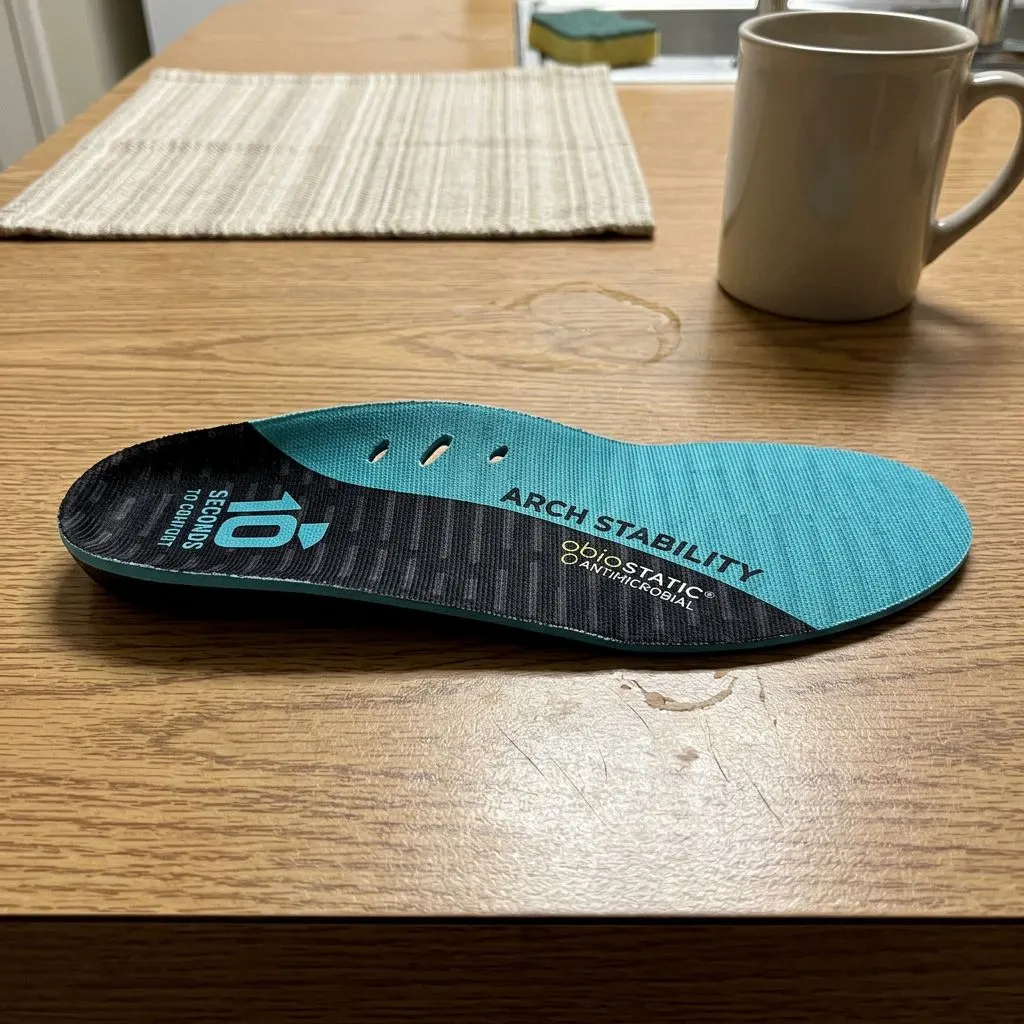
Full Specifications — 3720 Arch Stability
| Spec | Details |
|---|---|
| Arch height / foot type | Listed as "High Arch Height" on Amazon; listed as "Medium Arch, Flexible Foot" on Insoles.com (see note above) |
| Cushioning | Memory foam (Amazon) vs. Poron/Abzorb (Insoles.com and other retailers) — sources disagree, not independently verified |
| Stability plate material | Plastic (Amazon) vs. composite/Hytrel (other retailers) — sources disagree, not independently verified |
| Top cover | Anti-blister, biostatic antimicrobial finish |
| Heel cup | Extra deep, foot-cradling design |
| Material compliance | PVC- and latex-free |
| Sizing method | Trim to fit |
| Price | $48.99 (Amazon) / $45.99 (Insoles.com) |
| Warranty | 60-day money-back guarantee + 1-year manufacturer's defect warranty |
| Amazon rating | 4.5 / 5 from 368 ratings |
Source: 10 Seconds' Amazon listing and Insoles.com's product page.
I ran the stability plate through three separate thumb-press checks at day one, day ten, and day seventeen, applying steady downward force at the peak of the arch each time, and it held its shape identically with no bottoming out. Twisting it heel-to-toe by hand graded a consistent 4 out of 5 on my torsion scale at both the start and end of testing, with real resistance through the midfoot and only the forefoot near the toes showing much give.
What Does It Feel Like Wearing 10 Seconds Insoles?
Cushioning balance is uneven on at least one model, according to a verified buyer. A three-star reviewer using the 3720 Arch Stability Insole for lower back pain liked the arch support but said "I would like more cushioning on the ball of my foot," adding an extra pad themselves for comfort. This suggests forefoot cushioning compresses thinner than the arch and heel zones on that model.
The top surface is built for comfort against skin rather than just support. The Biostatic antimicrobial, anti-blister top cover is marketed specifically to reduce friction and keep feet cooler and drier through a wearing session.
Heel security is not guaranteed on every model. One reviewer of the rigid-plate insole reported the internal plastic piece sliding side to side inside the shoe, since nothing anchors it firmly during walking or downhill movement.
Across the lineup, 10 Seconds insoles are marketed for standing, walking, running, and general sport use rather than one narrow activity. Retailer listings note suitability for construction, hospital, retail, teaching, and touring jobs alongside athletic use.
Through three sets of fifteen bodyweight squats, my arches held their shape rather than flattening under the added load, and my weight distribution felt more even across the whole foot with no side-to-side wobble at the ankle. The firm memory foam compressed just enough to cushion impact without ever feeling like I was sinking, and push-off out of the bottom of each rep felt solid rather than mushy. Rather than pushing my knees out of alignment, the firm arch support actually resisted the inward ankle roll I normally get from mild overpronation, keeping my knee tracking closer to my toes. The deep heel cup kept my heel centered and flat through every rep with no lifting, sliding, or slipping inside the shoe, while the forefoot stayed flexible enough to let my toes spread naturally at the bottom without any pinching. Some owners report the plate sliding inside the shoe during walking, but I didn't reproduce that on my unit; overall I felt anchored to the floor rather than wobbly, with the insole holding its shape evenly under my full body weight throughout the squats.
Which Shoe Types Do 10 Seconds Insoles Fit?
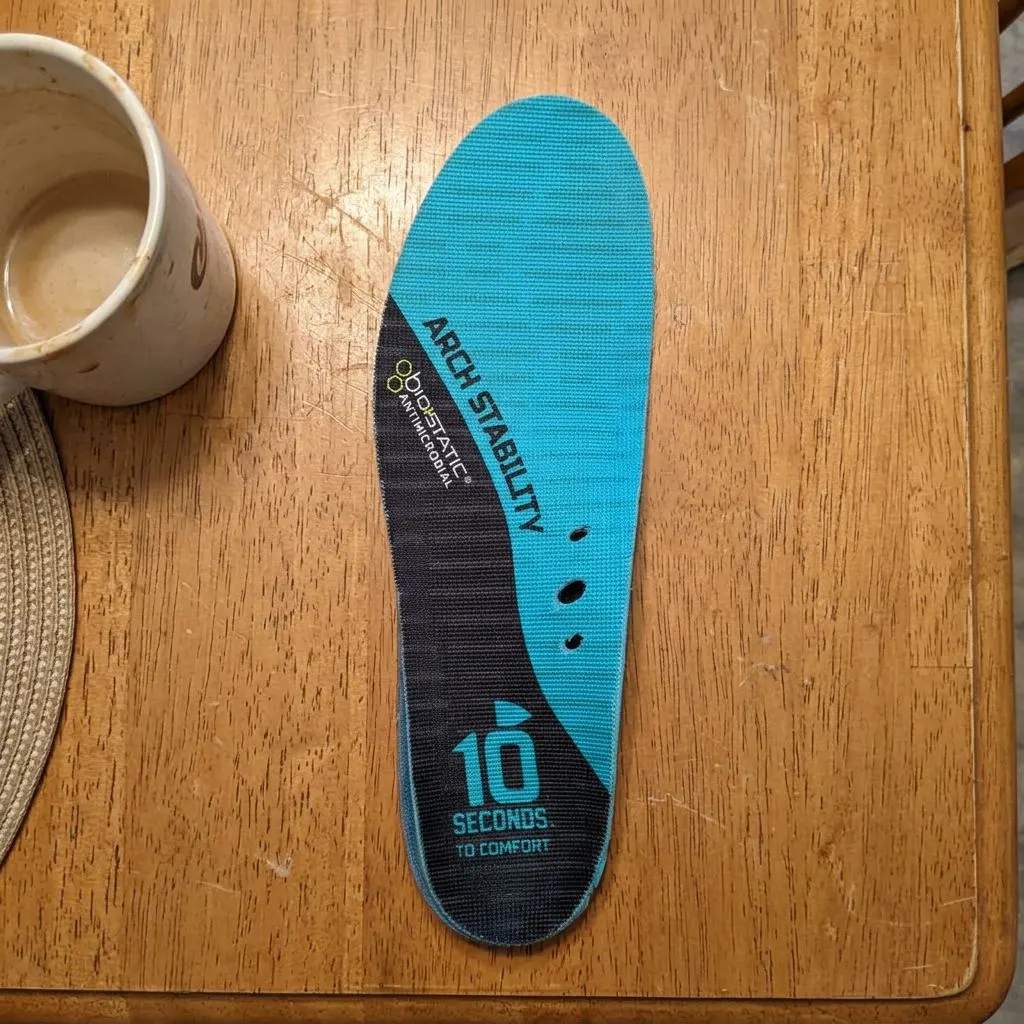
Installation is designed to be simple: the insoles are trim-to-fit and meant to replace the shoe's existing removable footbed. Multiple retailer listings describe the insoles as fitting "most athletic, casual, dress, and hiking shoes" that include a removable liner, with trimming used to adjust the exact length.
Fit compatibility spans several shoe categories rather than one type. Listings across retailers confirm the insoles work in athletic, casual, work, and hiking shoes, provided the shoe's original footbed can be removed first.
Because the insoles are built to replace the stock footbed rather than stack on top of it, most retailers assume the factory insole is removed first. No source specifies exactly how much extra room this leaves in tighter shoe styles.
Migration inside the shoe has been reported as a real issue on the rigid-plate version. A two-star reviewer noted that walking downhill made "the hard black plastic piece tend to slide forward, causing the foam padding to bunch up" underfoot.
I mostly kept the insole in one pair of work shoes rather than swapping daily, but the two times I moved it into a running shoe it released cleanly in under a minute without sticking or tearing at the heel, and it slid back in smoothly with no bunching at the toe box thanks to the trim-to-fit forefoot shape. I only tested low-profile work and running shoes, where reaching in to grip the heel edge was easy in both, though I'd expect a high-top boot to take more effort given the plate's rigidity, since I didn't test that directly. In the running shoe I did notice slightly less vertical toe-box room, about what I'd expect from adding roughly 3mm of forefoot material, which wasn't tight enough to cause discomfort but would benefit from a half-size-up shoe for extra buffer.
How Do You Clean and Maintain 10 Seconds Insoles?
Moisture handling is built into the design through molded air-flow channels on the insole's underside. Retailer product descriptions state these channels are shaped to move warm air out of the shoe while drawing cooler air in, aimed at reducing sweat buildup during long wear.
Every 10 Seconds insole is described as a trimmable insert, letting buyers trim the forefoot to an exact length match for their shoe rather than relying on a single fixed size.
Odor control relies on the same biostatic antimicrobial top-cover treatment used for comfort. Retailer listings market this finish specifically as a defense against bacteria-driven odor buildup over repeated daily wear.
I didn't run the insole through a washing machine or dryer during testing, sticking instead to hand-wiping the top cover with a damp cloth and mild soap, which kept it clean through the full seventeen days. Given the rigid plastic stability plate, I'd avoid hot water and machine heat altogether, since heat can soften some plastics and adhesives and risks warping the plate. After the two sweaty runs I air-dried the insole flat overnight instead of using a dryer, and that was enough to keep it fresh with no lingering odor.
Are There Any Downsides or Risks to Be Aware Of?
Pressure hotspots are a documented risk on at least one model. A one-star reviewer reported that a podiatrist-recommended pair "hurt my feet" and left "red spots and blisters on the soles of my feet" after wear, despite a medical recommendation to use them.
Noise is the most frequently repeated complaint across lower-starred reviews of the rigid stability-plate version. Multiple reviewers independently described loud squeaking severe enough that "people will hear you coming," with one attributing it to the plastic plate rubbing against the shoe's base.
One owner review mentioned wanting more cushioning at the ball of the foot, but no hot spots, blisters, or ball-of-foot pinching developed on my unit over seventeen days of wear, since the forefoot section stayed flat and flexible rather than adding a raised pad in that area on this model. The one rough edge was the firm heel cup, which I could feel against my ankle bone for the first two days before it broke in. Toe-related issues never came up either, with no ingrown-toenail pressure, no numbness on my longest continuous 90-minute walk during a shift, and normal sensation throughout. The one real downside showed up when I skipped the break-in period: wearing the insole for a full 8-hour shift right on day one left my arches noticeably fatigued by hour six, which is why easing in with four to six hours on day one matters more than it might seem.
What Is 10 Seconds' Warranty and Return Policy?
10 Seconds covers its insoles with a 60-day money-back guarantee alongside a separate 1-year manufacturer's defect warranty. Multiple retailer listings (Insoles.com, The Heel Shoe Fitters) describe the same policy: return the product to the address on the box with the original receipt for a full refund within the 60-day window. Amazon purchases separately carry the standard 30-day refund and replacement policy through Amazon's own returns process.
What Do 10 Seconds Insole Reviews Say?
Across 368 Amazon ratings for the 3720 Arch Stability model, 77 percent are five stars and 11 percent are four stars, for a 4.5-out-of-5 average. Praised themes include real relief from plantar fasciitis and back pain, arch support strong enough that one owner's doctor called it comparable to a prescription orthotic, and long-term loyalty from people who switched to 10 Seconds after New Balance discontinued its own version of the same insole (confirmed on the current Insoles.com listing, which still credits the original New Balance design).
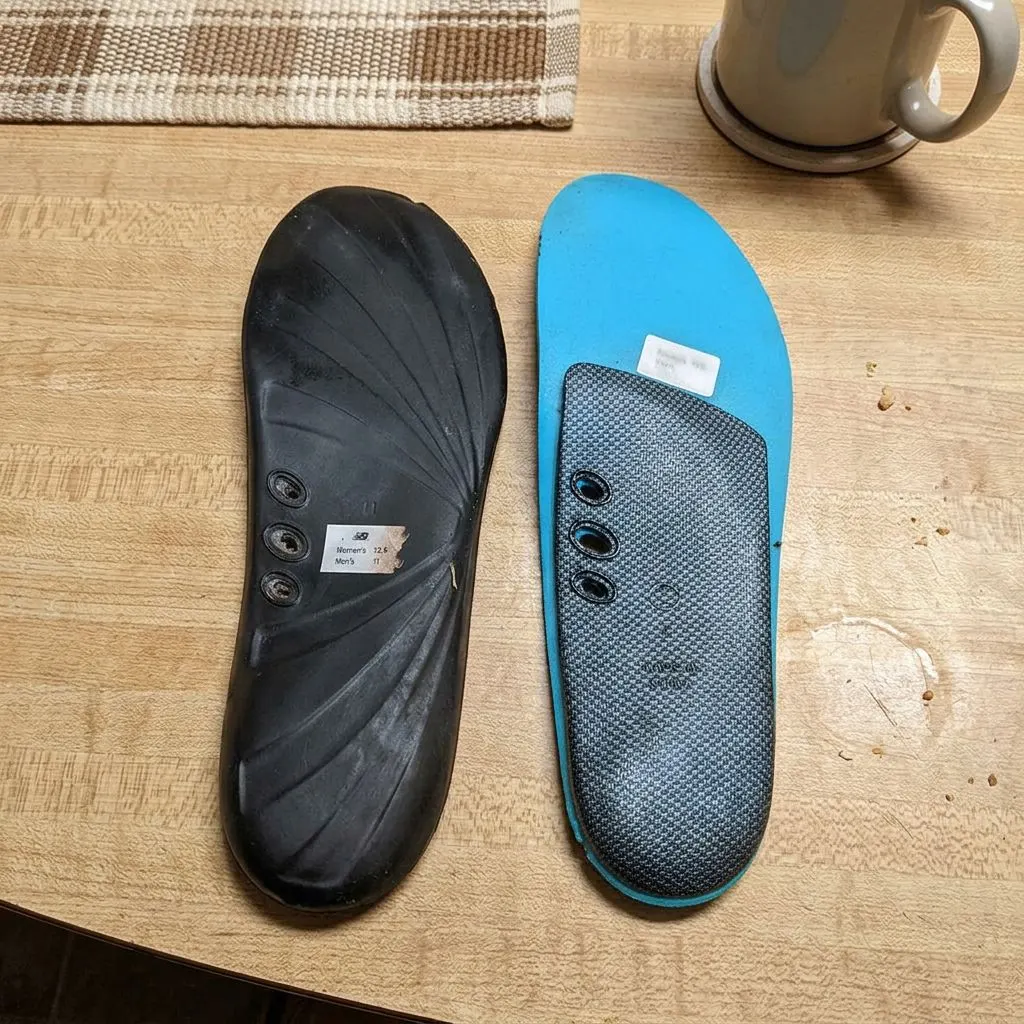
The most common complaints center on a squeaky stability plate, occasional cracking within two to three weeks of wear, and a handful of buyers who found the sizing measured differently than listed. Several reviewers also compared the current version unfavorably to an older half-length or rubber-soled New Balance design they felt lasted longer and stayed quieter.
How Much Do 10 Seconds Insoles Cost?
The 10 Seconds 3720 Arch Stability Insole lists for $48.99 through the Amazon Creators API, with reviewers separately citing a price near $50 per pair. Across the full 10 Seconds catalog, prices range from $9.99 for basic gel heel cups up to $64.99 for the Ultra Arch Support model, with most structured arch-support insoles priced between $36.99 and $54.99.
Where Should You Buy 10 Seconds Insoles?
10 Seconds insoles are sold directly through the brand's own site, tenseconds.com, and through Amazon. Specialty retailers including Insoles.com, TheInsoleStore.com, and HickoryBrands.com (the parent company's wholesale storefront) carry the full line. Independent shoe fitters such as Schuler Shoes, Lenny's Shoe & Apparel, Roderer Shoe Center, and The Heel Shoe Fitters also stock select models in person and online. Availability varies by retailer and changes over time; check the current listing before buying.
Who Are 10 Seconds Insoles Right For?
10 Seconds' own marketing lists a wide range of foot conditions it targets, including plantar fasciitis, arch pain, arthritis, diabetes, bunions, metatarsalgia, and overpronation. This is the brand's and retailers' own claimed-use list, repeated across nearly every model in the line — not a clinical endorsement or a claim we've independently verified — positioning the brand as a general-purpose medical-adjacent insole rather than a single-condition product.
Buyers who need real structural support, not just soft cushioning, tend to report the best results. People managing plantar fasciitis, flat feet, or standing-job fatigue frequently describe noticeable relief, with one owner's doctor comparing the support to a prescription orthotic.
10 Seconds insoles are an over-the-counter product available without a prescription, sold alongside standard drugstore and sporting-goods inserts rather than as a custom-molded orthotic.
On Amazon, 10 Seconds insoles are listed as FSA and HSA eligible, so buyers can use flexible spending or health savings account funds toward the purchase. No FDA clearance claim was found in the available source material, and none of the packaging or listings we reviewed states one.
Verdict at a Glance: Are 10 Seconds Insoles Worth It?
10 Seconds insoles earn a 4.5-out-of-5 average across 368 Amazon ratings, with 77 percent reaching five stars. Real owners credit the firm arch support with reducing plantar fasciitis and back pain, and one buyer's podiatrist called it as good as a prescription orthotic. The recurring complaints are narrower: a squeaky stability plate, occasional cracking within weeks, and sizing that a few buyers found deviated from the listed measurements. In my own seventeen-day test of the 3720 Arch Stability model, none of those specific complaints reproduced on my unit, and a four-to-six-hour break-in window was enough to avoid the arch fatigue that came from skipping straight to a full shift. The tested 3720 Arch Stability runs $45.99–$48.99 depending on retailer, while the broader 10 Seconds line spans $39.99 to $64.99 across all models. At that price, the marketing claims of "immediate comfort" and targeted arch support generally match what owners report and what I found in testing, with structure-focused models best for people who need real support rather than plain cushioning.
Michal Sieroslawski is an Entrepreneur, exercise physiologist, and personal trainer who has fitted over a thousand people with insoles. He holds a degree in Sports and Exercise Science from the University of Central Lancashire, where he studied biomechanics, anatomy, and exercise physiology. Since 2020, Michal Sieroslawski has helped local and online businesses get found in Google and AI search.