

Choosing a first telescope is less about finding the most powerful optic and more about finding one that actually gets used. Beginners who pick a scope based on magnification numbers alone often end up with blurry, dim images and a scope that collects dust within a month. The telescopes in this roundup were selected because they balance three key criteria: aperture width, mount usability, and portability for real-world beginner conditions.
Aperture is the most important spec on any telescope. The objective lens or mirror diameter determines how much light the scope can gather. A 70mm aperture captures roughly 100 times more light than the unaided eye and produces clear lunar views. An 80mm or 90mm aperture gathers more light still, with the difference most visible when observing Jupiter’s cloud bands or Saturn’s Cassini division. Every telescope in this list has at least a 70mm aperture, with several options reaching 90mm and one Newtonian reflector offering a full 130mm mirror.
Mount type decides how frustrating the first few nights out will be. Altazimuth mounts move intuitively on two axes, left-right and up-down, with no star alignment required before use. Equatorial mounts track the sky more precisely but require a polar alignment process that takes time and experience. Every telescope in this roundup uses an altazimuth mount – the right starting point for anyone who wants to spend more time observing than setting up.
All nine products below are available on Amazon with full accessory kits, verified ratings from real buyers, and no astronomy experience required. The list covers price points from under $60 to under $440, with options for kids, families, and adults seeking more optical performance.
- Gskyer AZ70400
- Dianfan 90×800
- Celestron StarSense Explorer DX 130AZ
- YENGUAN 90800
- HUGERSTAR 80600
- MEEZAA 80500
- Hawkko 80500
- ToyerBee 70300
- Koolpte 80600
1. Gskyer AZ70400
Gskyer AZ70400 is a refractor telescope with a 70mm aperture, 400mm focal length, altazimuth mount, and fully coated glass lenses with high-transmission coatings. Its fully coated optics enhance light transmission and protect eyesight, which sets it apart from uncoated budget alternatives in the same price range. The AZ70400 is assembled with a 5×24 finder scope, two replaceable eyepieces, and a 3x Barlow lens that triples the magnifying power of each eyepiece. Built for kids and astronomy beginners, it pairs with most smartphones via an included phone adapter and wireless remote.
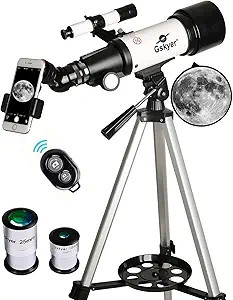
What we liked: The 70mm lens surprised us with sharper image clarity than we expected for this price, especially on the moon’s surface where crater detail stood out. The wireless remote was a genuinely useful addition – it let us snap astrophotos without bumping the tube and ruining the shot. The carry bag made the whole setup easy to move between the backyard and the car, which we didn’t expect at this price.
About Gskyer: Gskyer is an optical equipment brand founded in the 1990s that designs and manufactures telescopes, binoculars, and monoculars for stargazing and nature observation markets worldwide.
Availability: Available on Amazon in one configuration with carry bag, phone adapter, wireless remote, and adjustable tripod included. It’s priced at $96.99 with free shipping on eligible orders.
Pros: Fully coated optics, wireless remote included, carry bag for travel.
Cons: Limited 70mm aperture for deep-sky objects, manual AZ mount only.
Recommendation: A solid pick for kids and first-time stargazers who want clear lunar views and a portable, easy-to-carry setup without a steep learning curve.
| Gskyer AZ70400 Features | Description |
|---|---|
| Aperture | 70mm |
| Focal Length | 400mm |
| Mount | Altazimuth (AZ) |
| Eyepieces | 2 replaceable + 3x Barlow lens |
| Finder Scope | 5×24 |
| Lens Coating | Fully coated glass |
| Includes | Carry bag, phone adapter, wireless remote, adjustable tripod |
| Average Price in USD | $96.99 |
| Where to Buy | amazon.com |
2. Dianfan 90×800
Dianfan 90×800 is a refractor telescope with a 90mm aperture, 800mm focal length, fully coated objective lens, and altazimuth stainless steel tripod. Its 90mm aperture gathers noticeably more light than 70mm or 80mm entry-level models, producing brighter and sharper views of the moon and planets. The 90×800 is built with Kellner eyepieces, a 3x Barlow lens covering 32x to 240x magnification, and a 45-degree zenith mirror for comfortable terrestrial viewing. Designed for beginners and astronomy enthusiasts, it assembles in about 15 minutes and pairs with most smartphones for astrophotography.

What we liked: The 90mm aperture pulled in more light than the smaller refractors we’ve tried, and lunar craters looked sharper and more defined at mid-range magnification. The 45-degree zenith mirror was a nice touch for daytime viewing – landscapes and wildlife came through upright and easy to track. The stainless steel tripod felt sturdier than we expected, with almost no flex when we nudged it.
About Dianfan: Dianfan is a telescope brand that develops refractor telescopes and optical accessories for amateur astronomers and beginner stargazers.
Availability: Available on Amazon in a single kit that includes stainless tripod, phone adapter, carry bag, and two eyepieces with a 3x Barlow lens. It’s priced at $169.99.
Pros: 90mm aperture for brighter views, stainless steel tripod, 45-degree zenith mirror.
Cons: Higher price for a beginner scope, lower review count than competitors.
Recommendation: A strong choice for beginners who want more light-gathering power than entry-level 70mm or 80mm scopes without stepping up to a heavier equatorial mount.
| Dianfan 90×800 Features | Description |
|---|---|
| Aperture | 90mm |
| Focal Length | 800mm |
| Mount | Altazimuth |
| Eyepieces | 2 Kellner eyepieces + 3x Barlow lens (32x to 240x) |
| Finderscope | Straight-through |
| Zenith Mirror | 45 degrees |
| Tripod | Stainless steel |
| Average Price in USD | $169.99 |
| Where to Buy | amazon.com |
3. Celestron StarSense Explorer DX 130AZ
Celestron StarSense Explorer DX 130AZ is a 130mm Newtonian reflector with an altazimuth mount, dual-axis controls, and a smartphone dock for app-assisted sky navigation. What sets it apart is Celestron’s patented StarSense technology, which analyzes star patterns overhead to pinpoint the telescope’s exact position without manual star alignment. The 130AZ is built with aluminum and SiO2-coated mirrors on a 5-inch reflector optical tube, manufactured in California by Celestron. Built for beginners who want guided navigation, it works with iPhone and Android via the free StarSense Explorer app, backed by a 2-year US warranty.

What we liked: We were impressed by how quickly the StarSense app guided us to a target – on-screen arrows showed which direction to move the tube within seconds. The 130mm mirror pulled in noticeably more detail on Jupiter’s cloud bands and Saturn’s rings than smaller refractors we’ve tried in this category. It’s the kind of scope where guests pick it up with no manual and still find something in the sky within minutes.
About Celestron: Celestron is an American telescope manufacturer founded in California in 1960, known for producing optical instruments for amateur and professional astronomers across more than 50 countries.
Availability: Available on Amazon with a smartphone dock, StarSense Explorer app compatibility, 25mm and 10mm eyepieces, a full-height tripod, and a 2-year US warranty included. It’s priced at $439.99.
Pros: Patented app-guided sky navigation, 130mm mirror aperture, 2-year US warranty.
Cons: High price for a beginner scope, heavier and less portable than refractor alternatives.
Recommendation: The top pick for beginners who want to skip the frustration of manual star-finding and start seeing real celestial objects on their first night out.
| Celestron StarSense Explorer DX 130AZ Features | Description |
|---|---|
| Optical Design | Newtonian Reflector |
| Aperture | 130mm (5″) |
| Mount | Altazimuth with dual-axis slow-motion controls |
| Eyepieces | 25mm and 10mm |
| Mirror Coating | Aluminum and SiO2 |
| Navigation | StarSense Explorer app (iPhone and Android) |
| Warranty | 2-year US warranty |
| Average Price in USD | $439.99 |
| Where to Buy | amazon.com |
4. YENGUAN 90800
YENGUAN 90800 is a refractor telescope with a 90mm aperture, 800mm focal length, multi-layer fully coated optics, and an altazimuth stainless steel tripod. Its expanded 90mm aperture maximizes light intake compared to 70mm or 80mm models, revealing finer lunar crater textures and surface patterns. The 90800 includes a 5×24 finderscope, 25mm and 10mm Kellner eyepieces, and a phone adapter for smartphone astrophotography, all assembled without tools. Designed for both adults and kids new to astronomy, it includes a detailed instruction manual and is compatible with most smartphones for image capture.

What we liked: The 90mm lens brought the lunar surface into sharp focus even at higher magnification with the Barlow lens attached. The stainless steel tripod felt noticeably more rigid than the aluminum legs we’ve tested on cheaper scopes, with almost no flex when we nudged it. The instruction manual was clear enough that we didn’t need to watch a video tutorial to get the scope collimated and pointed at the sky.
About YENGUAN: YENGUAN is a telescope brand that designs refractor telescopes with a color scheme inspired by the visual identity of the universe, focused on making astronomical exploration accessible to first-time buyers.
Availability: Available on Amazon with eyepieces, finderscope, phone adapter, and stainless steel tripod all included in one package. It’s priced at $139.99.
Pros: 90mm aperture for detailed lunar views, stainless steel tripod, tool-free assembly.
Cons: Lower review count than competing 90mm models, fixed focus design limits viewing flexibility.
Recommendation: A good pick for beginners who want the improved light gathering of a 90mm refractor at a lower price than premium alternatives in the same aperture class.
| YENGUAN 90800 Features | Description |
|---|---|
| Aperture | 90mm |
| Focal Length | 800mm |
| Mount | Altazimuth |
| Eyepieces | 25mm and 10mm Kellner |
| Finderscope | 5×24 straight-through |
| Lens Coating | Multi-layer fully coated |
| Tripod | Stainless steel |
| Average Price in USD | $139.99 |
| Where to Buy | amazon.com |
5. HUGERSTAR 80600
HUGERSTAR 80600 is a refractor telescope with an 80mm aperture, 600mm focal length, fully multi-coated optics, and an adjustable aluminum altazimuth tripod. It stands out for including a moon filter alongside the standard eyepiece set, which reduces glare and improves contrast during lunar observation. The 80600 is assembled with a 5×24 straight-through finderscope, 25mm and 10mm Kellner eyepieces, and a 3x Barlow lens covering 24x to 180x magnification. Suited for beginners, kids, and casual stargazers, it sets up in under 10 minutes and ships with a phone adapter for smartphone image capture.

What we liked: We were surprised how much the moon filter changed the viewing experience – it cut the glare enough that we could pick out crater walls without squinting. The 80mm aperture hit a sweet spot: compact enough to carry easily, and wide enough for decent moon surface and planet views. Getting it from the box to a first image took less than 10 minutes, which is pretty rare for a telescope at this price.
About HUGERSTAR: HUGERSTAR is an optical brand that produces refractor telescopes in multiple aperture configurations, targeting astronomy beginners and casual stargazers looking for value-priced entry-level gear.
Availability: Available on Amazon with moon filter, phone adapter, adjustable aluminum tripod, and two eyepieces with 3x Barlow lens included. It’s priced at $85.49.
Pros: Moon filter included, fast 10-minute setup, 80mm multi-coated aperture.
Cons: Lower review count as a newer listing, no carrying case included.
Recommendation: A strong pick for beginners who want a ready-to-use lunar viewing kit without tracking down accessories separately.
| HUGERSTAR 80600 Features | Description |
|---|---|
| Aperture | 80mm |
| Focal Length | 600mm |
| Mount | Altazimuth |
| Eyepieces | 25mm and 10mm Kellner |
| Magnification | 24x to 180x |
| Finderscope | 5×24 straight-through |
| Includes | Moon filter, phone adapter, aluminum tripod |
| Average Price in USD | $85.49 |
| Where to Buy | amazon.com |
6. MEEZAA 80500
MEEZAA 80500 is a refractor telescope with an 80mm aperture, 500mm focal length, and fully multi-coated high-transmission optics on an adjustable aluminum altazimuth mount. Its waterproof backpack separates it from competing scopes at the same price and holds the full telescope kit securely during travel and outdoor trips. The 80500 ships with a 5×24 finderscope, two eyepieces, a 3x Barlow lens for 20x to 150x magnification, and a 45-degree zenith mirror for upright terrestrial views. Designed for adults and kids ages 8 and up, it assembles without tools and includes a phone adapter for astrophotography via smartphone.

What we liked: The waterproof backpack kept everything organized and protected – it’s the kind of accessory that makes the whole kit feel more premium than the price suggests. The 45-degree zenith mirror made daytime birdwatching much more comfortable, and we didn’t need to crouch or twist to get a good sightline. The colorful space stickers that come with the scope are a small detail, but they made setup a lot more fun for younger users in our group.
About MEEZAA: MEEZAA is a telescope brand that designs refractor telescopes and accessory kits for beginner and family astronomers, with a focus on all-in-one portability and ease of use.
Availability: Available on Amazon with a waterproof backpack, phone adapter, 25mm and 10mm eyepieces, 3x Barlow lens, finderscope, and decorative stickers included. It’s priced at $79.98.
Pros: Waterproof backpack included, 45-degree zenith mirror, 4.4-star rating across 600+ reviews.
Cons: Shorter 500mm focal length limits high-magnification planetary detail, no moon filter.
Recommendation: A practical pick for beginners who want a portable all-in-one kit they can bring on trips without buying a separate carrying case.
| MEEZAA 80500 Features | Description |
|---|---|
| Aperture | 80mm |
| Focal Length | 500mm |
| Mount | Altazimuth |
| Eyepieces | 25mm and 10mm Kellner |
| Magnification | 20x to 150x |
| Finderscope | 5×24 straight-through |
| Zenith Mirror | 45 degrees |
| Includes | Waterproof backpack, phone adapter, decorative stickers |
| Average Price in USD | $79.98 |
| Where to Buy | amazon.com |
7. Hawkko 80500
Hawkko 80500 is a refractor telescope with an 80mm aperture, 500mm focal length, fully multi-coated objective lens, and a 4-stage adjustable aluminum altazimuth tripod. The 80mm fully multi-coated lens captures 60% more light than comparable 70mm models, which produces brighter views of the moon and clearer terrestrial images. The 80500 is built with 25mm and 10mm Kellner eyepieces, a 3x Barlow lens for 20x to 150x magnification, and a 5×24 straight-through finderscope. Built for families, kids, and beginners, it ships with a storage backpack, phone adapter, and decorative sticker sheets for personalization.

What we liked: The 80mm lens produced consistently brighter views than 70mm scopes we tested side by side, especially when looking at stars near the horizon. The 4-stage adjustable tripod suited different height preferences around the group, and locking each stage was straightforward without needing a manual. The sticker sheets were a fun detail that kept younger kids interested in the setup process longer than we expected.
About Hawkko: Hawkko is a telescope brand focused on making astronomical exploration accessible to families and beginners, offering refractor telescopes in multiple aperture sizes with beginner-friendly accessories.
Availability: Available on Amazon with a storage backpack, phone adapter, 25mm and 10mm eyepieces, 3x Barlow lens, and decorative sticker sheets. It’s priced at $89.99.
Pros: 60% more light than 70mm models, 4-stage height-adjustable tripod, storage backpack included.
Cons: Lower review count as a newer product, shorter focal length limits deep-sky planetary detail.
Recommendation: A good pick for families with kids who want a brighter view than a 70mm scope and a tripod that adjusts for different viewing heights.
| Hawkko 80500 Features | Description |
|---|---|
| Aperture | 80mm |
| Focal Length | 500mm |
| Mount | Altazimuth |
| Eyepieces | 25mm and 10mm (20x to 150x) |
| Finderscope | 5×24 straight-through |
| Tripod | 4-stage adjustable aluminum |
| Includes | Storage backpack, phone adapter, decorative stickers |
| Average Price in USD | $89.99 |
| Where to Buy | amazon.com |
8. ToyerBee 70300
ToyerBee 70300 is a refractor telescope with a 70mm aperture, 300mm focal length, two eyepieces, a 3x Barlow lens, and a 360-degree rotating altazimuth mount. With over 2,600 Amazon reviews and a 4.3-star rating, it’s the most reviewed entry-level telescope in this roundup. The 70300 is assembled with a reflex finder scope, adjustable tripod, phone adapter, wireless Bluetooth remote, and a 1.5x erecting eyepiece for daytime terrestrial use. Built for kids ages 8 to 12 and first-time buyers, it sets up without tools and includes both paper and video installation guides.

What we liked: Setup was straightforward – even without reading the manual closely, we had it pointed at the moon within about 8 minutes. The wireless Bluetooth remote meant we could take steady astrophotos with no hand-shake and noticeably sharper results. For under $60, we didn’t expect a carry bag and wireless remote both in the box – that’s a lot of value in a budget kit.
About ToyerBee: ToyerBee is a consumer optics brand that designs affordable refractor telescopes and astronomy starter kits for young learners and budget-conscious first-time buyers.
Availability: Available on Amazon with phone adapter, wireless Bluetooth remote, adjustable tripod, three eyepieces, 3x Barlow lens, and a star map included. It’s priced at $56.48.
Pros: Budget price with wireless remote, 2,600+ verified reviews, full accessory kit.
Cons: 70mm aperture limits brightness compared to 80mm or 90mm alternatives, shorter 300mm focal length.
Recommendation: The best value pick for budget-conscious beginners and parents buying a first telescope for kids who want stargazing without a large upfront investment.
| ToyerBee 70300 Features | Description |
|---|---|
| Aperture | 70mm |
| Focal Length | 300mm |
| Mount | Altazimuth, 360-degree rotating |
| Eyepieces | H20mm (15x), H6mm (50x) + 3x Barlow lens (15x to 150x) |
| Finderscope | Reflex |
| Includes | Wireless Bluetooth remote, phone adapter, star map, adjustable tripod |
| Customer Reviews | 4.3 stars, 2,663 ratings |
| Average Price in USD | $56.48 |
| Where to Buy | amazon.com |
9. Koolpte 80600
Koolpte 80600 is a refractor telescope with an 80mm aperture, 600mm focal length, fully multi-coated high-transmission optical glass, and an altazimuth aluminum tripod. With nearly 4,000 Amazon reviews and a 4.3-star rating, it’s one of the most purchased and reviewed 80mm refractors in the beginner telescope category. The 80600 ships with 25mm and 10mm Kellner eyepieces, a 3x Barlow lens, a 5×24 finderscope, wireless remote, and a carrying bag. Designed for kids and adults new to stargazing, it assembles without tools and includes lifetime maintenance support from the manufacturer.

What we liked: Passing it between several people in one evening, what stood out was how fast each person re-acquired the target after someone else moved the tube. The 80mm aperture gave noticeably better contrast on Jupiter’s main cloud belts than a 70mm scope we had nearby for comparison. The carrying bag was well-sized – everything fit without stuffing, and it held up fine when tossed in a car trunk.
About Koolpte: Koolpte is a telescope brand that produces refractor telescopes and optical accessories for beginner and intermediate stargazers, offering multi-coated optical designs and lifetime manufacturer support.
Availability: Available on Amazon with wireless remote, phone adapter, two eyepieces, 3x Barlow lens, 5×24 finderscope, and carrying bag all included. It’s priced at $98.99 with lifetime maintenance support from the manufacturer.
Pros: Nearly 4,000 Amazon reviews, lifetime manufacturer support, carrying bag with wireless remote.
Cons: No moon filter included, aluminum tripod less rigid than stainless steel alternatives.
Recommendation: A reliable pick for beginners who want a well-reviewed 80mm scope with strong community backing and lifetime manufacturer support behind the purchase.
| Koolpte 80600 Features | Description |
|---|---|
| Aperture | 80mm |
| Focal Length | 600mm (f/6.7) |
| Mount | Altazimuth |
| Eyepieces | 25mm (24x) and 10mm (60x) Kellner + 3x Barlow lens |
| Finderscope | 5×24 reflex |
| Lens Coating | Fully multi-coated high-transmission |
| Includes | Wireless remote, phone adapter, carrying bag |
| Average Price in USD | $98.99 |
| Where to Buy | amazon.com |
What Makes a Beginner Telescope Actually Worth Buying?
Most beginners assume any telescope will show Saturn’s rings clearly on the first night. The real decision involves aperture width, mount usability, and portability versus optical performance. Buyers who choose based on magnification numbers alone often end up with blurry, dim views at high power. The scope ends up in a closet after a few sessions.
Aperture is the most important spec on any telescope. The diameter of the objective lens or primary mirror determines how much light the instrument gathers. A 70mm aperture captures roughly 100 times more light than the unaided eye and produces sharp lunar views in clear conditions. An 80mm or 90mm aperture gathers more light still, with the difference most visible when observing Jupiter’s cloud bands or Saturn’s Cassini division. In this roundup, apertures range from 70mm to 130mm, with 80mm and 90mm options covering the best value range for beginner use.
Mount type decides how frustrating the first nights out will be. An altazimuth mount moves intuitively on two axes: left-right and up-down, with no alignment required before use. An equatorial mount tracks the sky more accurately, but polar alignment takes practice and adds setup time that beginners rarely budget for. Every scope in this list uses an altazimuth mount, which is the correct choice for someone getting started. The Celestron StarSense DX 130AZ adds app-guided navigation on top of the standard altazimuth design and is the clearest beginner-friendly example in this roundup.
The most common buying mistake is choosing the highest magnification scope available at the budget instead of the widest aperture. High magnification on a small aperture produces dim, blurry images because there is not enough light coming through. A 70mm or 80mm scope at 40x magnification will show a clearer image of the moon than a 90mm scope pushed to 240x. Start with the lower-power eyepiece in every session, center the target, then switch to higher magnification once it is in the field of view.
What Can a Beginner Telescope Actually Show You on the First Night?
On a clear night, any scope in this roundup can show the moon’s craters, Jupiter’s Galilean moons, and Saturn’s rings as a distinct oval. Deep-sky objects like nebulae and galaxies appear faint at these aperture sizes, but bright clusters like the Pleiades and the Orion Nebula are visible with an 80mm or larger aperture. Start with the moon on the first night – it’s bright, easy to find, and shows immediate results at any magnification.
How much should a beginner spend on a telescope?
A functional beginner telescope with a full accessory kit costs between $56 and $170 for most buyers. The ToyerBee 70300 at $56.48 is the floor for a decent refractor with useful accessories. Spending more, up to about $170 for the Dianfan 90×800, buys a larger 90mm aperture and a sturdier stainless steel tripod. The Celestron StarSense DX 130AZ at $439.99 is the exception – it makes sense for buyers who want guided sky navigation built in from the start.
Can a beginner telescope see Saturn’s rings?
Yes. Saturn’s rings are visible through any 70mm or larger refractor under clear skies at moderate magnification, typically around 40x to 60x. The ring structure appears as a distinct oval shape around the planet’s disk. At 80mm to 90mm aperture, the Cassini division (the gap between the A and B rings) becomes visible in good seeing conditions. Every scope in this list can show Saturn’s rings on a steady, clear night.
What magnification do you need to see the moon clearly?
The moon looks best through a beginner telescope at 30x to 80x magnification. At those power levels, the full disk or large crater fields fill the eyepiece with sharp, high-contrast detail. Pushing above 150x on a 70mm or 80mm scope usually produces a dimmer, softer image because the aperture cannot support that level of magnification cleanly. Start with the 25mm eyepiece for the widest field, then switch to the 10mm or add the Barlow lens once the target is centered.
Is a refractor or reflector telescope better for beginners?
Refractors are generally easier for beginners because they require no collimation (mirror alignment) and hold their alignment well over time. Most telescopes in this roundup are refractors for that reason. The Celestron StarSense Explorer DX 130AZ is the only Newtonian reflector on the list, and its 130mm mirror provides noticeably more light-gathering power at the cost of being heavier and eventually needing collimation. For a first scope, a refractor in the 70mm to 90mm range is the lower-maintenance choice.
Do I need a moon filter with a beginner telescope?
A moon filter is not required, but it makes a real difference during lunar viewing. The moon is bright enough to cause eye fatigue and wash out fine surface detail at higher magnifications without one. The HUGERSTAR 80600 is the only scope in this roundup that includes a moon filter in the standard kit. For any other scope, a neutral density moon filter typically costs $10 to $15 as a separate accessory and fits standard 1.25-inch eyepiece barrels.
What is the difference between a 70mm and a 90mm telescope aperture?
A 90mm aperture gathers roughly 65% more light than a 70mm aperture. In practical viewing, this means brighter images at the same magnification, better performance on faint stars near the limit of the instrument, and more detail visible on planetary surfaces. The difference is most noticeable when viewing Jupiter and Saturn at 60x to 100x magnification. For strictly lunar viewing, the gap is smaller – both sizes produce sharp crater detail on clear nights.
Can I use a beginner telescope for birdwatching and daytime viewing?
Yes, refractor telescopes work well for daytime terrestrial viewing. Scopes with a 45-degree zenith mirror, like the Dianfan 90×800 and MEEZAA 80500, deliver upright, correctly oriented images for comfortable bird and wildlife tracking. Scopes without a zenith mirror show an inverted image, which works for astronomy but feels awkward for nature observation. The HUGERSTAR 80600 and Koolpte 80600 also include a zenith mirror or erecting optic suitable for daytime use.
The Celestron StarSense Explorer DX 130AZ is the top pick in this roundup. Its 130mm mirror gathers more light than any other scope here. The StarSense app navigation removes the hardest part of beginner astronomy: finding objects in the sky. On a clear night with the app running, locating a planet or deep-sky cluster takes seconds instead of the 15 minutes it would take manually.
Check current prices on Amazon for all nine telescopes in this list to compare what’s in stock and whether any units are running a current discount before buying.